
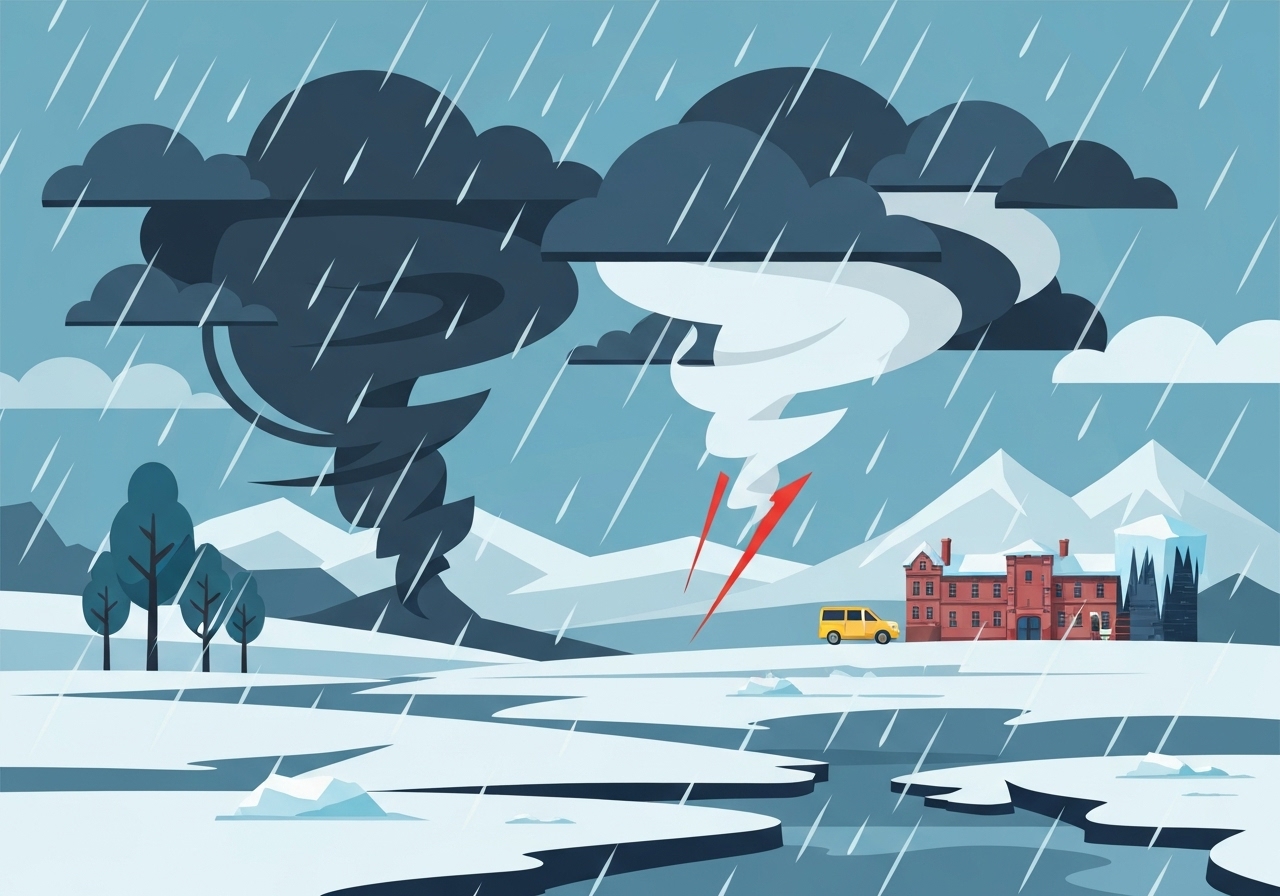
Lead: On Friday a powerful Atlantic low named Storm Goretti swept across southwestern Britain and northwestern France, bringing extreme winds, heavy rain and snow that cut power to hundreds of thousands and disrupted travel across multiple countries. The system lashed the Isles of Scilly with gusts up to 99 mph (159 kph) and produced a 213 kph (132 mph) gust in Normandy, while more than 57,000 customers lost power in parts of England and Wales and some 320,000 remained without electricity in France at midday. The storm collided with an Arctic air mass, extending heavy snowfall in northern Britain and additional freezes across Central and Eastern Europe. Authorities issued top-level warnings, suspended services and closed schools as emergency crews worked through the day.
Key Takeaways
- Storm Goretti brought gusts up to 99 mph (159 kph) in the Isles of Scilly and 213 kph (132 mph) in Gatteville-le-Phare, Normandy, straining local infrastructure.
- Enedis reported roughly 320,000 homes without power in northwestern France at midday, down from 380,000 earlier on Friday.
- National Grid recorded more than 57,000 outages across southwestern England, the Midlands and Wales on Friday morning.
- The Met Office issued a rare red weather warning for southwestern England for Thursday evening, signaling a high risk to life and property.
- Snowfall exceeding half a meter (about 20 inches) earlier in the week left northern Scotland coping with extended road clearances and more than 250 schools closed on Friday.
- Rail services were suspended across regions of the U.K. and France; Deutsche Bahn halted some long-distance services in northern Germany, leaving many travelers stranded.
- Road closures and accidents linked to icy or snowy conditions in Germany and the Czech Republic led to fatalities and long motorway blockages.
Background
Storm Goretti developed as a deep low-pressure system over the northeastern Atlantic and moved eastward into the Bay of Biscay and the English Channel. Meteorological agencies had forecast high winds and disrupted travel, and several national weather services issued escalating warnings as the system intensified. In Britain the Met Office used its red-level warning in parts of southwestern England, a measure reserved for the most dangerous weather scenarios when there is a significant risk to life and serious infrastructure damage.
France’s national operator Enedis and Britain’s National Grid prepared for widescale outages as gusts and falling trees brought down lines and left some communities without electricity or water. The storm arrived against a backdrop of an Arctic air mass already affecting Central and Eastern Europe, where subzero nighttime temperatures and fresh snow compounded earlier snowfall totals. Regional transport networks across multiple countries operate close to capacity during winter, making these events particularly disruptive when coupled with severe wind and snow.
Main Event
Gusts and driving rain struck the southwestern tip of England overnight, with the Isles of Scilly recording the highest U.K. gusts. Local officials reported blocked roads, structural instability in a small number of buildings and interruptions to water supplies where power was lost. National Grid logged more than 57,000 customers without power across southwestern England, the Midlands and Wales early Friday, and crews were dispatched to restore services where it was safe to do so.
In northwestern France, the Normandy coast experienced the strongest recorded gust of the event, 213 kph (132 mph) at Gatteville-le-Phare, and Enedis said outages peaked at about 380,000 before falling to roughly 320,000 by midday. Regional TER train services were suspended across parts of Normandy and Brittany, though high-speed TGV services and most flights into Paris airports were reported to have minimal disruption.
Across Scotland, a prior accumulation of more than half a meter (about 20 inches) of snow earlier in the week left communities and roads strained; snowplows worked continuously to keep arteries open and more than 250 schools remained closed on Friday. In Central Europe, heavy morning snow hit Prague, blocking major routes such as the D5 toward Germany and disrupting bus and rail operations, while Prague’s Vaclav Havel Airport reported delayed and canceled flights.
Germany faced cascading effects: Deutsche Bahn halted long-distance northbound services, regional bus routes were canceled in several districts and ferry links to North Sea islands such as Langeoog and Norderney were largely suspended due to strong easterly winds. Authorities in Bavaria and the Upper Palatinate reported fatal road accidents in which poor winter conditions were a likely factor, and a Bundesliga match between Leipzig and St. Pauli was canceled because stadium snow clearance was not safe.
Analysis & Implications
Storm Goretti highlights the vulnerability of aging distribution and transport networks to concentrated, high-intensity weather events. Power grids in both France and Britain experienced large but differing outage footprints — France’s distribution operator reported substantially higher numbers, reflecting the storm’s coastal impact there — and restoration efforts depended on safe access and the condition of local lines. Repeated winter storms test utility staffing and logistics, particularly when crews must balance speed of restoration against worker safety in dangerous winds.
The collision of the Atlantic storm with an Arctic air mass amplified impacts: rain driven by intense winds on the southern fringe turned to snow where cold air prevailed, creating a mixed-hazard environment that complicates response. Transport systems are especially sensitive to that mix; airports and high-speed lines can often run with limited disruption, but regional rail and road networks — which depend on local crews and de-icing resources — suffer disproportionate breakdowns.
Economic and social ripple effects are immediate: business operations, freight movements and school attendance were curtailed, and emergency services diverted resources to clear roads, repair infrastructure and respond to accidents. For sectors such as logistics and retail the cost of a day or more of disruption can be considerable, particularly during winter when supply chains operate with limited slack. Policymakers and utilities face increasing pressure to harden networks and improve forecasting, prioritization and mutual aid agreements across borders.
Comparison & Data
| Country/Region | Reported peak outages | Notable wind gust |
|---|---|---|
| Southwestern England / Wales / Midlands (UK) | ~57,000+ customers | 99 mph (159 kph) – Isles of Scilly |
| Northwestern France (Normandy) | ~380,000 peak → ~320,000 at midday | 213 kph (132 mph) – Gatteville-le-Phare |
| Northern Scotland | — (major snow accumulations) | Snow totals >0.5 m (≈20 in) |
These figures illustrate the geographic concentration of damage: coastal and exposed locations experienced the highest winds and the largest immediate outages, while cold inland areas faced severe snow accumulations that disrupted transport. Restoration timelines differ by damage type — downed distribution lines versus extensive snow clearance — which explains why some French areas saw a drop in outage numbers by midday even as British regions continued to report significant impacts.
Reactions & Quotes
Authorities and operators framed Friday’s disruptions as a predictable but still severe test of preparedness, emphasizing safety-oriented responses and staged restoration. Communications focused on warnings ahead of the peak period and on asking residents to avoid unnecessary travel while crews worked.
“Red warnings are issued when the forecaster considers it very likely that there will be life‑threatening conditions.”
Met Office (official)
This wording explains the rationale behind the Met Office’s highest-level alert and why regional services and institutions moved to emergency footing. Local councils and emergency responders use such warnings to trigger school closures, road restrictions and proactive workforce deployments.
Transport and utility operators highlighted operational limits under extreme wind and snow conditions, and asked the public for patience as restorations proceed.
“We have reopened with reduced runway operations,”
Birmingham Airport (operator)
The airport phrased its update to signal that while movements had resumed, capacity was constrained — a common interim status while de-icing and runway inspections continue. Reduced operations have knock-on effects for connecting flights and ground transport schedules.
Grid operators stressed the scale of work required to make lines safe and to re-energize networks only after hazards such as fallen trees are cleared.
“Most outages were concentrated in the Normandy region,”
Enedis (distribution operator)
Enedis’ situational summary highlighted where crews were prioritizing repairs and helps explain differing regional recovery timetables. Operators also warned that gusty conditions and residual flooding could delay full restoration in some communities.
Unconfirmed
- Reports of localized water supply cuts in isolated Isles of Scilly communities have been made by local officials but full verification and extent remain unclear.
- Initial accounts linking particular road collisions directly to the storm conditions are consistent with weather reports but are still subject to police investigation.
- Some localized structural damage reports were noted by municipal sources; comprehensive assessments of building instability had not been published at midday.
Bottom Line
Storm Goretti demonstrated how a single, fast-moving Atlantic low can produce a complex mix of wind, rain and snow when it encounters cold Arctic air, creating simultaneous risks for power, transport and public safety across western and central Europe. Coastal and exposed areas faced the strongest gusts and the largest early outage counts, while inland regions with heavy snow saw prolonged transport disruption and localized infrastructure strain.
Emergency and utility crews will focus next on safe access for repairs, prioritizing critical sites and vulnerable customers, while transport agencies work to restore regional links. The event underlines the value of top-level warnings, cross-agency coordination and investment in grid and transport resilience to reduce disruption when similarly intense storms recur in the future.
Sources
- Associated Press (news agency) — original field reporting and situational summary.
- Met Office (national weather service, U.K.) — weather warnings and definitions.
- National Grid (electricity transmission operator, U.K.) — outage and system statements.
- Enedis (distribution operator, France) — reported outage figures and restoration updates.
- Météo‑France (national weather service, France) — regional storm warnings.
- Deutsche Bahn (rail operator, Germany) — service suspension notices.
- dpa (news agency, Germany) — regional impact reporting.