
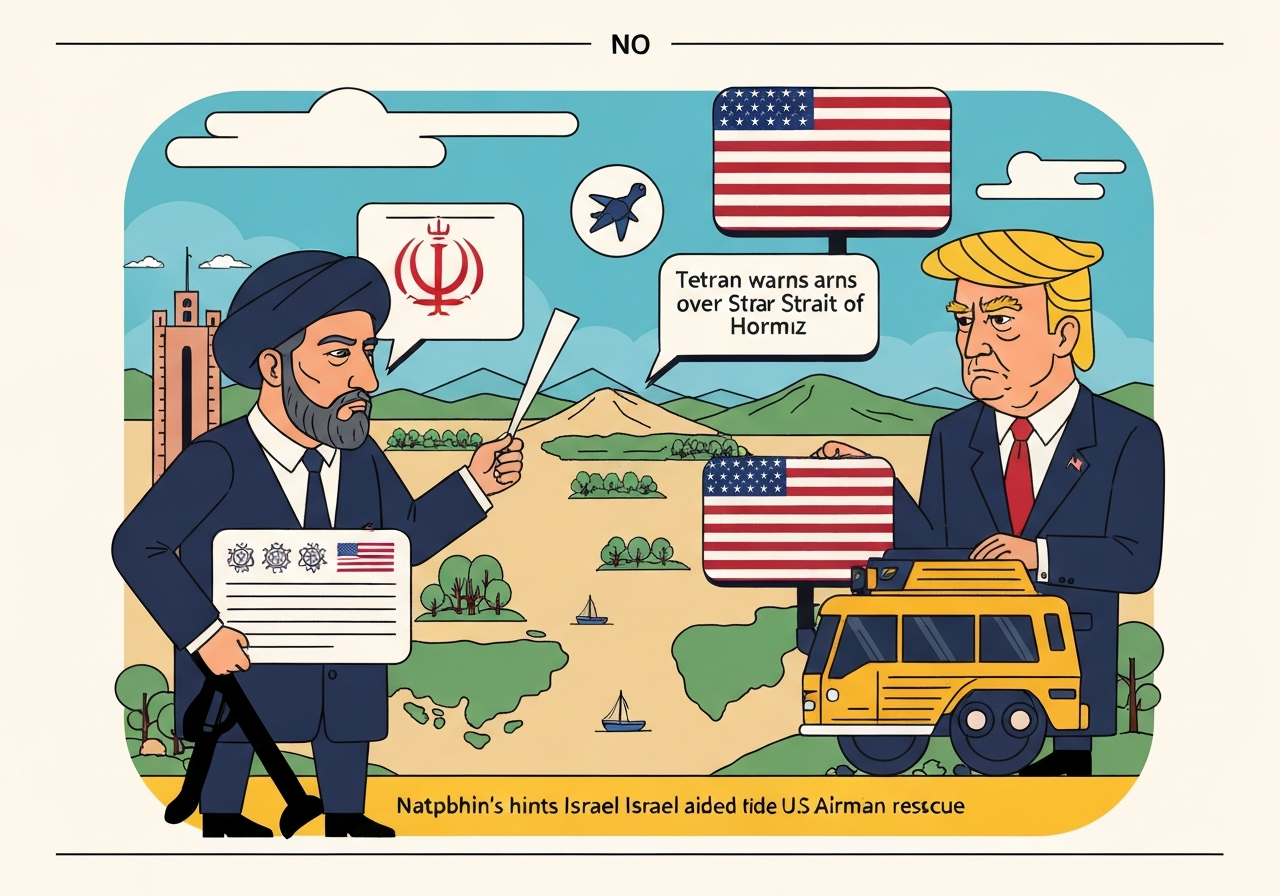
In a rapidly escalating episode on April 5, 2026, Tehran issued a stark warning after US President Donald Trump demanded the Strait of Hormuz be reopened, while Israeli prime minister Benjamin Netanyahu suggested Israel played a role in the US recovery of a downed F-15E crew member in Iran. The rescue, carried out by US commandos from a mountainous location in south‑west Iran, ended a two‑day search and followed the crash of the jet. The same day saw intensified Israeli strikes across Lebanon that authorities said killed at least 15 people, and global oil benchmarks rose as markets braced for disruption. Tensions widened as the UK and UAE reported defensive actions against incoming Iranian drones and missiles.
- US commandos recovered a crew member of a downed F-15E in south‑west Iran after a two‑day search; Israeli prime minister Netanyahu later said Israel “helped”, an assertion not independently verified.
- At least 15 people were killed in new Israeli strikes in Lebanon on April 5; Lebanese authorities say more than 1,400 people have died in Lebanon since the war began, including 126 children, and over 1 million have been displaced.
- Oil prices jumped: West Texas Intermediate opened up about 1.86% to $113.62 per barrel; WTI briefly rose above $114 by Sunday evening amid threats and market anxiety.
- President Trump issued an expletive‑filled ultimatum demanding the Strait of Hormuz be reopened by Tuesday and threatened strikes on Iranian infrastructure, including power plants and bridges.
- The UK Royal Air Force reported shooting down multiple Iranian drones; the UAE said its air defences intercepted ballistic missiles, cruise missiles and drones targeting its territory.
- Médecins Sans Frontières (MSF) described mass‑casualty admissions after an apartment strike in Beirut and called for protection of civilians and health facilities.
Background
The confrontation comes amid a five‑week conflict that has drawn in regional actors and strained global supply lines. The Strait of Hormuz, a narrow maritime chokepoint through which a significant share of the world’s oil passes, has become a focal point: any prolonged disruption would ripple through energy markets and commerce. US and allied forces have been conducting defensive and, in some cases, offensive operations in the region; those actions have in turn prompted threats and retaliatory claims from Iran and Iran‑aligned groups.
Israel and Lebanon remain principal flashpoints. Israel has carried out repeated air strikes inside Lebanon as it seeks to degrade Hezbollah’s military capabilities; Lebanon’s authorities say civilian tolls and displacement are mounting. Meanwhile, Washington faces pressure at home and abroad over the scope of its military steps and the rhetorical escalation from President Trump, who has used social media and broadcast interviews to set deadlines and threaten infrastructure strikes.
Main Event
US special operations forces rescued a crew member of an F‑15E that crashed in south‑west Iran, concluding a two‑day search. The operation reportedly recovered one airman from a mountainous area overnight over the weekend; Reuters and US officials later confirmed a second crew member had been recovered in a separate extraction. Netanyahu posted on X early on Monday that he had spoken with Trump, congratulated him on the “perfectly executed” mission and said the president “expressed his appreciation for Israel’s help.”
Iran responded to the rescue and to Trump’s incendiary social‑media warnings by threatening “much more devastating” retaliation if civilian infrastructure is attacked. Separately, Iran’s parliament speaker warned of regional conflagration, saying the whole region could “burn” if tensions continue to rise. Tehran has rejected a US demand to reach a deal within 48 hours, according to reports from the weekend.
On the ground in Lebanon, Israeli strikes on April 5 killed at least 15 people, including civilians in Beirut’s Jnah neighbourhood and in the mountain town of Ain Saadeh, where reports said a prominent Lebanese Forces official, Pierre Mouawad, and his wife were among the dead. The Israeli military also warned it would target the Masnaa border crossing with Syria over alleged weapon‑smuggling uses; Syrian authorities said the crossing serves civilians and would close temporarily amid the threats.
Elsewhere, the UK Ministry of Defence said RAF Typhoons and F‑35s engaged multiple Iranian drones over the region overnight, while the UAE reported air‑defence engagements against ballistic and cruise missiles and drones. These defensive actions underscore how the conflict’s kinetic effects are extending across the eastern Mediterranean and Gulf airspace.
Analysis & Implications
The rescue operation and the subsequent public claims have immediate tactical, strategic and political consequences. A successful extraction demonstrates US special operations reach and may be intended to signal deterrence; public attribution or hints of allied involvement, however, risk broadening the conflict by giving Tehran a tangible grievance to cite when planning retaliation. Netanyahu’s suggestion that Israel aided the recovery — if accurate — would mark a notable off‑battlefield cooperation between the two militaries and could complicate Israel’s claims of non‑involvement in certain strikes.
Rhetoric from Washington, including explicit threats to strike civilian infrastructure, raises legal and diplomatic concerns. Senior lawmakers on Capitol Hill publicly condemned the language as reckless and potentially unlawful; that criticism undermines unified domestic support for expansive military options and may constrain the administration’s room to maneuver. Allies in the region and beyond are already signalling reluctance to be drawn in, while urging de‑escalation to protect trade routes and global markets.
Markets reacted quickly: oil benchmarks rose on the prospect of supply disruption in the Strait of Hormuz, amplifying inflationary and macroeconomic pressures worldwide. Even short‑term interruptions to tanker traffic can send prices higher and stoke volatility. For regional actors like the UAE and Gulf states, defensive interceptions of missiles and drones highlight both improved air‑defence coordination with partners and the risk of miscalculation from surface‑to‑surface and air attacks.
Comparison & Data
| Metric | Reported Value |
|---|---|
| Deaths in Lebanon since start of war | More than 1,400 (including 126 children) |
| Displaced in Lebanon | Over 1,000,000 |
| WTI crude (market open Apr 5) | $113.62 per barrel (+1.86%) |
| WTI (Sunday evening) | Above $114 per barrel |
| Recent air strikes reported (Apr 5) | At least 15 killed in Lebanon |
The figures above consolidate government and media tallies published during the day. Casualty counts and displacement figures are frequently updated as access to strike sites improves; market prices are volatile and reflect trader expectations about future supply disruptions rather than confirmed production losses.
Reactions & Quotes
Senior political and humanitarian actors reacted sharply to both the rescue operation and to the spiralling rhetoric.
The President expressed his appreciation for Israel’s help, and I am deeply proud that our cooperation off the battlefield is unprecedented.
Benjamin Netanyahu (posted on X)
Netanyahu’s message framed the apparent cooperation as a matter of pride and close coordination; Israeli officials have not publicly detailed the nature of any assistance, and US authorities gave limited comment on partners’ roles. The outsize visibility of the post may be intended to reinforce deterrence, but it also risks feeding Iranian narratives of a wider coalition of adversaries.
The president of the United States is ranting on social media … He’s threatening possible war crimes and alienating allies.
Senate Majority Leader Charles Schumer
Senate Democrats expressed alarm at the tenor of Mr. Trump’s threats, arguing that incendiary public rhetoric complicates diplomacy and may breach international norms. Congressional warnings reflect a broader domestic debate about escalation, oversight and the legal limits of targeting civilian infrastructure.
When strikes hit crowded residential areas without warning, the consequences are severe. Civilians cannot be collateral damage.
Médecins Sans Frontières (MSF)
MSF’s statement highlighted the humanitarian impact of strikes in Beirut and warned about the strain on hospitals facing mass‑casualty influxes. Humanitarian groups have repeatedly called for protected access to medical facilities and for combatants to avoid populated areas.
Unconfirmed
- Netanyahu’s assertion that Israel assisted in the airman’s rescue has not been independently corroborated by US official statements detailing partner involvement.
- Hezbollah’s claim of firing a cruise missile at an Israeli warship was reported by the group but the Israeli military told AFP it was “not aware” of such an incident; the claim remains unverified.
- Some local casualty and identity reports from strike sites (including individual names and affiliations) remain subject to confirmation as authorities complete on‑site verification.
Bottom Line
The events of April 5 illustrate how a single high‑visibility operation and a string of public threats can accelerate a multi‑front crisis. A tactical success in rescuing a downed airman may bolster US morale and demonstrate special‑operations capability, but public attribution and allied involvement create additional diplomatic and military hazards that could widen the conflict.
Markets and regional partners are watching closely: energy prices reacted upward and defensive military postures were reinforced across the Gulf and eastern Mediterranean. De‑escalation will require careful quiet diplomacy, clarified chains of command about strikes and greater transparency on the facts of sensitive operations to avoid miscalculation. Observers should expect further claims, counterclaims and tactical moves in coming days as all sides test limits and seek leverage.
Sources
- The Guardian — live coverage (news outlet, live reporting summarising regional developments).
- Reuters — US forces rescue report (press agency reporting on the recovery of F‑15 crew members).
- UK Ministry of Defence — public statements (official defence updates on RAF activity and force protection in the region).
- Médecins Sans Frontières (MSF) — statement (medical NGO statements on civilian casualties and hospital impact).
- AFP — regional reporting (press agency reporting on strikes, border closures and casualty figures).