
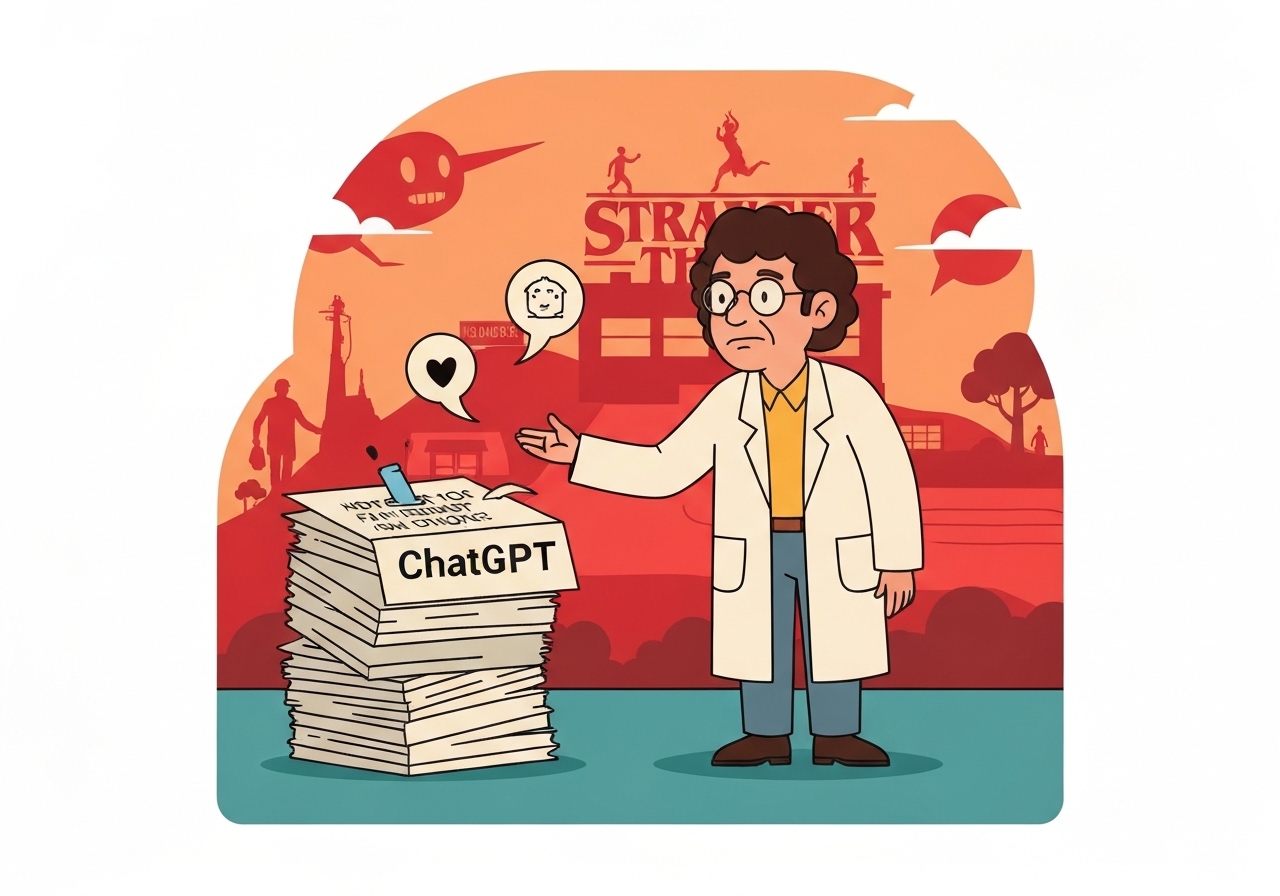
Filmmaker Martina Radwan, director of One Last Adventure: The Making of Stranger Things 5, spoke to The Hollywood Reporter about what she observed while documenting the show’s final season on Netflix. Radwan spent roughly four days in the writers room and hundreds of hours on set, and her film captures creative debates, production problem‑solving and moments that sparked intense online scrutiny. Fans have seized on small details — including an alleged ChatGPT tab — and Radwan addresses what she saw, what she didn’t, and how fans should interpret documentary footage of a long-running, collaborative production.
Key Takeaways
- One Last Adventure: The Making of Stranger Things 5 is streaming on Netflix and was directed by Martina Radwan; she filmed both writers‑room sessions and extended on‑set coverage.
- Radwan spent about four days embedded in the writers room and contributed hundreds of hours of filming on physical sets during principal photography.
- Online viewers flagged a frame they said showed a ChatGPT tab; Radwan says she did not witness generative‑AI being used to write scripts.
- The Duffers participated in the documentary and reviewed it; Radwan reports they were broadly satisfied and offered routine notes, not mandates.
- Script timing, production constraints and Netflix’s fixed air dates created routine pressure around schedules; Radwan frames this as common industry pressure tied to time and budget.
- Creative choices—such as whether to include monsters in certain sequences or how overt to play a relationship between two characters—were presented as iterative discussions rather than fixed edicts.
- Practical effects were used on set (for example, the goo in one Upside Down scene), with limited VFX applied in closeups according to Radwan.
- Radwan included candid moments to show the collaborative nature of story development and to illustrate how actor and director conversations can alter on‑screen choices.
Background
Stranger Things concluded a decade‑long run that built a vocal, highly engaged fandom. The Duffer Brothers, Matt and Ross, shepherded the series from its 2016 debut to a five‑season arc notable for a large ensemble (Radwan notes roughly 19 principal characters) and sprawling production demands across multiple locations. The final season’s making was a complex logistics and storytelling exercise, with guest directors and parallel writing and shooting schedules—a process Radwan observed and recorded for her Netflix documentary.
Documentaries that embed with active productions often capture fragments of debate and revision rather than final creative decisions. Radwan’s film aims to reveal that iterative process: writers pitching, actors testing subtleties, and directors balancing performance authenticity with plot clarity. That transparency has a double edge—fans hungry for definitive answers can read provisional rehearsals as spoilers or proof of concealed decisions.
Main Event
Radwan filmed a mix of writers‑room sessions, rehearsal moments and on‑set problem solving. She describes most writers‑room activity as “creative exchange”: a series of conversations that shape story arcs but do not equate to instant script pages. Her presence captured questions about story economy—how to manage 19 characters across 12 locations—and the kinds of discussions that led the Duffers to remove or restrain creature beats in certain sequences.
The filmmaker recounts being present when actors and directors negotiated tone, notably a scene where Maya Hawke’s character discusses how overt to play Robin’s relationship with Vickie. Radwan presents the exchange as an example of collaborative character interpretation rather than a continuity error or hidden agenda. She emphasizes that actors often propose nuances that are then calibrated with directors in service of plausibility.
Fans also homed in on a brief image they said showed a ChatGPT tab on a writer’s laptop. Radwan says she cannot confirm that the tool was actively used to generate scripts in her presence. She frames whatever was visible as part of routine multitasking and quick research during long creative sessions rather than evidence of generative‑AI authorship of material.
Production pressures appear in the film as well: sequences showing rewrites, scheduling crunches and Netflix representatives visiting set. Radwan situates those moments in standard industry practice—time equals money—while noting the added stakes of a fixed streaming release schedule that leaves less slack than a festival‑timed film.
Analysis & Implications
Radwan’s documentary and the reaction to it highlight tensions between transparency and interpretation. When behind‑the‑scenes footage is released, fans evaluate fragments as if they were finished statements; this can create conspiracy narratives from ordinary production choices. The ChatGPT frame demonstrates how modern production tools and ubiquitous tabs invite speculation, even when there is no substantive evidence of misuse.
If generative AI were introduced into writers’ rooms at scale, it would raise ethical, creative and labor questions—but Radwan’s on‑the‑record account does not support claims that scripts were produced by AI during her observations. The broader concern among some viewers is philosophical: whether algorithmic tools should be part of creative work, not whether a specific episode of authorship was outsourced to a model.
The documentary also underscores a practical point about big ensemble storytelling: with nearly 20 key characters and many locations, decisions are often about trade‑offs. Removing a monster from a scene or adjusting how an intimate moment reads are decisions rooted in pacing, character focus and screen time distribution. Those are artistic choices, not necessarily admissions of error or evidence of a behind‑the‑scenes conspiracy.
Comparison & Data
| Item | Radwan’s Observations |
|---|---|
| Writers‑room days observed | Approximately 4 days |
| On‑set filming | Hundreds of hours |
| Principal characters noted | About 19 |
| Locations referenced | Roughly 12 |
| Season release format | Planned three‑part split |
These figures put into context why small production details—props, laptop tabs, practical effects—draw outsized attention: the sheer scale demands many parallel workflows and provisional materials that can look decisive when they are not.
Reactions & Quotes
“You have to participate — it’s not a definitive answer,”
Martina Radwan, documentary director
Radwan used that phrasing to explain why she avoided giving a categorical statement about a major character’s fate, arguing that narrative ambiguity is part of viewer engagement.
“No, of course not,”
Martina Radwan, on witnessing unethical generative‑AI use
She said this succinctly when asked whether she observed AI replacing human writers; her broader point was that she documented conversation and iteration, not automated authorship.
“The biggest pressure point on any film set is time, which equals money,”
Martina Radwan
Radwan contextualized Netflix’s involvement as part of standard production timelines rather than exceptional micromanagement specific to Stranger Things.
Unconfirmed
- Whether any writer had an active ChatGPT session that contributed text to final scripts during Radwan’s observation remains unproven; the frame in question does not constitute direct evidence.
- Claims that the documentary produced or concealed a secret “bonus finale” were denied by Radwan and lack corroboration from the Duffers.
- Allegations that Netflix uniquely or unusually pressured the Duffers beyond standard production timing are not substantiated by Radwan’s account.
Bottom Line
Martina Radwan’s One Last Adventure provides a close look at the collaborative machinery behind Stranger Things 5, and her reporting suggests more nuance than many online readings of the footage. The documentary emphasizes process—debate, iteration and practical problem solving—rather than revealing unilateral directives or AI authorship of scripts.
For viewers interpreting small details as proof of larger claims, Radwan’s account is a reminder to distinguish between provisional production artifacts and final creative decisions. As big‑budget shows continue to be dissected frame by frame, transparency about how television is made may reduce conspiratorial leaps and help audiences appreciate the many craft decisions that shape the finished episodes.
Sources
- The Hollywood Reporter — entertainment trade press (interview with Martina Radwan)
- Netflix — streaming service / official distributor of the documentary