
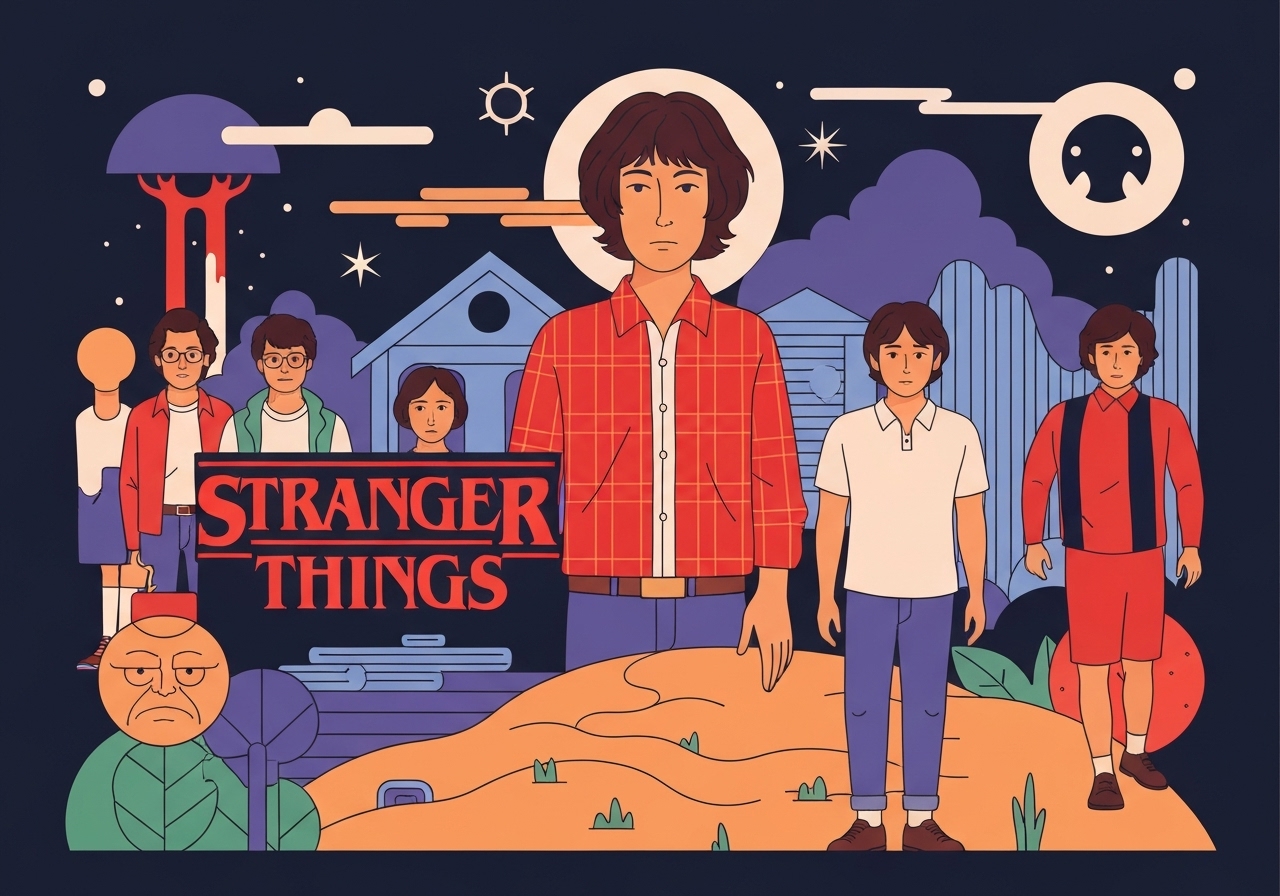
Lead: After nine years and five seasons, Stranger Things has concluded, but the Duffer brothers have confirmed a television spinoff is in development. The series finale revealed a pivotal origin scene — a glowing black rock tied to Henry Creel’s awakening — which the Duffers say will feed into the new project. The spinoff will use a fresh cast and setting, and the Duffers describe it as a new mythology that connects to, but does not re-run, Hawkins’ story. Production details and a release timetable remain limited.
Key Takeaways
- The original Stranger Things ran nine years across five seasons and concluded in 2024.
- Series finale flashback shows a young Henry Creel finding a glowing black rock that appears to trigger his powers and link him to the Mind Flayer.
- Matt Duffer has said the rock’s origin is a loose end the spinoff will address, though the new show is not primarily about mining rocks.
- The spinoff will feature new characters, a new location and different actors; members of the Hawkins cast are not expected to be regulars.
- The Duffers will act as creative stewards but will not run the spinoff full-time because of other commitments, including a Paramount deal.
- Finn Wolfhard has privately speculated about the spinoff’s scope and reportedly guessed its premise correctly, per the Duffers.
- Netflix and the Duffers confirmed in November that they are moving forward with the project; many narrative specifics remain withheld.
Background
Stranger Things debuted in 2016 and grew into a global franchise built on 1980s-inflected sci-fi, child-centered adventure, and an expanding supernatural mythology. Over five seasons the series threaded Hawkins-based science labs, the Upside Down, and the Mind Flayer into a single, long-running arc that culminated in the 2024 finale. Creators Ross and Matt Duffer developed a tightly connected ensemble cast; their decision to end the original saga reflects a desire to close that particular chapter while preserving intellectual property for future exploration.
The television industry frequently extends successful franchises with spinoffs to explore peripheral corners of a fictional universe or to reboot tone and format for new audiences. For Netflix and the Duffers, a spinoff offers a way to retain the Stranger Things brand — its genre mix of child-led mysteries and supernatural threat — without stretching the Hawkins narrative beyond a coherent endpoint. At the same time, the Duffers’ move to other deals, including a reported arrangement with Paramount, affects how involved they will be operationally.
Main Event
The series finale includes a crucial flashback in which Henry Creel (young) kills a scientist after being shot in the hand and then opens the scientist’s briefcase to find a luminous black rock. That object is depicted as the catalyst for Henry’s emerging abilities and his later connection to the Mind Flayer. Creators have said this rock and its provenance are among the unresolved elements the spinoff will address.
In interviews following the finale, Matt Duffer emphasized that while the rock’s backstory will be revisited, the upcoming series will not primarily revolve around rocks or mining. Instead, he framed the project as an opportunity to build a distinct mythology that intersects with the original show’s unanswered questions — particularly those tied to Henry’s early memories — without rehashing Hawkins-centered plotlines.
The Duffers have also signaled that the new series will deploy a different ensemble and setting. Industry reporting and the creators’ public comments indicate the project is conceived as an independent story within the broader franchise umbrella: familiar genre DNA but a separate narrative focus. As a result, viewers should not expect the Hawkins kids to be the spinoff’s lead characters.
Analysis & Implications
Strategically, a spinoff preserves brand equity while allowing narrative reset. By starting with new characters and locations, creators can reintroduce the show’s core appeals — adolescent discovery, retro-inflected atmosphere, and speculative peril — without legacy constraints. This reduces the risk of diminishing returns that often accompanies reusing principal cast members or stretching a single plotline indefinitely.
From a creative standpoint, centering the new story on a previously teased element (the black rock) gives writers a concrete hook that ties to the original series’ mythology while enabling broader worldbuilding. If the rock’s origin is linked to other laboratories or cosmic sources, the spinoff could expand the diegesis geographically and thematically, raising stakes for how the Upside Down concept operates across locations.
For Netflix the project is commercially attractive: it leverages an existing, passionate audience while offering publishers and producers new merchandising and licensing opportunities. However, success will depend on execution — whether the spinoff balances reverent callbacks with fresh plotting and whether it can establish compelling new protagonists who sustain long-term viewer investment.
Comparison & Data
| Item | Detail |
|---|---|
| Original run | Five seasons, nine years |
| Finale revelation | Black rock tied to Henry Creel |
| Spinoff approach | New cast, new location, connected mythology |
The table condenses the core factual relationships: the show concluded after five seasons and nine years; the finale introduced a physical object that creators identify as narratively significant; the spinoff will pursue different characters and setting while answering select unresolved questions.
Reactions & Quotes
“The rock and where the rock came from” is a thread the new series will pick up, according to Matt Duffer.
The Hollywood Reporter (interview)
Ross Duffer said Finn Wolfhard was the only cast member who guessed the spinoff’s premise, noting they had “mind-melded with this kid a bit.”
Variety (conversation with creators)
Finn Wolfhard speculated the new show could be anthology-like and widespread in scope, imagining labs in other locations beyond Hawkins.
Variety (actor interview)
Unconfirmed
- The exact plotline of the spinoff and how directly it will reveal the rock’s origin remain unannounced.
- No official casting list has been released; it is unconfirmed whether any Hawkins-era actors will appear in guest roles.
- The production timeline, premiere date, episode count, and showrunner for the spinoff have not been publicly confirmed.
- It is not yet confirmed whether the Upside Down itself will be a central focus or remain an incidental element in the new series.
Bottom Line
The Stranger Things spinoff represents a deliberate choice to extend the franchise without repeating the Hawkins arc. Creators intend to answer specific lingering questions — notably the provenance of the black rock introduced in the finale — while using a new cast and setting to preserve creative flexibility. For viewers, the most important expectation is tonal continuity (kids, adventure, sci-fi/fantasy) paired with narrative novelty.
Key uncertainties remain: concrete plot details, casting, and a production schedule have not been disclosed. How Netflix and the creative team balance nostalgia with fresh storytelling will determine whether the spinoff becomes a worthy expansion of the Stranger Things universe or simply a commercial extension of a closed story.
Sources
- Yahoo Entertainment (news report summarizing creators’ comments and finale spoilers)
- The Hollywood Reporter (entertainment trade reporting/interview)
- Variety (industry coverage and interviews)
- ScreenRant (entertainment analysis and reporting)
- Deadline (industry news confirming development)