
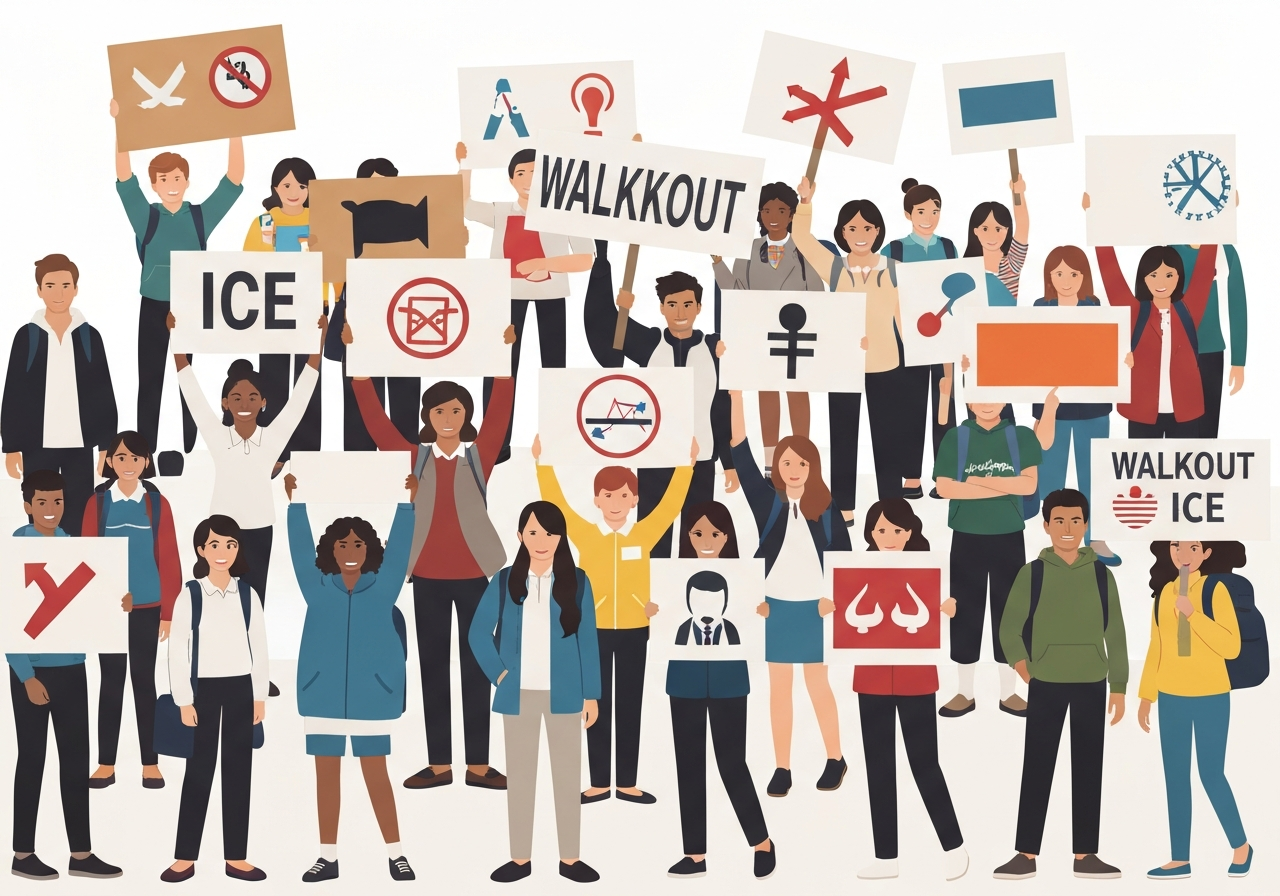
Lead: On Feb. 15, 2026, students in more than three dozen states staged walkouts to protest U.S. Immigration and Customs Enforcement (ICE) deportation tactics, disrupting classes in cities from Salt Lake County, Utah, to coastal Maine. Demonstrations included coordinated exits from multiple schools, marches that halted traffic and public gatherings on bridges and school parking lots. In Texas — where more than half of public-school students are Hispanic — Governor Greg Abbott and state education officials responded with threats to strip funding, pursue arrests for disorderly conduct and, in some statements, take control of districts deemed to have facilitated protests. Despite those warnings, the demonstrations continued through mid-February, signaling sustained youth mobilization on immigration policy.
Key Takeaways
- More than three dozen states reported student walkouts in February 2026, with actions ranging from single-campus protests to multi-school exits in counties such as Salt Lake County, Utah.
- Examples include eight schools in Salt Lake County, students staging a march on a bridge over the Kennebec River in Maine, highway disruptions in Maryland and a parking-lot demonstration in Sunnyside, Washington.
- Texas officials, led by Gov. Greg Abbott, publicly threatened sanctions including the possible withdrawal of state funding and arrests for disorderly conduct tied to protests.
- The Texas Education Agency warned that districts found to have permitted or coordinated walkouts could face state takeover procedures under existing state law.
- Texas demographics are relevant: over 50% of public-school students in the state are Hispanic, shaping the protests’ scale and political salience there.
- Despite administrative pleas and threats, student organizers reported continuing actions, indicating a high level of grassroots coordination and commitment among teenage protesters.
Background
The February 2026 walkouts grew out of sustained youth activism on immigration enforcement, following months of high-profile ICE operations and deportation cases. Student demonstrations have periodically surged in the U.S. when immigration policy becomes a flashpoint; the current wave reflects both local incidents and national organizing via social media and youth-led coalitions. School-based protests test the intersection of student free-speech rights and school disciplinary authority; landmark court decisions such as Tinker v. Des Moines affirm some protections for student expression but allow schools to act when demonstrations materially disrupt instruction. Political leaders’ responses vary sharply by state: in several jurisdictions officials publicly defended students’ right to protest, while in Texas state leaders framed walkouts as unacceptable, threatening sanctions and enforcement measures. That divergence has turned routine school protests into a test case for how states will balance civil liberties, school governance and political signaling ahead of elections and legislative sessions.
Organizers have used a mix of tactics — coordinated walkouts during class periods, lunchtime marches, planned sit-ins and public demonstrations near courthouses or highways — to maximize visibility and media coverage. Local media and national outlets documented specific incidents: Salt Lake County reported coordinated exits from eight schools; students in Maine gathered on a bridge over the Kennebec River in winter conditions; in Maryland, some protests temporarily interrupted traffic; and in Sunnyside, Washington, students assembled in a parking lot with handmade posters. In Texas, these protests intersect with ongoing state debates over immigration enforcement, education funding and school governance, elevating the stakes of any administrative response.
Main Event
On Feb. 15 and the days surrounding it, student groups across more than three dozen states organized walkouts to call attention to ICE enforcement practices and deportations they described as unjust. In many places the actions were peaceful and brief — a mass exit, a march to a nearby public space, chants and signs — but local authorities in some jurisdictions responded with arrests or dispersal orders when protests affected traffic or school operations. Organizers relied on text threads, social platforms and community groups to coordinate timing and messaging, often urging participants to remain nonviolent and to document interactions with law enforcement or school officials.
In Texas, the response escalated quickly. Governor Greg Abbott used social media last week to condemn school staff who he said allowed or facilitated walkouts, stating that such personnel should be treated as co-conspirators. The Texas Education Agency followed with formal warnings that districts permitting or aiding walkouts could face administrative intervention, including potential takeover under state statutes that address governance failures. Some district superintendents issued stern reminders that participating students could face discipline under local codes of conduct and that staff permitting demonstrations might be subject to personnel action.
School leaders in many districts urged students to stay in class and sought to defuse tensions, citing safety and instructional priorities. At the same time, students and advocacy groups argued that walking out was a protected form of political expression and a response to policy decisions they view as directly affecting immigrant communities and classmates. The public exchanges between state officials and school communities produced heightened media attention and mobilized both critics and supporters of the protests.
Law enforcement presence increased near some demonstrations, particularly where actions coincided with major roadways or public infrastructure. Reports indicate a small number of disorderly-conduct citations and brief detentions in localized incidents, though comprehensive arrest data across all states involved was not available as of Feb. 15, 2026. Organizers encouraged documentation of interactions to challenge any heavy-handed discipline or enforcement after the fact.
Analysis & Implications
The student protests signal an intensifying youth engagement on immigration policy that could have lasting civic and political effects. High-school organizers are employing rapid communication tools and aligning with community groups, which increases their capacity to mount synchronized actions across state lines. For Texas, the political calculus is acute: threats to strip funding or seize district control are powerful signals to local administrators and may chill school-sanctioned political expression. However, state intervention carries legal and logistical risks, from litigation over student speech to operational disruptions if funds are withheld.
Administratively, declaring that school staff who permit walkouts are “co-conspirators” raises questions about personnel liability and the standards for proving facilitation. School boards and superintendents may tighten supervision or pre-emptively discipline staff to avoid state scrutiny, which could strain labor relations and provoke union responses. Conversely, aggressive state actions could fuel further protests by deepening perceptions of political targeting, especially in districts with large immigrant or Hispanic student populations.
On the legal front, courts will likely see challenges that test the boundaries of student speech protections when protests occur during instructional time. Past rulings permit some regulation of on-campus disruption, but blanket punitive measures aimed at districts or staff may face constitutional and statutory review. Economically, sudden funding threats could impair district operations, affecting classroom resources and services for vulnerable students. Nationally, how one large state responds may set a precedent that other governors or education agencies follow, amplifying the policy ripple effect beyond Texas.
Comparison & Data
| Location | Reported Action | Reported Scale/Detail |
|---|---|---|
| Salt Lake County, Utah | Coordinated walkouts | Exits at eight schools |
| Kennebec River, Maine | Bridge demonstration | Students gathered outdoors in winter conditions |
| Maryland | Street/highway disruptions | Traffic temporarily halted in some areas |
| Sunnyside, Washington | Parking-lot protest | Students carried hand-drawn posters |
| Texas (multiple districts) | Walkouts + official threats | State warnings of funding cuts, possible district takeover |
The table summarizes reporting compiled from regional and national outlets; it is not an exhaustive inventory of every action in all affected communities. While the number of states involved exceeds three dozen, the scale of each protest varies considerably — from brief classroom exits to public marches that drew media and law-enforcement attention. Texas stands out for the scale of political pushback from state leadership and the combination of demographic factors that make schooling and immigration especially politicized there.
Reactions & Quotes
“Schools and staff who allow this behavior should be treated as co-conspirators.”
Gov. Greg Abbott (official social media post)
This statement by the governor framed the protests as disciplinary and possibly criminal, prompting immediate responses from district officials and civil-rights groups questioning the legal basis for such a stance.
“Districts that facilitate walkouts risk state intervention under existing education statutes.”
Texas Education Agency (official warning)
The TEA warning emphasized administrative remedies, including takeover procedures, and urged districts to uphold policies that maintain instructional continuity and safety.
“We are skipping our lesson to teach you one,”
Student organizer (reported placard slogan)
Students used succinct messages to explain their rationale: framing walkouts as civic education and a response to policies they view as harming classmates and communities.
Unconfirmed
- Whether any Texas district had funds actually redirected or formally seized by the state as of Feb. 15, 2026 — reports indicate warnings but not confirmed statewide funding removals.
- Comprehensive, nationwide arrest and citation totals connected to the February walkouts were not available at the time of reporting; isolated local incidents were noted.
- Claims that school staff were universally coordinating protests with organizers remain unverified and appear to vary by district.
Bottom Line
The February 2026 walkouts represent a significant moment of youth-led mobilization on immigration enforcement across the United States, drawing attention to the intersection of student expression, school governance and state politics. In many communities the actions were peaceful and symbolic; in Texas, statewide political pushback transformed local demonstrations into broader debates over funding, legal authority and the limits of permissible protest in schools.
Watch for legal challenges and administrative actions in the weeks ahead: threatened funding cuts or district takeovers could prompt lawsuits, accelerate union and civil-rights mobilization, and influence how districts manage political expression going forward. For observers and policymakers, the episode underscores how polarized policy issues played out in schools can quickly escalate into statewide and national flashpoints.
Sources
- The New York Times (national news reporting)
- Austin American-Statesman / Associated Press (local/national reporting; photo attribution)
- Office of the Governor of Texas (official statements)
- Texas Education Agency (official agency guidance)
- Associated Press (news reporting)