
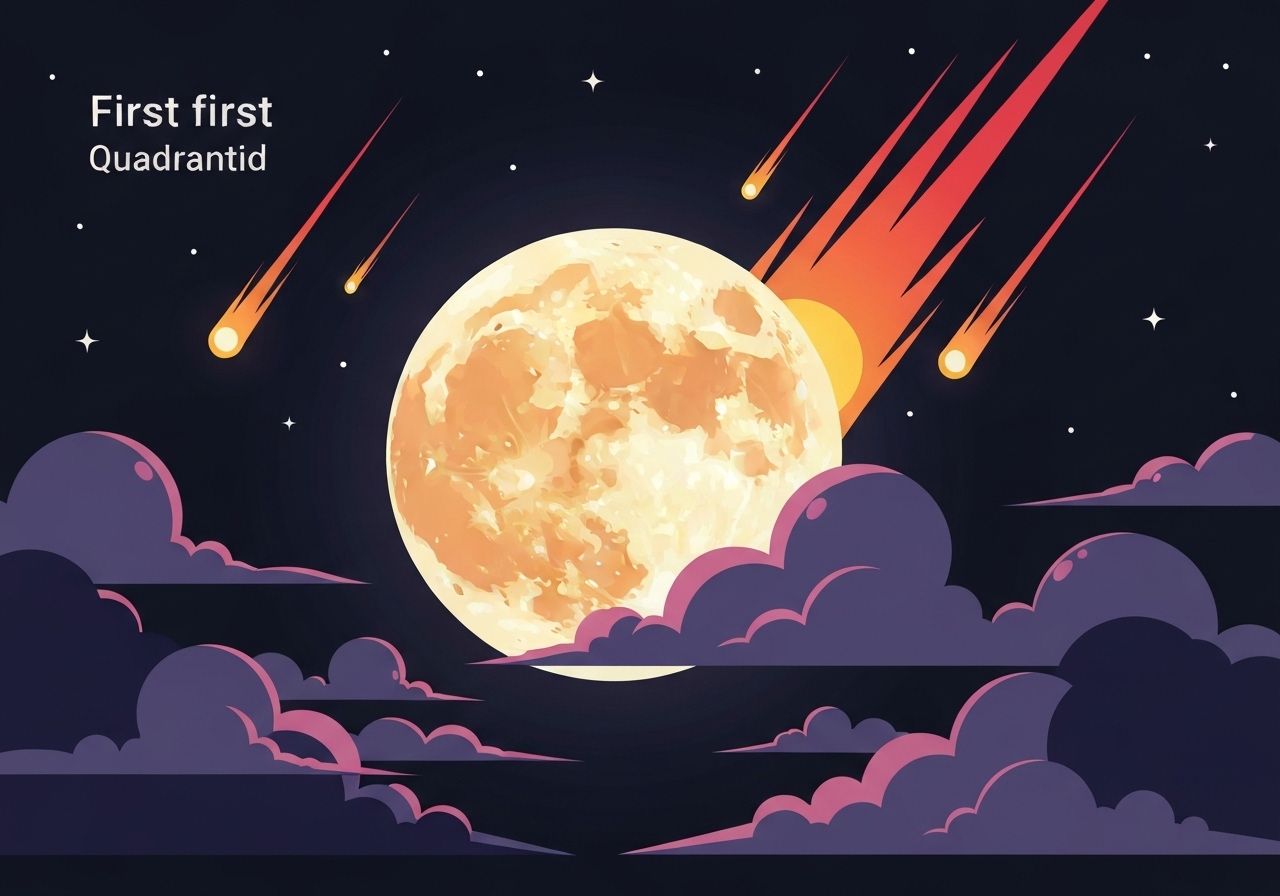
In early January skies, the year’s first supermoon coincides with the Quadrantid meteor shower peak, creating a contest between lunar brightness and shooting stars. The American Meteor Society says the Quadrantids typically produce about 25 meteors per hour under dark conditions, but moonlight from the full supermoon will likely reduce visible rates to fewer than 10 per hour. The effect will be most pronounced for viewers in the Northern Hemisphere where the shower is strongest, though both phenomena are visible without telescopes. Observers are advised to seek dark locations and monitor the hours before dawn when the shower can be most active.
Key Takeaways
- The Quadrantid meteor shower peaks Friday night into Saturday morning; peak rates in dark skies are around 25 meteors per hour, per the American Meteor Society.
- This January’s full moon is a supermoon and can appear up to 14% larger and 30% brighter than the year’s faintest full moon, according to NASA, reducing meteor visibility.
- Due to lunar glare, expected visible meteors during the peak are likely to drop to fewer than 10 per hour for many observers.
- The Quadrantids are primarily visible from the Northern Hemisphere and originate from debris associated with asteroid 2003 EH1.
- Experts recommend watching in the pre‑dawn hours and allowing 20–30 minutes for eyes to adjust to darkness; avoid phone screens to maximize sightings.
- Supermoons occur several times a year; this event ends a four‑month sequence that began in October, with the next supermoon not expected until late 2026.
Background
Meteor showers appear when Earth passes through concentrated streams of dust and small rocks left behind by comets or asteroids. When these particles hit the atmosphere at high speed they vaporize and create brief streaks of light commonly called shooting stars. The Quadrantids are an annual early‑January shower known for a relatively short, sharp peak of activity compared with other showers.
The object linked to the Quadrantids, asteroid 2003 EH1, produces the debris that intersects Earth’s orbit and yields the visible meteors. Because the Quadrantids radiate from a region best seen from northern latitudes, observers in the Northern Hemisphere have the clearest view during the peak. Full moons, and especially supermoons, raise the sky background and can overwhelm faint meteors across wide areas of the sky.
Main Event
The American Meteor Society forecasted the Quadrantid peak for Friday night into Saturday morning; precise peak timing changes year to year as Earth moves through the debris stream. Under ideal, dark conditions that peak can produce roughly 25 meteors per hour, concentrated into a brief window of high activity. This January the moon reaches full phase very near the shower’s maximum, producing a bright sky that will drown out many fainter meteors.
On-site planetarium staff and skywatching groups are advising people to look away from the moon and allow their eyes to adapt, which can improve chances to catch the brighter fireballs that still penetrate the lunar glare. Public outreach from museums and science centers emphasizes safety—no equipment is required—and suggests arriving well before the predicted peak to find a dark site.
Observers who cannot reach remote dark skies may still spot the brightest Quadrantid meteors, sometimes described as fast, white streaks or occasional fireballs. The shower’s brief maximum means observers benefit from checking both the evening before and the pre‑dawn hours after the nominal peak; some activity can remain detectable during early morning on Sunday.
Analysis & Implications
Moonlight has a quantifiable impact on meteor counts: the full phase increases sky brightness substantially, reducing the contrast needed to see smaller meteors. NASA’s 14% larger/30% brighter supermoon figure describes apparent diameter and integrated brightness relative to the faintest full moon of the year; for meteor watching the critical factor is the increased sky background that hides faint streaks.
For citizen scientists and amateur networks that log meteor counts, this event will produce a lower ground count than the Quadrantid average, complicating comparisons with previous years unless observers correct for lunar phase. Professional monitoring systems that use wide‑field cameras and all‑sky sensors will still record many events, but human visible rates reported from the field will skew lower.
Public interest in sky events often rises when two phenomena overlap; the supermoon itself draws casual viewers and photographers, while meteor showers attract enthusiasts. That overlap can boost attendance at planetariums and public observing sessions, even if the number of visible meteors is reduced. Organizers should emphasize education about viewing techniques and the scientific value of continued monitoring despite reduced counts.
Comparison & Data
| Condition | Estimated meteors/hour | Notes |
|---|---|---|
| Dark, moonless peak | ~25 | Typical Quadrantid maximum in optimal skies (American Meteor Society) |
| Full supermoon night | <10 | Estimated reduction due to lunar brightness; many faint meteors obscured |
These figures summarize typical human‑visible rates and are intended to guide expectations rather than provide exact counts. Automated detection systems and photographic records may show higher absolute event numbers because they are less affected by visible‑contrast limits. Seasonal and annual variability of the debris stream also influences the true rate; some years the Quadrantids produce a sharper or weaker peak depending on localized density within the stream.
Reactions & Quotes
Planetarium staff and educators stressed that the moon is the limiting factor for casual observers.
The biggest enemy of enjoying a meteor shower is the full moon.
Mike Shanahan, Liberty Science Center (planetarium director)
Shanahan made this point while explaining why even experienced observers will see fewer meteors when a bright full moon is present. He recommended finding the darkest available horizon and letting eyes adjust for the best chance at sightings.
Try to watch in the early evening away from city lights, and then again before dawn—avoid looking at your phone so your eyes stay dark‑adapted.
Jacque Benitez, Morrison Planetarium, California Academy of Sciences
Benitez emphasized practical tips for maximizing detections, noting that fireballs and faster meteors are more likely to be seen despite lunar interference. Public outreach teams plan to communicate these tips on social channels and at on‑site events.
Unconfirmed
- Exact visible meteor counts for this year’s peak vary by location and local sky conditions; field reports will be needed to confirm estimates under different skies.
- Any reports claiming unusually high fireball frequency during this peak should be treated cautiously until backed by camera or multi‑station confirmation.
Bottom Line
This January’s overlap of a supermoon with the Quadrantid peak means casual viewers should expect fewer visible meteors than in a moonless year, though the brightest events may still cut through the glare. Observers in the Northern Hemisphere, away from urban lights and during pre‑dawn hours, will have the best chance to see fireballs that remain visible despite the moon.
For science and outreach, the event is still valuable: camera networks and experienced observers will gather data that help characterize the stream, and public interest gives educators an opportunity to explain orbital dynamics and observational technique. Plan ahead—find a dark site, avoid screens, and temper expectations to enjoy the spectacle responsibly.