
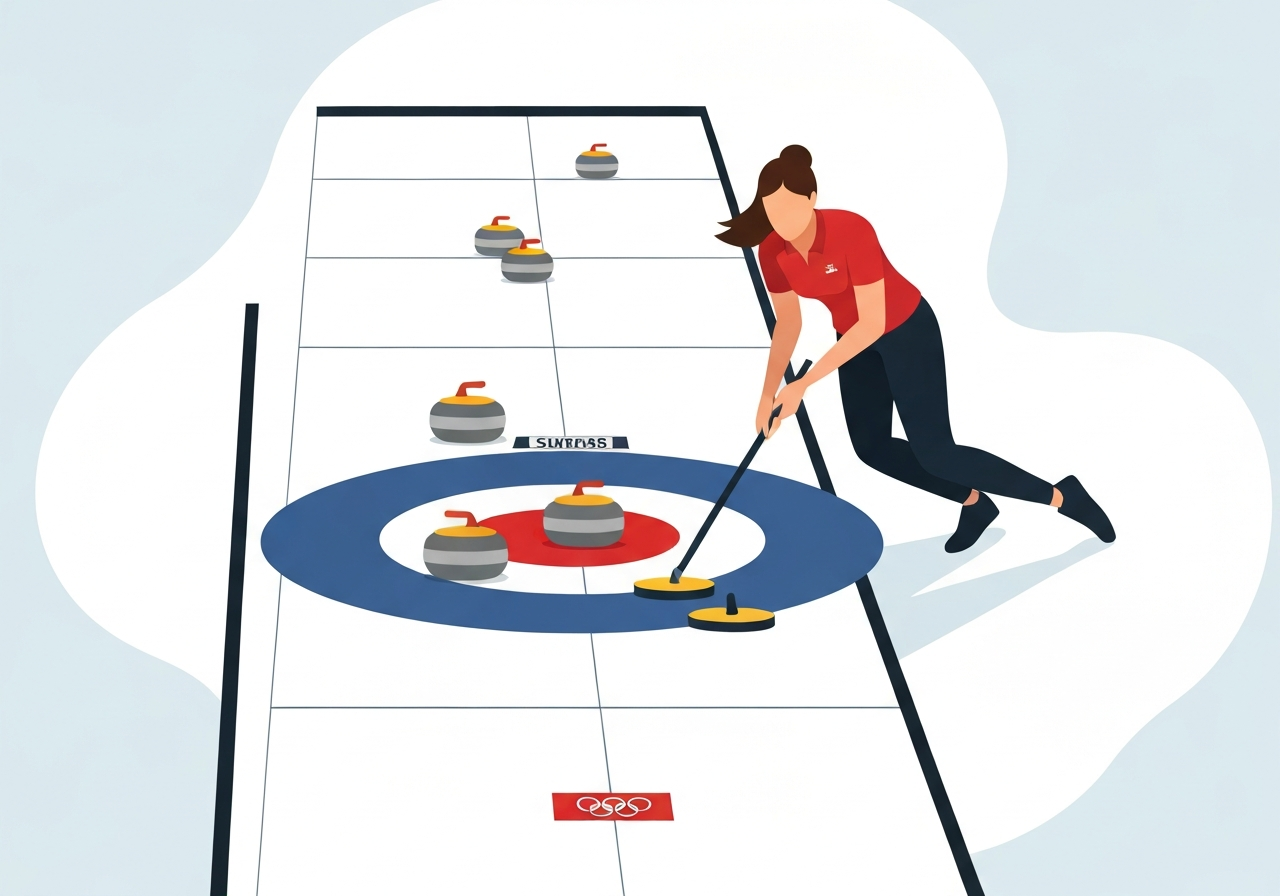
At the Milan-Cortina Winter Olympics on Friday, Switzerland beat the United States 7-4 in the women’s curling semifinal, sending the Swiss to the gold-medal game and moving the U.S. into the bronze-medal match. Switzerland’s vice-skip Alina Patz produced near-flawless play — shooting 100% on draw shots, 98% on takeouts and 99% on game shots — and her precision proved decisive down the stretch. The U.S. fought back late but trailed 5-4 entering the 10th end, where a Swiss takeout for two sealed the victory. The result sets Switzerland against Sweden for gold on Sunday, while the U.S. faces Canada for bronze on Saturday morning.
Key takeaways
- Final score: Switzerland 7, United States 4 in the women’s semifinal at Milan-Cortina 2026.
- Alina Patz shot 100% on draws, 98% on takeouts and 99% on game shots; Switzerland recorded 85% overall shooting.
- Swiss team total takeouts: 48 versus Team USA’s 25; Swiss takeout success was 90% compared with the U.S. 71% on takeouts.
- Individual takeouts in the match included Patz 13, Carole Howald 17 and Silvana Tirinzoni 16.
- Team USA shot 82% overall with 86% on draws; this was the U.S. women’s first Olympic semifinal appearance since 2002.
- Bronze match: USA vs Canada (USA beat Canada 9-8 on Feb. 13 in round-robin); Gold match: Switzerland vs Sweden.
Background
Women’s Olympic curling has been dominated by a handful of nations historically, and Switzerland has frequently been among the contenders despite never winning this event’s gold. Switzerland last reached the Olympic women’s podium in 2006, and its current squad—skipped by Silvana Tirinzoni with Alina Patz as vice-skip—arrived in Milan-Cortina with strong international form. The United States entered the semifinal having broken new ground during round-robin play and reaching its first Olympic women’s curling semifinal since 2002, yet the U.S. program has never secured an Olympic curling medal in either discipline.
On the ice, matches often turn on a handful of high-precision shots and relegating the opponent to playing difficult angles; that dynamic was central in this semifinal. Switzerland built advantages through shot-making on takeouts and controlled the scoring pace without generating large single-end swings. The U.S. kept pressure by scoring singles in multiple ends and forcing the Swiss to repeatedly execute precise answers. With medals on the line, both teams prioritized conservative, high-percentage play and careful management of the hammer.
Main event
The game opened with Team USA drawing for one in the first end, a pattern that repeated as the Americans never scored more than a single in any end. Switzerland replied with two in the second and added two in the fourth to establish a 4-3 lead at halftime. The Swiss blanked the sixth and seventh ends at key moments, with Tirinzoni executing a mid-end throw that removed two American stones and cleared the house to preserve the hammer.
Switzerland used the hammer again in the eighth to take a two-point edge, then weathered a late U.S. attempt to mount a comeback. In the ninth, the Americans elected an aggressive shot sequence that aimed to generate a multi-point end; the final throw was too thin and failed to roll back into the scoring area, leaving the U.S. with one and a 5-4 deficit. Entering the 10th, the U.S. needed a steal to force extra ends or win, but Patz navigated a narrow path through guards on the final shot to remove the American shot rock and score two for the match-clinching margin.
Statistically, the Swiss dominance on takeouts told the story: 48 Swiss takeouts to 25 for the U.S., and the visitors converted key shots when invited. Patz’s precision on both draw and hitting shots kept Swiss angles clean and limited the Americans’ opportunities to generate multiple-point ends. While the scoreboard did not show a blowout, the shot charts and end-by-end control showed Switzerland managing the critical moments more consistently.
Analysis & implications
Technically, the Swiss win was founded on superior takeout execution and consistency under pressure. A 90% success rate on takeouts and 85% overall shooting means Switzerland forced the U.S. into low-percentage shots and limited any chance for multi-rock scoring. For the U.S., an 82% team shooting day and 86% on draws indicate strong fundamentals, but the gap on takeout conversion (71% for the U.S.) proved decisive against a team that excels at removing opposition stones.
Strategically, the Swiss approach—blanking ends to retain the hammer and picking moments to apply pressure—left the Americans needing high-risk shots late in the game. When Tabitha Peterson chose an aggressive alternative in the ninth to try for a lead rather than settling for two, the attempt failed to produce the desired swing and instead left the U.S. trailing. In tournament play, those calculated risks can pay off, but against a near-perfect opponent they carry a higher cost.
Looking ahead, Switzerland faces Sweden for gold, and both nations will enter the final with tactical clarity about end management and the value of takeout accuracy. For the U.S., the bronze match against Canada offers a realistic path to the program’s first Olympic curling medal; beating Canada in the earlier round-robin (9-8 on Feb. 13) provides confidence, but a medal match is a different environment with amplified pressure and focus on execution.
Comparison & data
| Team | Final | Takeouts (total) | Takeout % | Overall % |
|---|---|---|---|---|
| Switzerland | 7 | 48 | 90% | 85% |
| United States | 4 | 25 | 71% | 82% |
The table highlights the margin in takeout attempts and conversion that underpinned Switzerland’s control. Even with modest single-point scoring across many ends, superior removal of opponent stones reduced the Americans’ scoring windows. In close Olympic matches, these statistical edges often translate into the one or two decisive ends that decide medals.
Reactions & quotes
Before and after the final stone, players framed the match as the product of high-level execution by Switzerland and resilience by the U.S. Both teams emphasized learning and process as they turned to medal games.
“Just a relief. So many happy feelings, overwhelming emotions,”
Alina Patz, Switzerland (vice-skip)
Patz expressed relief and confidence after playing a recognition shot she and the team had rehearsed; her calm under pressure was visible in the match-clinching throw. Teammates noted that a series of practiced patterns produced the final shot opportunity.
“We still have a big game tomorrow… we’ll have a good debrief and rest,”
Tabitha Peterson, United States (skip)
Peterson framed the loss as a step in a broader process ahead of the bronze match, emphasizing routine and recovery. The American focus shifted quickly to preparation for Canada and managing expectations in pursuit of the program’s first Olympic curling medal.
“Being in an Olympic final with a fantastic team, this is what I always hoped was going to happen,”
Silvana Tirinzoni, Switzerland (skip)
Tirinzoni reflected on reaching the Olympic final for the first time in three Games, characterizing the outcome as a rare career milestone for a team with deep international experience. Her remarks underscored the historic weight of Switzerland being in a gold-medal position in this event.
Unconfirmed
- Any internal team selection choices or line-up changes for medal games have not been officially announced by either federation.
- There are no public, verifiable reports that illness or equipment issues affected play for either team in this match.
Bottom line
Switzerland advanced to the Olympic women’s gold-medal match by turning superior takeout execution and near-perfect individual shotmaking into a 7-4 semifinal win over the United States. The match illustrated how consistent removal of opposition stones, even without large multi-point ends, can control outcomes at the highest level of curling.
For the United States, the loss is a setback but not an end: facing Canada for bronze is a tangible opportunity to secure the program’s first Olympic curling medal. Switzerland and Sweden will meet for gold on Sunday, and the final will likely hinge on which team better sustains precision on takeouts and manages the hammer in tight ends.
Sources
- NBC Olympics — media report and match recap.
- Olympic Games (Milan-Cortina) official schedule — official event times and schedule.
- World Curling Federation — sport governance and competition statistics.