
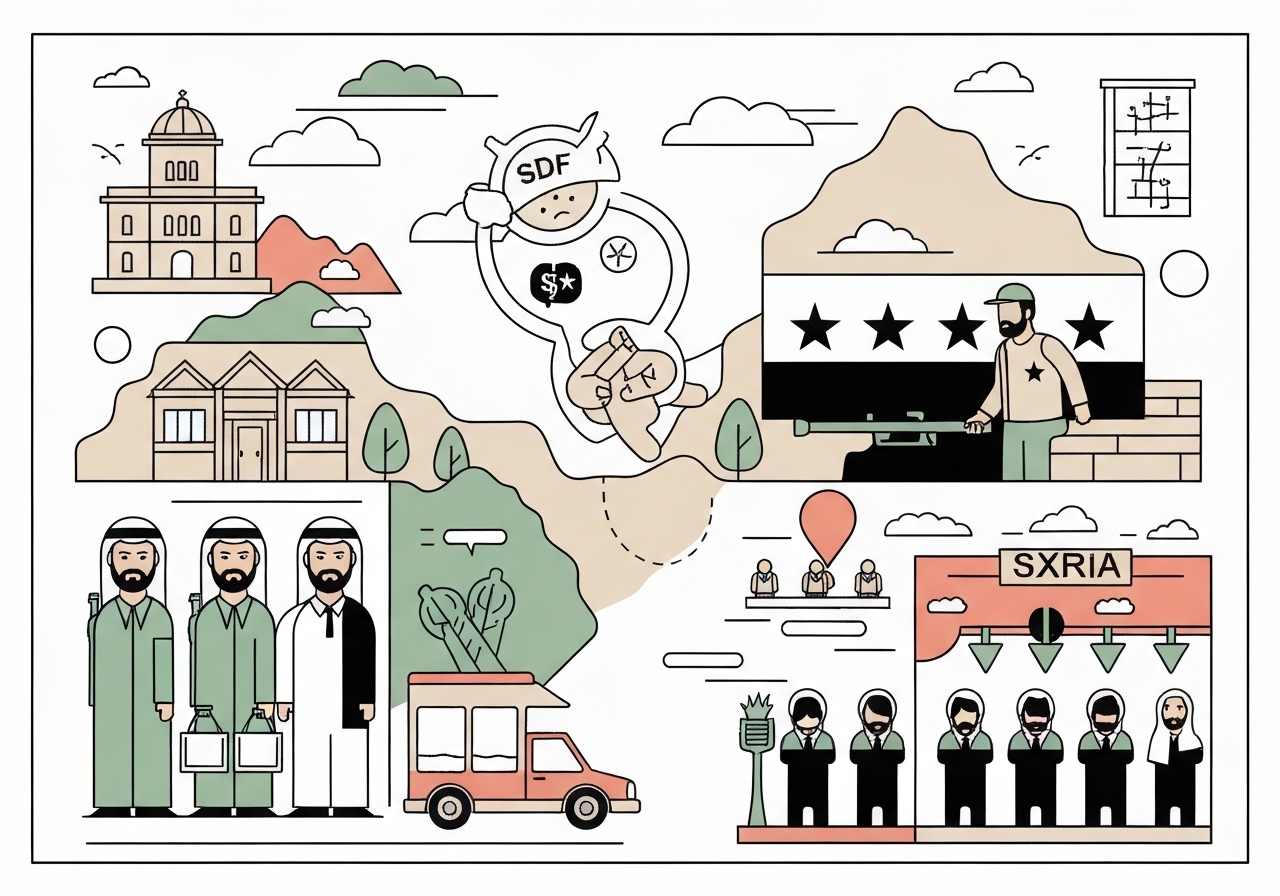
Lead: The Syrian government and the Kurdish-led Syrian Democratic Forces (SDF) announced an immediate nationwide ceasefire on a 14-point integration agreement reached in Damascus on Sunday. The deal — described by Syrian state media as returning near-full control of the country to Damascus — covers administration of al-Hasakah, Deir Ezzor and Raqqa and the handover of border crossings, oil and gas facilities. SDF commander Mazloum Abdi confirmed the meeting and said he will brief Kurdish constituencies after travelling to the capital; his attendance at the initial talks was postponed because of weather. Syrian President Ahmed al-Sharaa said the accord enables state institutions to reassert authority in the northeast.
Key Takeaways
- The agreement is a 14-point framework that includes an immediate nationwide ceasefire and plans to integrate SDF personnel into Syria’s defence and interior ministries after vetting.
- Damascus will assume control of civilian institutions, border crossings and oil and gas fields in al-Hasakah, Deir Ezzor and Raqqa, areas long administered by the Kurdish-led autonomous administration.
- Syria will take responsibility for prisons and detention camps holding tens of thousands of foreign Islamic State (IS) fighters and their families, according to the agreement.
- The deal includes formal recognition of Kurdish cultural and linguistic rights, including Kurdish as an official language and recognition of the Kurdish new year as a national holiday—the first formal Kurdish rights recognition since 1946.
- The US special envoy to Syria, Tom Barrack, attended talks in Damascus and praised the agreement as a step toward a “unified Syria.”
- SDF withdrawal preceded Syrian government advances into Raqqa and nearby oil facilities earlier on Sunday, easing Damascus’s physical re-entry to those areas.
- This arrangement follows months of stalled negotiations and a prior failed integration attempt; the deal reaffirms Syria’s participation in the US-led coalition against IS.
Background
During Syria’s civil war the Kurdish-led SDF established a semi-autonomous civil administration across large parts of northeastern Syria, backed materially and politically by the United States as its partner against the Islamic State group. With US support the SDF expelled IS from much of the region and administered a mixed Kurdish and Arab population, creating parallel governance structures that endured through a decade of conflict.
Damascus has long insisted that militia control of territory and national resources is unacceptable; state officials framed the agreement as restoring sovereign authority over roughly a quarter of Syrian territory and its key economic assets. Previous attempts to fold SDF forces into state institutions stalled, leaving a protracted political stalemate and intermittent local clashes in recent months.
Main Event
In Damascus, President Ahmed al-Sharaa and SDF representatives signed the 14-point document that lays out the ceasefire and steps for institutional integration. Syrian state media reported the government would retake administration of civil services, border points and hydrocarbon fields that underpinned Kurdish self-rule. Al-Sharaa characterized the move as necessary to reunify state control.
SDF commander Mazloum Abdi confirmed the talks in a televised address and on Kurdish broadcaster Ronahi, saying the deal aims to prevent a broader war and preserve the SDF’s achievements and some of the administration’s specific characteristics. Abdi’s initial in-person attendance was delayed by weather; he said he would travel to Damascus and brief Kurdish constituencies after his return.
The agreement sets a process for SDF military and security personnel to be absorbed into the ministries of defence and interior after vetting. Damascus will also assume management of prisons and camps containing large numbers of foreign IS suspects and families, an issue that has raised international security and humanitarian concerns.
According to reports, Syrian forces moved into Raqqa and adjacent oil infrastructure following an SDF pullback on Sunday, allowing Damascus to physically reassert presence ahead of formal integration measures. Tom Barrack, the US special envoy, attended meetings in Damascus and described the outcome as progress toward unity.
Analysis & Implications
The agreement represents a major political shift: it moves the de facto partition created during the war toward a formal reintegration process under Damascus authority. For the Syrian state, regaining control of oil fields, border crossings and civil institutions bolsters fiscal capacity and strategic depth, potentially improving its bargaining position domestically and regionally.
For the Kurds and local populations, the deal offers formal cultural concessions—language recognition and a national holiday—that could be politically significant if implemented. However, these concessions are procedural on paper and will require codified legal guarantees and administrative follow-through to translate into durable rights.
Security integration raises practical challenges. Vetting SDF personnel for incorporation into defence and interior ministries may be lengthy and contentious, and differing chains of command, local loyalties and the legacy of US training will complicate operational integration. Control of detention facilities also shifts responsibility for thousands of foreign IS suspects to Damascus, prompting international concerns about camp management, repatriation and legal processes.
Internationally, the deal may realign local power balances: it signals a reduced US footprint in northeast Syria as Damascus reasserts control, while reaffirming Syria’s nominal participation in the US-led anti-IS coalition. Regional actors will watch closely for how resource control and institutional access affect reconstruction, sanctions relief prospects and diplomatic leverage.
Comparison & Data
| Item | Pre-agreement | Post-agreement (planned) |
|---|---|---|
| Territorial administration | SDF autonomous administration across large parts of northeast | Syrian state institutions reassert control in al-Hasakah, Deir Ezzor, Raqqa |
| Security forces | SDF as primary local security actor | SDF personnel integrated into defence and interior after vetting |
| Prisons/camps | Managed by local SDF-affiliated authorities | Damascus assumes responsibility for camps holding tens of thousands |
| Cultural rights | Local recognition in practice | Plan to grant Kurdish official language status and national holiday |
These comparative points show the intended shift from autonomous local control to formal state administration. Implementation timelines, vetting criteria and legal changes will determine whether the plan produces lasting reintegration or a new form of contested authority.
Reactions & Quotes
This agreement is a step toward a unified Syria and a necessary move to stabilise the northeast.
Tom Barrack, US special envoy (comment at Damascus talks)
Barrack framed the deal as constructive; US comments signal diplomatic acceptance of a negotiated transition, though the depth of future US involvement remains uncertain.
We accepted a ceasefire to prevent a wider war and will explain the details to the Kurdish people when I return to the region.
Mazloum Abdi, SDF commander (televised and Kurdish TV statements)
Abdi emphasized conflict avoidance and the need to protect SDF “achievements” even as formal integration proceeds. His comments indicate SDF intent to secure political and social protections during the transition.
Unconfirmed
- The precise vetting criteria and timeline for integrating SDF personnel into Syrian defence and interior ministries have not been published and remain unspecified.
- The operational details and budgetary arrangements for administering oil and gas fields under Damascus control are not yet disclosed.
- Independent verification of the number of foreign IS fighters and family members held in camps and the plan for their legal processing is pending confirmation from international monitoring sources.
Bottom Line
The Damascus–SDF agreement marks a significant reconfiguration of authority in northeast Syria: it aims to end active hostilities, fold Kurdish-led structures into state organs, and transfer control of strategic resources and detention facilities to the central government. If implemented in full, it would restore much of Syria’s territorial administration to Damascus while offering formal cultural recognitions to Kurdish communities.
However, the agreement’s durability depends on concrete legal guarantees, transparent vetting and resource-management arrangements, and international engagement on security and humanitarian aspects—particularly the fate of tens of thousands held in camps. Close monitoring and clear implementation milestones will determine whether the deal reduces conflict and enables reconstruction, or becomes another short-lived political settlement.
Sources
- BBC News (UK broadcaster – news report)