
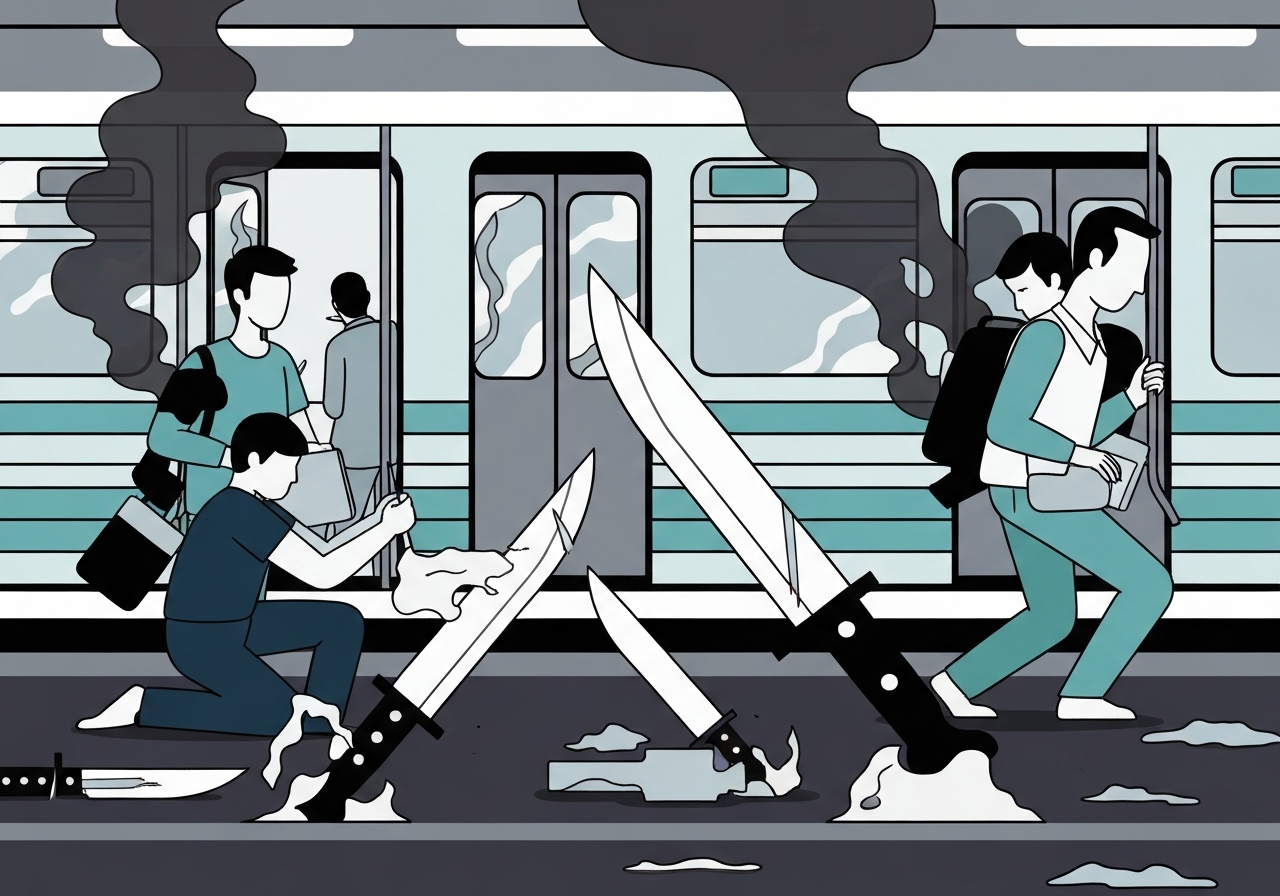
On Friday evening in Taipei, a 27-year-old suspect set off smoke bombs at Taipei Main Station and then moved about 800 metres to Zhongshan metro station, stabbing commuters during the city’s rush hour. Authorities say three people died and nine were injured; the suspect, identified by officials as Chang Wen, later fell from a multi-storey building and died. Taiwanese Premier Cho Jung-tai and President William Lai vowed an urgent investigation as police increased security at transit hubs and airports. Motive remains undetermined while investigators probe the suspect’s background and possible links.
Key Takeaways
- Three people were killed and nine injured in the attack during Friday evening rush hour, according to government statements.
- The suspect, identified by officials as 27-year-old Chang Wen, set off smoke bombs at Taipei Main Station before moving to Zhongshan station about 800 metres away.
- Authorities reported the suspect later died after falling from a multi-storey building; police are investigating whether the fall was related to pursuit or a separate action.
- Premier Cho Jung-tai ordered stepped-up security at metro and railway stations and airports immediately after the incident.
- This type of mass stabbing is rare in Taiwan; the last comparable attack in Taipei occurred in 2014 and left four people dead.
- Videos circulated on social media showed a person in dark clothing throwing smoke devices and carrying a large knife, prompting panic among commuters and passersby.
- Investigators have said they will review the suspect’s background and relationships to determine motive and whether others were involved.
Background
Taiwan typically records low rates of violent crime compared with many peers, and mass-casualty stabbings are uncommon. The capital was last struck by a similar incident in 2014, when a single assailant killed four people on an underground train, a case that shaped later public debate about mental health, public safety and sentencing policy. Taiwan’s dense urban transit corridors—heavy with commuters during morning and evening peaks—are recognized as points of vulnerability for any rapid, opportunistic attack.
The nation’s security apparatus has long balanced open, accessible public spaces with policing and surveillance measures that emphasize prevention and low intrusion. Taipei Main Station functions as a major multi-modal hub that links trains, the metro, and an underground shopping street—making it both strategically important and potentially crowded. Government officials, transit authorities and civil society groups have previously called for targeted measures after high-profile incidents to improve threat detection and emergency response.
Main Event
According to official briefings, the suspect first detonated smoke devices at Taipei Main Station, a central transport node connected to a busy underground retail concourse. Witness video on social platforms showed people running and shielding themselves as smoke spread across platforms and streets. Authorities say a man who intervened to stop the attacker was struck with a blunt object and later died in hospital.
The attacker then walked about 800 metres to Zhongshan metro station in a busy shopping area, where he set off additional smoke devices and proceeded to stab multiple people. Emergency services and police arrived on the scene amid chaotic evacuations; injured victims were taken to nearby hospitals. Officials confirmed nine people were wounded and three subsequently died of their injuries.
After the assaults, police located the suspect at a multi-storey building; officials state he later fell from that building and died. Authorities have described the fall as the point at which the suspect was found deceased and have opened inquiries into the circumstances surrounding his death. Officials, including Premier Cho, said they would investigate the suspect’s background, communications and any possible accomplices.
Analysis & Implications
Short-term, the attack prompted an immediate security response: police increased patrols and checkpoints at metro and railway stations and tightened controls at airports. That rapid tactical shift reflects a standard crisis posture aimed at preventing copycat incidents and reassuring the public. Transit operators face an operational trade-off between increasing visible security and maintaining smooth passenger flow—especially in a dense urban system where mass screening is difficult.
Politically, the government must balance decisive action with careful fact-finding. Rapid policy changes—such as more intrusive screening or curfews—risk public pushback if they are perceived as disproportionate. Conversely, perceived laxity could erode public confidence, particularly after an event during peak commuting hours. Officials will likely accelerate reviews of emergency protocols, staff training at stations, and the presence of first responders at key hubs.
Economically and socially, even isolated violent events can ripple through sectors dependent on urban foot traffic, including retail and hospitality in affected districts. The Zhongshan shopping area and businesses around Taipei Main Station may see short-term declines in customers while public confidence is reassessed. Over the longer term, policymakers may pursue targeted investments in surveillance, mental-health services, and community interventions if investigations point to identifiable systemic vulnerabilities.
Comparison & Data
| Incident | Year | Fatalities | Injuries |
|---|---|---|---|
| Current Taipei metro attack | 2025 | 3 | 9 |
| Taipei underground train attack | 2014 | 4 | several |
The table compares the immediate human toll of the current attack with the 2014 case, which left four dead and multiple injured. While raw counts differ, both events occurred in transit environments during periods of public activity, highlighting consistent points of exposure. Authorities will examine timelines, response intervals and the presence or absence of bystander intervention to identify operational lessons for emergency services and transit operators.
Reactions & Quotes
Government leaders quickly responded to the attack, emphasizing investigation and public safety measures before detailed findings were available.
“We will investigate [the suspect’s] background and associated relationships to understand his motives and determine if there are other connected factors.”
Premier Cho Jung-tai (official statement quoted by news agency)
The premier’s comment framed the immediate government priority—establishing motive and any wider network—while also signaling increased security measures at transit and aviation nodes.
“We are treating this with the utmost seriousness and will move swiftly to support victims and strengthen protections across the transport network.”
President William Lai (public statement)
The president’s statement underlined both victim support and a commitment to systemic safeguards, a common dual focus after mass-casualty events intended to reassure the public and limit panic.
Unconfirmed
- Whether the suspect acted alone remains unconfirmed; investigators are still examining communications and associations for possible accomplices.
- The motive for the attack has not been established publicly; official statements describe motive as pending further investigation.
- Details about the circumstances of the suspect’s fall from the building and whether it involved pursuit, attempted suicide, or an accidental collapse are not yet confirmed.
Bottom Line
The attack in central Taipei—three dead, nine wounded—represents a rare but severe breach of the city’s typically low-violence environment. Officials have moved quickly to cordon scenes, increase security at transport hubs and promise a full probe into motive and any wider connections. For residents and commuters, the immediate focus will be on medical care for the injured and clear, verified information from authorities to limit speculation.
Over the coming weeks investigators’ findings about motive, possible links and response timelines will shape policy choices on transit security, mental-health interventions and public-safety communication. While extraordinary events like this are unlikely to become routine, they expose practical vulnerabilities in dense urban transit systems and test the balance between openness and protective measures.
Sources
- BBC (news article) — reporting on the incident, casualties, and official statements.
- Reuters (news agency) — referenced by officials in media briefings for quoted statements and situational updates.