
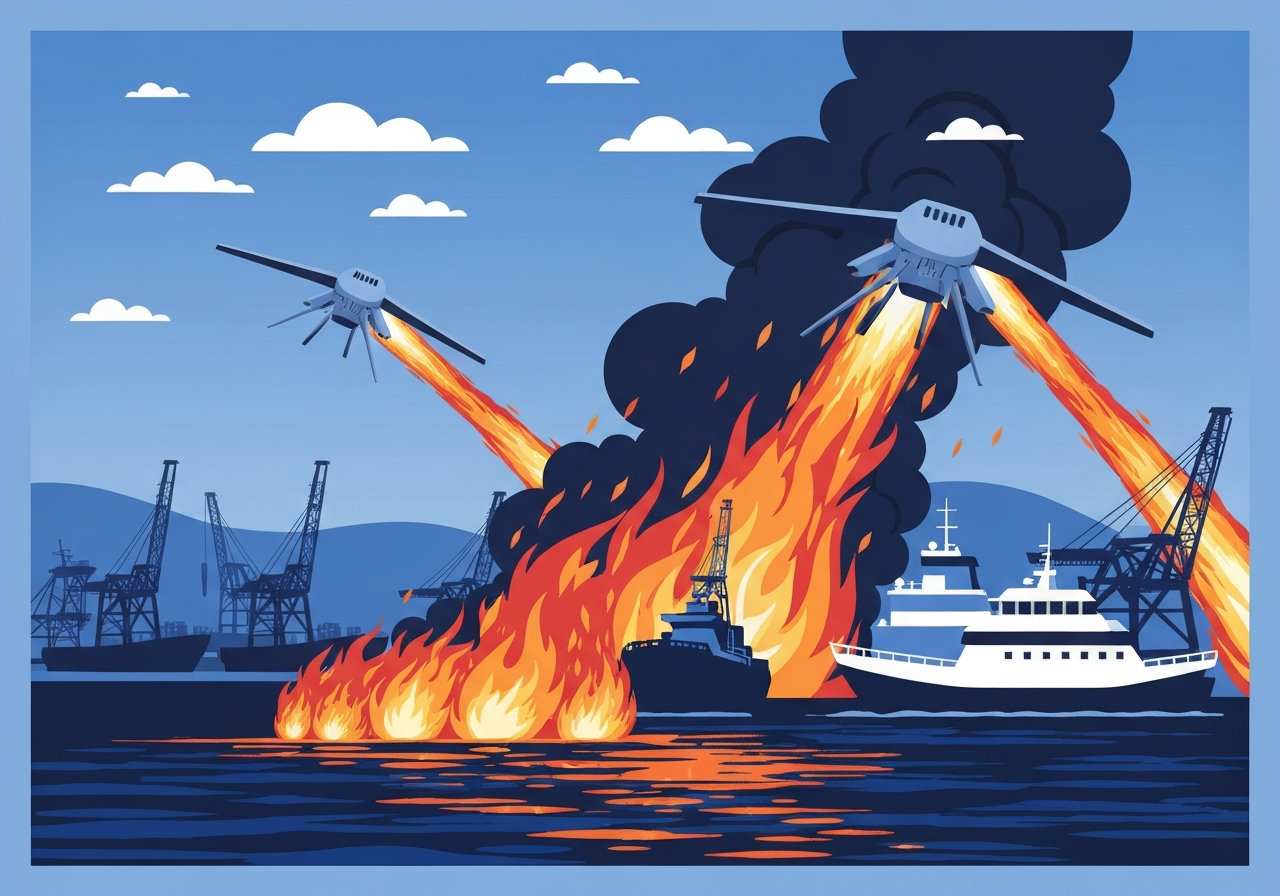
Lead: A Ukrainian long-range drone strike on Sunday set fires at the Taman port in Russia’s Krasnodar region, officials said, injuring two people and damaging an oil storage tank, a warehouse and terminals. The incident occurred just days before U.S.-brokered talks between Russian and Ukrainian envoys in Geneva, scheduled for Tuesday and Wednesday. Ukrainian and Russian statements framed the assaults as part of broader campaigns targeting each other’s logistics and civilian infrastructure. Local and regional officials reported additional damage in Ukraine from falling debris of Russian drones, disrupting power and water supplies in the Odesa region.
Key Takeaways
- Attack location: Taman port, Krasnodar region (Russia); two people wounded, according to regional Governor Veniamin Kondratyev.
- Damage reported: oil storage tank, a warehouse and terminal facilities at the port were hit and caught fire.
- Ukrainian intent: Kyiv has been striking long-range Russian energy and export infrastructure to reduce Moscow’s oil revenue stream.
- Reciprocal strikes: Debris from Russian drone operations damaged civilian and transport infrastructure in Odesa region, causing power and water disruptions.
- Diplomatic timing: The strikes came ahead of U.S.-brokered talks in Geneva on Tuesday and Wednesday, days before the Feb. 22 fourth anniversary of Russia’s full-scale invasion.
- Political tensions: Ukrainian leaders and Western officials emphasized that security guarantees remain a central unresolved issue in any negotiated settlement.
Background
The conflict between Russia and Ukraine entered a sustained, large-scale phase nearly four years ago, with Moscow launching a full-scale invasion that escalated fighting across multiple fronts. Since then, Kyiv has increasingly used long-range unmanned aerial systems to strike infrastructure it views as supporting Russia’s war effort, including energy terminals and export facilities. Russian forces, in turn, have executed strikes on Ukrainian energy and civilian infrastructure, a campaign Kyiv and Western allies say seeks to deprive civilians of heat, light and water during winter months. Diplomatic attempts to negotiate an end to hostilities have been intermittent and inconclusive, with previous U.S.-led rounds — including talks in Abu Dhabi — failing to close gaps on core issues like territory and security guarantees.
International mediators have sought to bring representatives from both capitals together to explore frameworks for ceasefires or longer-term settlements while balancing sanctions, reconstruction aid and security arrangements. The United States has proposed mechanisms such as security guarantees and elements of economic integration for post-conflict Ukraine, while Russia has pressed for territorial concessions and relief from sanctions and asset freezes. These conflicting priorities have made substantive progress elusive, and each new round of negotiations has arrived under the shadow of ongoing military operations and reciprocal strikes.
Main Event
Regional authorities reported that Ukrainian drones struck facilities at the port of Taman on Sunday, igniting fires that spread through an oil tank, adjacent warehouse space and terminal infrastructure. Governor Veniamin Kondratyev said two people were wounded in the attack; local emergency services were dispatched to contain the blaze and assess structural damage. Satellite and open-source imagery analyzed by independent monitors in prior instances have shown how port terminals and storage sites can be vulnerable to aerial strikes, but official confirmation of precise damage patterns often lags.
Separately, officials in Ukraine’s Odesa region said falling debris from Russian drone activity damaged civilian infrastructure and transport links, interrupting electricity and water supplies for some communities. Local authorities worked to restore services and to reroute essential deliveries, describing the disruptions as part of a broader pattern of Russian attacks aimed at degrading civilian utilities. Both Kyiv and Moscow have framed such operations in military terms: Kyiv as striking wartime logistics and revenue sources, Moscow as targeting Ukrainian infrastructure to undermine civilian resilience in winter.
The timing of the Taman strike — immediately before envoys meet in Geneva — added a diplomatic overlay to the incident. U.S. officials organizing the talks have sought to advance agreements while insisting that security guarantees and sequencing of commitments remain key sticking points. Representatives from both sides arrived in Geneva to discuss potential frameworks, but observers cautioned that battlefield dynamics and reciprocal targeting of infrastructure complicate negotiators’ ability to agree on verification, sequencing and enforcement mechanisms.
Analysis & Implications
The strike on a Black Sea export facility underscores a strategic Ukrainian emphasis on hitting economic nodes that fund Russia’s military operations. By targeting storage and terminal capacity, Kyiv aims to reduce Moscow’s ability to generate export revenue, which Western analysts say helps sustain the war effort. If such strikes degrade export throughput, they could pressure Russia economically but also raise commercial and humanitarian concerns for third-party buyers and regional energy markets.
Russia’s continued attacks on Ukrainian utilities — described by Kyiv as efforts to “weaponize winter” — aim to erode civilian morale and complicate Ukraine’s domestic resilience. Western officials warn this approach risks escalation by targeting essential services, and they stress the need for backup humanitarian and energy support to mitigate civilian harm. In diplomatic terms, civilian suffering from disrupted utilities can harden negotiating positions and reduce political space for concessions on both sides.
The Geneva talks face a classic sequencing dilemma: Ukraine seeks firm security guarantees up front, while U.S. mediators have signaled a preference for synchronizing multiple agreements to lock in reciprocal steps. This disagreement complicates prospects for a near-term breakthrough. Even if negotiators reach preliminary understandings, verification regimes, enforcement mechanisms and the fate of occupied territories—especially parts of Donbas—remain formidable barriers to a durable accord.
Comparison & Data
| Item | Recent pattern |
|---|---|
| Targets struck by Ukraine | Energy terminals, storage facilities, transport nodes |
| Russian strikes in Ukraine | Power grid components, water infrastructure, civilian sites |
| Diplomatic rounds since 2022 | Multiple attempts (including Abu Dhabi rounds) with limited resolution |
These categories illustrate a tit-for-tat dynamic: Ukraine focuses on economic interdiction, while Russia concentrates on degrading civilian infrastructure. Analysts note that such reciprocal targeting often prolongs conflict by intertwining military objectives with economic and humanitarian pressure.
Reactions & Quotes
Western and Ukrainian leaders framed the timing of the strike in light of upcoming talks, emphasizing unresolved security questions as central to any settlement. Below are representative public remarks with context.
“Unless we have real security guarantees on whatever peace agreement is ultimately determined, we are going to be here again.”
Sen. Jeanne Shaheen, U.S. Senate Foreign Relations Committee (quoted at Munich Security Conference)
Shaheen’s comment, delivered at the Munich Security Conference, echoed Kyiv’s insistence that enforceable security commitments must precede or be tightly coupled with territorial and economic arrangements to prevent renewed aggression.
“If we want a sustainable peace then we need concessions also from the Russian side.”
Kaja Kallas, EU foreign policy chief (Munich Security Conference)
Kallas cautioned against unilateral concessions to Moscow, arguing that European decisions on sanctions and asset freezes are sovereign and will factor into any agreement, particularly if negotiators hope to secure lasting stability.
“Questions remain over future security guarantees and how a free trade zone would operate in Donbas.”
Volodymyr Zelenskyy, President of Ukraine (Munich Security Conference remarks)
Zelenskyy raised concerns about how proposed economic arrangements would apply to territories whose status is contested, signaling that territorial questions remain core obstacles to compromise.
Unconfirmed
- Whether the strike at Taman specifically aimed to render the terminal unusable long-term rather than temporarily disrupting operations remains unconfirmed.
- No independent verification has yet confirmed the full extent of structural damage to the oil tank and terminals beyond regional official statements.
- Details about the exact weapon types used in the Taman attack and the Odesa debris incidents have not been publicly corroborated by independent analysts.
Bottom Line
The Taman port strike and reciprocal damage in Odesa illustrate how battlefield tactics and diplomacy remain tightly linked: kinetic actions are being used to shape leverage at the negotiating table even as envoys meet in Geneva. Kyiv’s targeting of energy export infrastructure is intended to cut funding streams for Moscow’s war effort, while Russian attacks on Ukrainian utilities aim to impose civilian pressure during winter.
These dynamics make a negotiated settlement harder: each side’s actions both undermine trust and raise the political costs of compromise. Observers should watch whether negotiators can agree on sequencing—security guarantees versus economic concessions—and whether international monitors can secure enforceable verification measures to prevent a rapid return to hostilities.
Sources
- AP News (U.S. news organization) — original reporting on the Taman strike and Geneva talks.
- AP News: Russia-Ukraine hub (U.S. news organization) — ongoing coverage and context.