
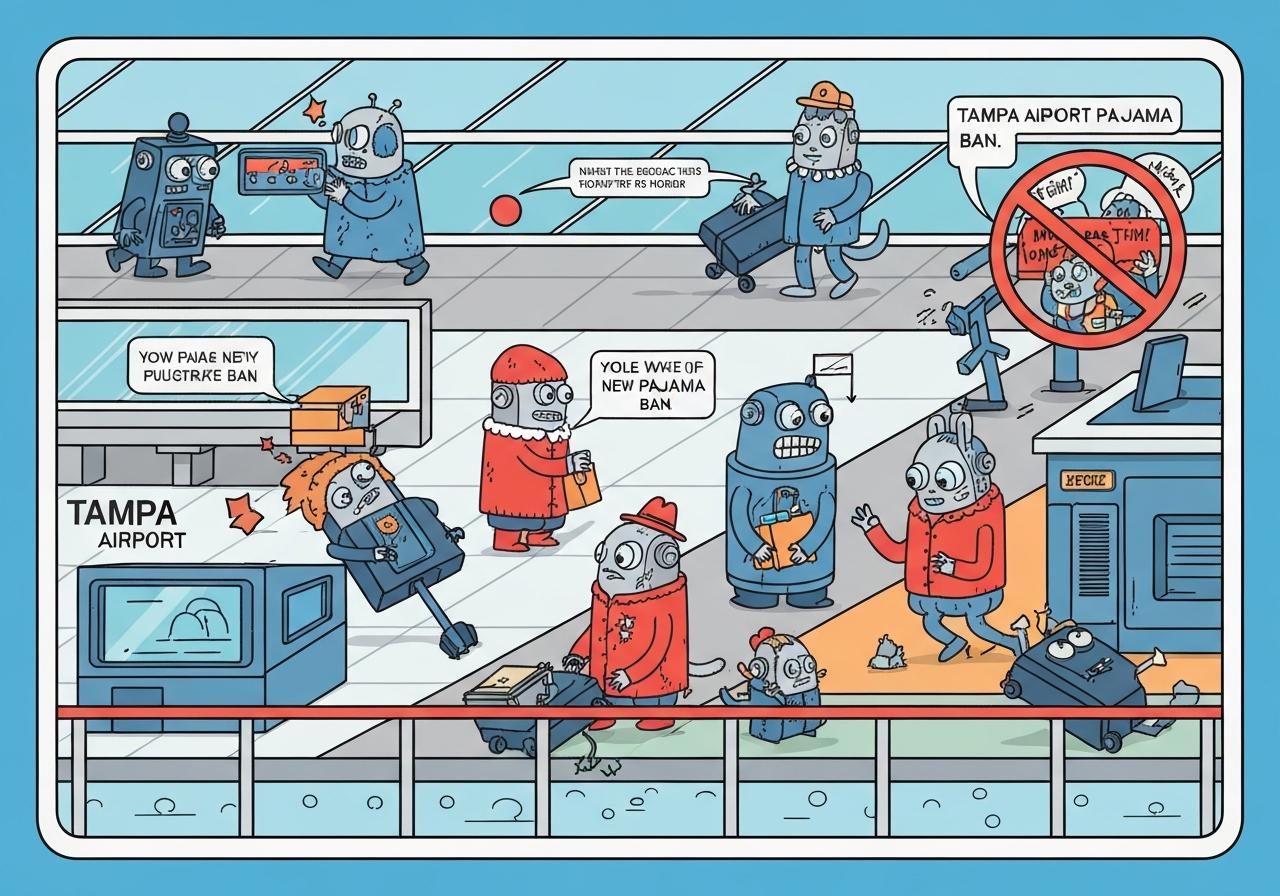
Lead: On February 26, 2026, Tampa International Airport used an X (formerly Twitter) post to announce a new public-service-style dress-code campaign that targets travelers wearing pajamas. The airport framed the move as a continuation of a previous effort to discourage Crocs on its property, arguing the change responds to passenger feedback and airport image concerns. The post stopped short of detailing formal enforcement, leaving the announcement as a public appeal rather than a codified rule. The message immediately sparked debate online about practicality, passenger comfort and where airports can draw the line on attire.
Key Takeaways
- Tampa International Airport posted a PSA on X on February 26, 2026 announcing it will ban pajamas from the terminal, following an earlier campaign about Crocs.
- The airport’s message used the phrase “We’ve seen enough. We’ve heard enough,” directly quoting the social-media post that launched the campaign.
- No formal enforcement mechanism or penalty was outlined in the announcement; the tone suggests a recommendation more than a regulation.
- Major U.S. carriers—United, American, Spirit, Southwest, Delta and Hawaiian—already require passengers to be “properly clothed,” a phrase used in cabin policies to bar offensive clothing and barefoot travel.
- The PSA mixes marketing and policy signaling: Tampa frames the effort as improving the terminal experience while relying on social pressure rather than stated rules.
Background
Airport dress codes are uncommon as formal, site-wide regulations; most attire rules appear in airline conditions of carriage or in venue-specific security advisories. Historically, airports have focused on safety and security rather than policing fashion, so Tampa’s public-facing campaign marks a departure in tone if not in legal authority. The social-media push follows the airport’s earlier, widely publicized campaign discouraging Crocs, which the airport described as an effort to change traveler behavior rather than to impose fines.
Airlines have long reserved the right to refuse boarding to passengers whose clothing poses health, safety or decorum concerns; typical wording is that passengers must be “properly clothed,” which commonly excludes offensive graphics, nudity and travel while barefoot. Still, those airline rules are applied onboard and during boarding, and they rarely extend to terminal spaces outside of airline-controlled zones. Tampa’s PSA therefore occupies a gray area between airline policy, airport stewardship and public relations.
Main Event
On February 26, 2026, Tampa International Airport posted a message on X announcing a campaign to make the terminal both Crocs-free (a prior initiative) and now pajama-free. The post framed pajamas as an aesthetic and operational concern for daytime terminal environments, using conversational language and an exhortation for travelers to change habits. The airport also invoked a lighthearted cultural reference to emphasize social norms around daytime attire.
The announcement did not specify how the ban would be implemented — whether through signage, staff requests, policy language updates, or barring entry — and airport officials did not follow the post with a formal regulatory statement. Observers noted the timing and platform: social networks allow quick audience engagement but do not substitute for formally adopted rules published by airport authorities or local regulators.
Reactions unfolded rapidly online. Supporters said the PSA could improve the experience for travelers seeking a more polished environment, while critics argued that such measures risk penalizing those who choose sleepwear for comfort, people with certain medical needs, or travelers on long-haul itineraries. The breadth of responses highlighted a tension between airport branding goals and everyday traveler convenience.
Analysis & Implications
Tampa’s decision to announce a pajama ban via social media functions primarily as reputation management: it signals a desired standard for the airport’s image and attempts to mobilize social norms rather than rely on enforceable rules. From a legal and operational perspective, airports typically lack broad statutory authority to dictate dress for all visitors; enforcement would likely require coordination with tenant airlines, ground handlers, and security staff. The absence of an enforcement plan suggests Tampa is testing public reaction before committing to any operational changes.
For passengers, the campaign raises practical questions. Travelers choose sleepwear for comfort, for long-flight schedules, or for health-related reasons. Blanket discouragement can create friction at the gate if airline staff attempt to apply new social expectations inconsistently. That could shift decision-making onto frontline staff, who must balance customer service with policy interpretation.
Broader implications reach airport branding and competitive positioning. Airports increasingly curate passenger experience — through retail, lounges and aesthetics — as non-aeronautical revenue grows. A visible dress-code campaign can be a low-cost way to differentiate a hub, but it risks alienating segments of the traveling public if perceived as exclusionary or performative. How other airports respond will shape whether this becomes a one-off PR effort or a wider trend.
Comparison & Data
| Policy/Actor | Scope | Notes |
|---|---|---|
| Tampa International Airport (PSA) | Terminal signage & social campaign | Targets Crocs (prior) and pajamas; enforcement not detailed |
| Major U.S. Carriers (industry practice) | Onboard/boarding | Require passengers to be “properly clothed”; commonly bar offensive clothing and barefoot travel |
| Typical Airport Practice | Safety & security-focused | Few formal, sitewide fashion rules; emphasis on behavior that affects safety or operations |
These distinctions show that airport messaging and airline rules occupy different practical domains: airlines enforce condition-of-carriage standards at the point of travel, while airports shape the overall environment through signage, staff guidance and public campaigns. Tampa’s message narrows a cultural issue into a terminal-level initiative without clear operational teeth.
Reactions & Quotes
Officials and the public reacted in varied ways; below are representative official-language excerpts and contextual responses.
“We’ve seen enough. We’ve heard enough.”
Tampa International Airport (X post, Feb 26, 2026)
The tweet’s blunt phrasing was intended to create a viral moment; the airport paired humor and admonition to prompt social-media engagement rather than announce a formal ordinance.
“Passengers must be properly clothed.”
Major U.S. carriers (passenger policy summaries)
That language summarizes airline conditions of carriage that govern behavior in the cabin and during boarding, but airlines typically do not police airport terminal fashion outside of boarding contexts.
“A PSA is one thing; consistent enforcement is another.”p>
Public reaction (social commentary)
Many travelers noted the difference between a viral post and operational rule-making, asking who would be asked to change and how consistently such requests would be applied.
Unconfirmed
- Whether Tampa International Airport will introduce formal penalties, staff directives or signage enforcement for pajamas is not confirmed by the PSA.
- It is unclear if airlines operating at Tampa have been consulted in advance or will coordinate enforcement at gates or checkpoints.
- Claims that the campaign will reduce specific operational issues (e.g., sanitation or passenger complaints) lack publicly available supporting data.
Bottom Line
Tampa International Airport’s February 26, 2026 PSA banning pajamas is best read as a public-relations initiative that seeks to shape traveler behavior through social norms rather than through immediate, codified enforcement. The move highlights tensions between passenger comfort, inclusive practices and an airport’s interest in a curated public image.
For travelers and industry observers, the key watch points are whether Tampa translates the PSA into concrete operational guidance, how airlines and frontline staff respond at gates, and whether other airports adopt similar high-profile campaigns. Until enforcement mechanisms or policy updates are published, the announcement remains a signaling exercise with uncertain practical impact.