
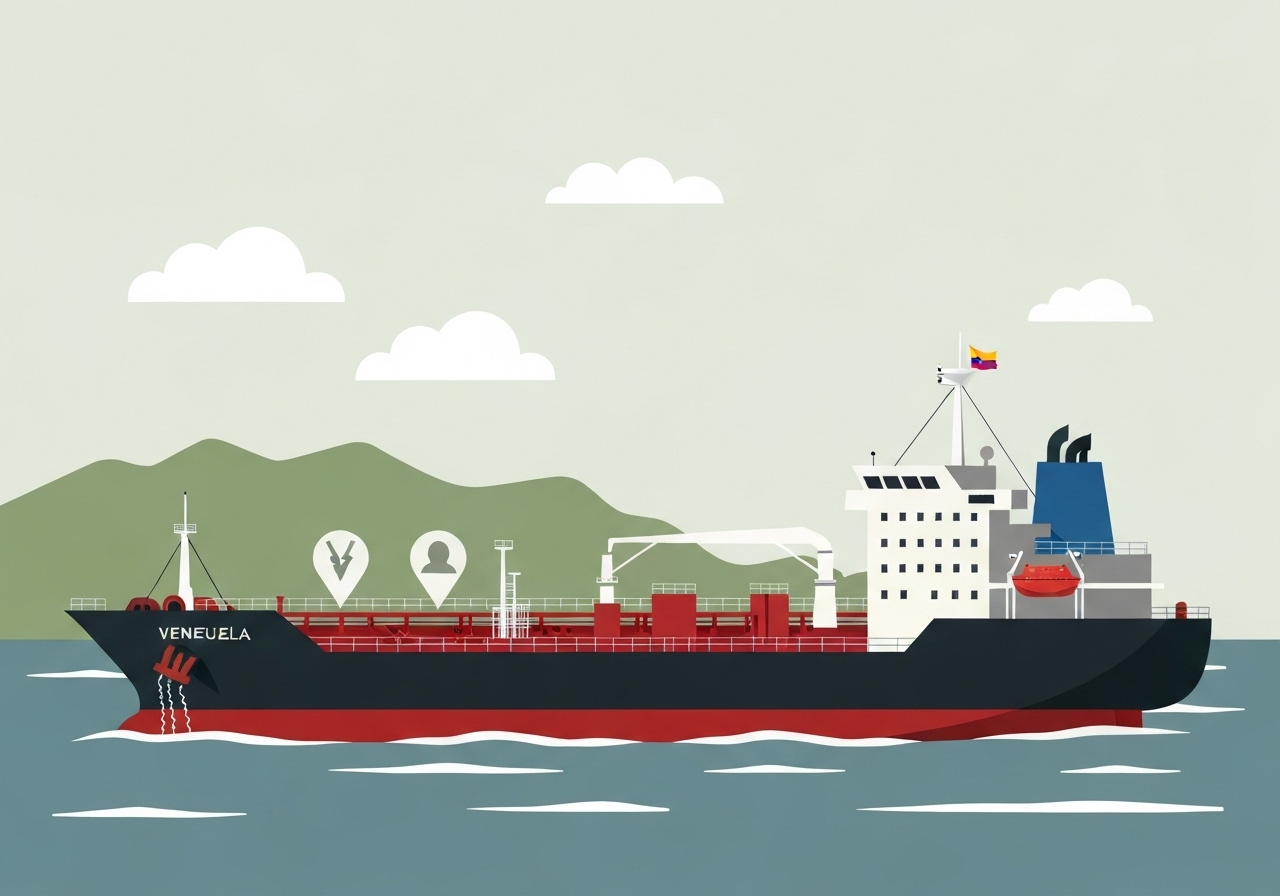
The United States seized a very large crude carrier (VLCC) off Venezuela in a high-profile operation on 11 December 2025, removing a vessel that analysts identify as Skipper and that was carrying about 1.1 million barrels of crude. The ship had been sanctioned by the US in 2022 while operating under a different name and is linked in public records to firms accused of moving Venezuelan and Iranian oil. The action—conducted by US forces from helicopters and maritime units—has intensified an already fraught standoff between Washington and Caracas and raised fresh legal and commercial questions about sanctions enforcement at sea.
Key takeaways
- The seized vessel is identified by maritime analysts as Skipper, a VLCC believed to be carrying roughly 1.1 million barrels loaded in Venezuela’s main export port last week.
- Tracking and public records show the same hull sailed as Adisa and was sanctioned by the US in 2022; ownership records tie it to Triton Navigation Corp, sanctioned in 2022 for Iran-related oil transport.
- Satellite imagery dated 18 November placed the ship off Venezuela, while automatic tracking data appeared to transmit a false position—an oft-used tactic among so-called shadow tankers.
- Approximately half the cargo was documented as owned by a Cuban state-run importer, according to Venezuelan state oil company documents seen by AP.
- The US has sanctioned more than 170 vessels it accuses of illicit oil movements; other governments and organisations have listed many more in recent years.
- The dramatic boarding footage circulated by US authorities has heightened political rhetoric and may raise insurance and freight costs for operators handling sanctioned crude.
- Venezuela called the seizure an act of piracy; US officials frame it as enforcement of sanctions and maritime law—both positions carry legal and diplomatic consequences.
Background
Tensions between Washington and Caracas have escalated amid an expanded US military posture in the region this year, including the deployment of the aircraft carrier USS Gerald R. Ford and an accompanying strike group. US officials have also carried out lethal strikes on vessels they allege were involved in drug smuggling, operations that have drawn scrutiny in Congress and criticism from rights organisations. The broader US campaign has mixed law-enforcement and geopolitical tones, driven by sanctions on oil and shipping networks tied to Iran, Russia and Venezuela.
Sanctions enforcement at sea has increasingly targeted a loosely organised “shadow fleet” of tankers that use obscured identities, frequent renamings and falsified flag registrations to move embargoed cargoes. Governments and analysts say those tactics complicate oversight and raise the costs and risks of transporting sanctioned crude. Venezuela, whose state oil company remains central to its economy, has relied on discounted sales and intermediaries to keep exports flowing despite restrictions and competition from sanctioned Russian and Iranian barrels.
Main event
US forces intercepted the VLCC identified as Skipper and executed a helicopter-borne boarding, images of which were released by US agencies. Analysts say the ship had been in the Venezuelan port of José for weeks and departed last week with most of its cargo aboard; tracking feeds had reported inconsistent positions, while satellite photos placed the vessel in Venezuelan waters on 18 November. The action unfolded on 11 December 2025 and was promoted widely by US accounts as evidence of active sanctions enforcement.
Maritime tracking databases and sanctions lists show the hull previously sailed under the name Adisa and was designated by US authorities in 2022 for involvement in Iran-related shipments. Public registries list Triton Navigation Corp as the registered owner; Triton was itself sanctioned in 2022 for alleged participation in transporting Iranian oil. TankerTrackers, a private analyst group, has reported that since 2021 the vessel has carried nearly 13 million barrels of Iranian and Venezuelan oil while operating within the shadow fleet.
Venezuelan officials condemned the seizure, describing it as theft and an act of international piracy, and have pointed to the Cuban ownership records for part of the cargo as additional proof of political motives. US spokespeople framed the interception as consistent with existing sanctions and maritime law. The public release of boarding footage—shared with music and rapid editing—has amplified the episode and fed competing narratives about motive and legitimacy.
Analysis & implications
Legally, the seizure rests on US sanction authorities and maritime interdiction powers; however, such actions raise complex jurisdictional and evidentiary questions when ships change names, flags and beneficial owners. If prosecutions or asset forfeitures follow, investigators will need to show clear chains of custody for cargo and demonstrate that specific transactions violated US or international law. That evidentiary burden is higher when operators employ sophisticated obfuscation tactics.
Economically, the encounter is likely to increase operating costs for vessels and owners willing to carry sanctioned barrels. Insurers and charterers may demand higher premiums to compensate for seizure risk, and shadow-fleet operators will likely factor those costs into freight rates or require more opaque payment arrangements. For Venezuela, already forced to offer steep discounts to maintain buyers, rising transport costs will further reduce net export revenue.
Geopolitically, the operation sharpens a confrontational posture between the US and Maduro’s government and has potential spillover effects across the Caribbean and Atlantic shipping lanes. Regional governments may face pressure to align with one narrative or the other; shipping registries and flag states could see renewed scrutiny. The incident also signals to Iran, Russia and other actors that maritime interdictions remain an active tool of US policy.
Comparison & data
| Metric | Figure / note |
|---|---|
| Reported cargo aboard Skipper | ~1.1 million barrels (loaded in Venezuela) |
| Ship’s reported transport since 2021 | Nearly 13 million barrels (Iranian & Venezuelan oil) |
| US-designated vessels (publicly listed) | More than 170 sanctioned by the US |
| US carrier presence cited | USS Gerald R. Ford strike group with >4,000 personnel |
The table summarises the principal figures cited in public statements and tracking databases. These numbers underline why the ship attracted enforcement attention and how the interception could alter commercial calculations for shipping and insurance markets.
Reactions & quotes
“This constitutes a blatant theft and an act of international piracy.”
Government of Venezuela (statement)
Venezuelan officials used this language to frame the seizure as a resource grab and to mobilise domestic and diplomatic support. The statement underscores Caracas’s long-standing position that US actions aim at Venezuela’s energy resources.
“Skipper has transported nearly 13 million barrels of Iranian and Venezuelan oil since joining the global dark fleet of tankers in 2021.”
Samir Madani, co-founder TankerTrackers.com (analysis)
TankerTrackers and other private monitors have tracked the vessel’s movements and flagged its pattern of voyages between Iran, Venezuela and intermediary ports—data that US authorities cite when justifying sanctions enforcement.
Video of the boarding was posted by US accounts and widely distributed to highlight the interdiction.
Department of Homeland Security / US public release
US agencies framed the imagery as an operational success and a deterrent to others involved in moving sanctioned cargoes; critics say the theatrical presentation risks politicising enforcement actions.
Unconfirmed
- Whether US authorities had additional undisclosed intelligence—such as financial transaction records or classified surveillance—directly linking the cargo to sanctionable transactions remains publicly unconfirmed.
- The precise chain by which the vessel adopted a false Guyanese flag and who arranged the falsification has not been independently verified in public records.
- Full ownership and beneficial-interest details for portions of the cargo, including the ultimate buyer(s) beyond the Cuban importer referenced in state documents, have not been independently corroborated.
Bottom line
The Skipper seizure is notable for its scale, the vessel’s sanctions history and the public, militarised presentation of the operation. It reinforces that maritime interdiction is an active element of US policy toward sanctioned oil flows but also raises legal and diplomatic questions that will play out in courts, capitals and commercial markets.
For Venezuela and buyers reliant on discounted crude, the episode will likely increase the cost and complexity of exports. For insurers, charterers and shadow-fleet operators, the incident signals heightened risk and the need for more elaborate risk premiums or operational secrecy. Watch for follow-on legal filings, further vessel or company designations, and responses from regional governments that will shape how sanctions are implemented at sea going forward.
Sources
- The Guardian (news report)
- MarineTraffic (maritime tracking service)
- TankerTrackers (private maritime analysis)
- Planet Labs (commercial satellite imagery)
- Associated Press (news agency reporting on cargo ownership)