
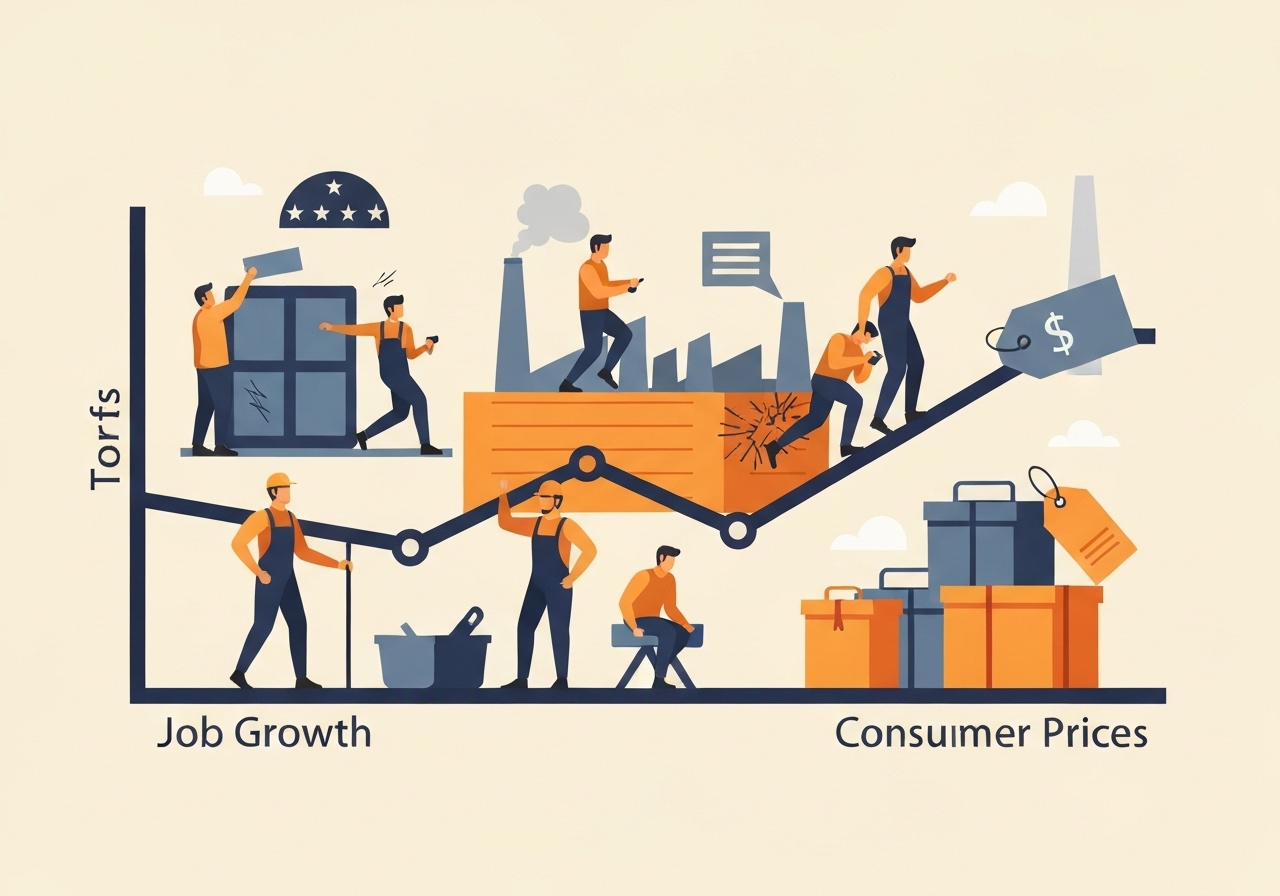
Lead: Last year’s broad tariff campaign under President Donald Trump left a clearer mark on employment than on headline consumer prices. While select imported goods—beef, coffee and tomatoes—saw substantial price increases in 2025, overall inflation remained only modestly changed. At the same time, average monthly job growth slid to its weakest pace in decades outside recession years, and the unemployment rate rose 0.4 percentage points to 4.4% by December 2025. Businesses cite policy uncertainty and shifting cost calculations as central reasons for pausing hiring or reducing payrolls.
Key Takeaways
- Unemployment rose to 4.4% in December 2025, up 0.4 percentage points from a year earlier, according to the December jobs report.
- Average monthly job gains in 2025 were the slowest in decades except during official recessions, reflecting a marked cooling of labor demand.
- Certain import categories—notably beef, coffee and tomatoes—recorded sharp price increases, but aggregate consumer prices showed only modest change for the year.
- Firms report pausing hiring or laying off workers amid uncertainty over tariff levels and frequent policy adjustments.
- Many companies absorbed tariff costs rather than immediately passing them to consumers, a factor that helped limit headline inflation in 2025.
- A pending Supreme Court case could, if decided against the administration, invalidate major levies and potentially lead to retroactive refunds for businesses, though any recovery process would be slow.
Background
Tariff measures introduced and expanded in 2025 represented a major shift in U.S. trade policy, affecting a wide range of imports. Policymakers framed the tariffs as tools to protect domestic producers and rebalance trade, but the repeated adjustments produced a high degree of unpredictability for importers and manufacturers. Historically, trade barriers can raise consumer prices by increasing input costs or by constraining supply; however, pass-through from import duties to retail prices varies by sector and competitive dynamics. Businesses that rely on imported inputs or sell into global supply chains faced recalculations of product profitability and capital planning. Those recalibrations occurred against an economy that had been tightening in 2024, so the tariffs arrived while labor markets were already shifting.
Previous episodes of tariff increases—both in the U.S. and abroad—offer mixed evidence on the balance between price effects and employment impacts. Some sectors with concentrated import exposure see immediate price jumps; others absorb costs or re-route sourcing, muting retail inflation. Labor markets, by contrast, often react to the investment and hiring decisions firms make under uncertainty, which can depress job creation before any pronounced consumer-price effects materialize. Stakeholders include manufacturers, retailers, agricultural exporters, and policymakers at the Federal Reserve and Treasury, all of whom are monitoring both prices and labor indicators as policy and legal developments unfold.
Main Event
Throughout 2025, the administration expanded tariff lists and repeatedly altered duties, creating a shifting policy landscape that complicated long-term planning for firms. According to business reports compiled for the Federal Reserve Bank of Richmond’s Beige Book, several manufacturing contacts said customers curtailed new orders amid tariff uncertainty. That pullback in new business translated into slower hiring and, in some cases, layoffs at production and logistics firms.
Employment data released in December 2025 confirmed the labor-market slowdown: monthly payroll gains averaged at the weakest non-recession levels seen in recent decades, and the unemployment rate increased to 4.4%. Employers cited both softened demand and higher input costs as drivers of slower recruitment. Even sectors not directly exposed to tariffs reported ripple effects through supply chains and consumer spending patterns.
Rather than immediately raising retail prices across the board, many companies absorbed higher tariff expenses to stay competitive or to avoid spooking consumers. That decision has helped keep headline inflation relatively restrained, but it has weighed on corporate profitability and investment plans. Some firms have also shifted sourcing or delayed capital projects while awaiting legal or policy clarity, further slowing job creation.
Analysis & Implications
Economic uncertainty is the thread connecting muted price effects and weakened hiring: firms facing unpredictable input costs and the potential for future tariff reversals prioritize liquidity and flexibility over expansion. When firms delay hiring and new investments, output and productivity growth can suffer, potentially lowering the economy’s growth trajectory. For labor markets, that means fewer openings and slower wage pressure, even if consumers do not immediately see large price increases for most goods.
Sectoral differences matter. Agricultural imports and certain food categories experienced notable retail price jumps, transferring cost pain to consumers in those markets. But in more competitive retail segments or where imported goods compete with domestic substitutes, companies often chose to absorb tariffs to maintain market share. Absorption trades present short-term trade-offs: they protect consumers from sticker shock but erode corporate margins and can prompt cost-cutting measures, including layoffs.
Policy and legal developments will shape the near-term outlook. A potential Supreme Court decision that strikes down major tariff authorities could reverse the tariff regime and lead to claims for refunds, altering firms’ balance sheets and investment incentives. Conversely, continuation or expansion of duties would preserve uncertainty and the incentive to defer hiring. For monetary policy, muted headline inflation but weakening labor markets complicate the Federal Reserve’s dual mandate trade-offs and could influence the timing of rate adjustments.
Comparison & Data
| Metric | 2025 Outcome | Context / Note |
|---|---|---|
| Unemployment rate | 4.4% (Dec 2025) | Up 0.4 percentage points year-over-year per December jobs report |
| Average monthly job growth | Lowest in decades outside recessions | Significantly below 2010s post-recovery norms |
| Import price spikes | Beef, coffee, tomatoes: notable increases | Price pressure concentrated in select categories |
| Headline inflation | Relatively muted | Firms frequently absorbed tariff costs rather than pass them to consumers |
These figures illustrate a divergence: sharper pain in labor-market indicators than in broad consumer-price measures. The table aggregates public-domain findings reported by government releases and regional Fed summaries, which emphasize that effects are uneven across sectors and time horizons.
Reactions & Quotes
“There’s no compelling reason to be out there hiring en masse,”
Sean Snaith, University of Central Florida (economist)
Experts like Snaith argue that heightened policy uncertainty makes conservative hiring strategies rational for firms managing risk in 2025.
“Companies are seeing higher prices, depressing profitability; and in terms of new investment, they’re hesitant because tariffs make a lot of investments that have been profitable unprofitable,”
Dean Baker, Center for Economic and Policy Research (senior economist)
Baker highlights the link from tariff-driven cost increases to reduced investment incentives, which can translate into weaker job creation and slower capital spending.
Unconfirmed
- Precise scale and timeline of potential tariff refunds contingent on the Supreme Court outcome remain unclear and unverified.
- The share of 2025 layoffs directly attributable to tariffs versus other cyclical or firm-specific factors has not been independently quantified.
- Whether firms will ultimately shift higher costs onto consumers if tariffs become permanent is uncertain and depends on future competitive dynamics.
Bottom Line
The 2025 tariff campaign produced a clear economic trade-off: limited broad-based inflation but noticeably weaker labor-market momentum. Firms opted in many cases to absorb tariff costs to protect sales, which held down consumer-price measures while squeezing profitability and suppressing hiring.
Going forward, a key inflection point will be the pending Supreme Court decision and any administrative moves that either lock in or dismantle the tariff framework. Policymakers, firms and investors should watch legal outcomes, Beige Book business reports and monthly employment releases closely—those signals will determine whether the current pattern of muted prices and slower job growth persists or reverses.
Sources
- CNN — news report (media)
- Bureau of Labor Statistics — official employment statistics (U.S. government)
- Federal Reserve Bank of Richmond (Beige Book) — regional central bank summary (official)
- Center for Economic and Policy Research (CEPR) — research institution (think tank)
- University of Central Florida — academic institution