
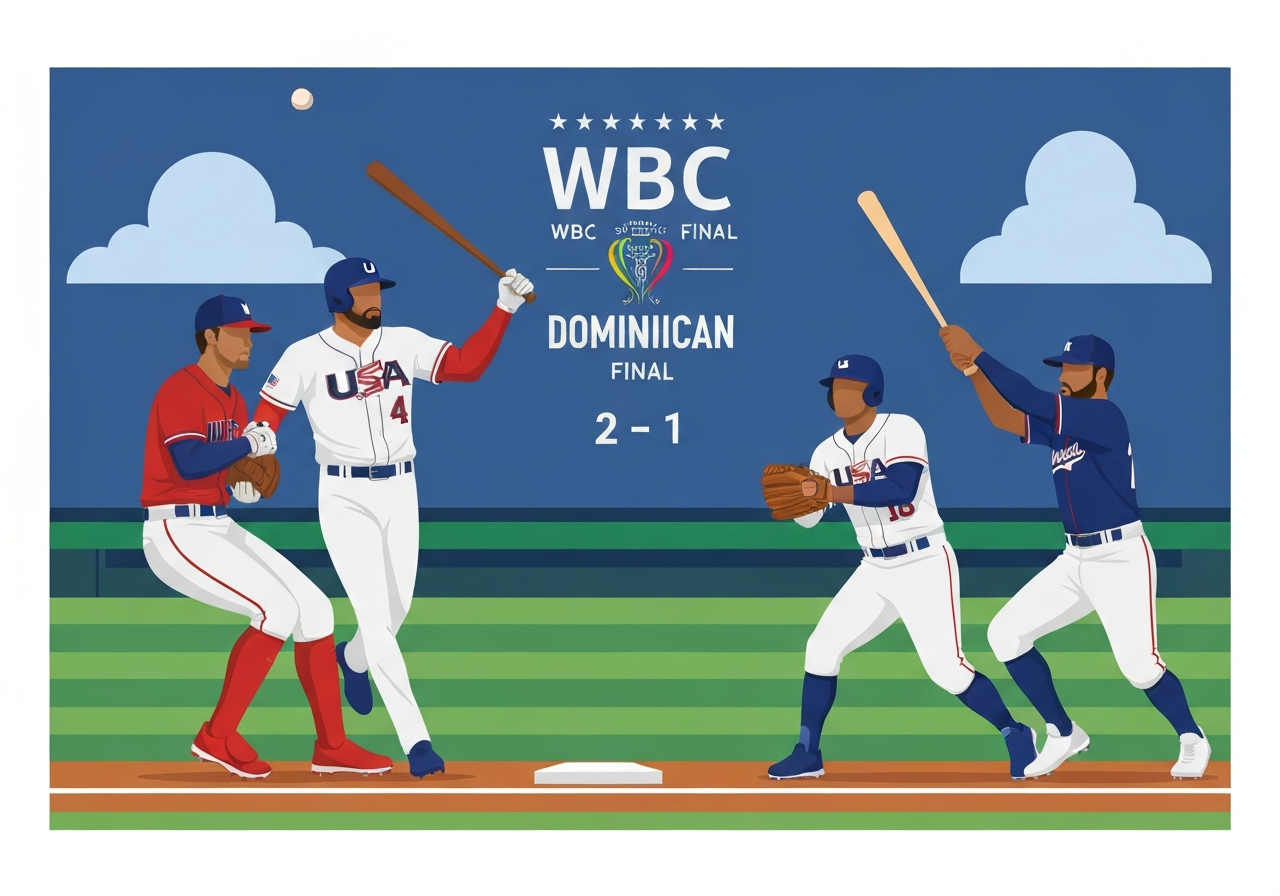
Lead: On March 15, 2026, at loanDepot Park in Miami, Team USA beat the Dominican Republic 2-1 to advance to the World Baseball Classic championship game. Gunnar Henderson and Roman Anthony supplied the game-tying and go-ahead home runs in the fourth inning stretch that turned the contest. Paul Skenes held the Dominican order scoreless through 4 1/3 innings, and relievers Tyler Rogers, David Bednar and Mason Miller preserved the win. The game ended amid controversy over a called third strike on the final pitch, but the result sends the United States into Tuesday’s final versus Italy or Venezuela.
Key takeaways
- Final score: Team USA 2, Dominican Republic 1; the victory puts USA into the WBC final on Tuesday, March 17, 2026.
- Gunnar Henderson hit a game-tying solo home run in the fourth; Roman Anthony supplied the go-ahead homer later in the inning.
- Paul Skenes worked 4 1/3 innings to limit the Dominican power through the middle innings.
- The relief trio of Tyler Rogers, David Bednar and Mason Miller combined to close out the game despite multiple late jams.
- Crowd of 36,337 at loanDepot Park leaned heavily toward the Dominican Republic, whose fans used cowbells and drums to create a raucous atmosphere.
- Controversial final strike: Cory Blaser called the last pitch to Geraldo Perdomo a strike, a decision protested by the Dominican side.
- The Dominican lineup had outscored opponents by 41 runs across its first five WBC games and entered the semifinal tied for the tournament home-run record with 14.
Background
The World Baseball Classic, now in its second decade, is a short, high-profile international tournament that blends national pride with professional commitments. Pitchers face innings and pitch-count restrictions, and players often balance national duty with obligations to major-league clubs; those constraints shape roster construction and in-game strategy. Team USA entered the knockout rounds with a mix of veterans and emerging stars, including captain Aaron Judge and outfielders such as Bryce Harper and Pete Crow-Armstrong.
The Dominican Republic arrived as one of the tournament’s most explosive offenses, scoring prolifically across pool play and the quarterfinals. They outscored opponents by 41 runs in their first five games and hit 14 home runs en route to the semifinal, matching a tournament record set by Mexico in 2009. That blend of depth and flair made the D.R. the favorite in many eyes, and their fans packed loanDepot Park to amplify that expectation.
Both teams have navigated disruptions and differing public narratives throughout the tournament. Team USA’s approach was often characterized as solemn or restrained — players used military-style gestures and hosted motivational speakers — while the Dominicans embraced rhythmic celebrations and overt displays of joy. Those contrasts framed the semifinal as both a stylistic and competitive clash.
Main event
In front of 36,337 fans in Miami, Luis Severino opened for the Dominican Republic and set an aggressive tone by striking out leadoff hitter Bobby Witt Jr. He followed with a second strikeout, flashing emotion after each. The Dominican crowd roared at each milestone, pushing the home side early while Team USA’s starters appeared measured in response.
Paul Skenes, the reigning National League Cy Young winner, navigated the charged atmosphere to retire batters through the early innings and retired multiple hazards before surrendering longball damage in the fourth. After a third-inning throw from Aaron Judge gunned down Fernando Tatis Jr. attempting to reach third, Gunnar Henderson tied the game with a solo homer off Severino in the fourth. Henderson invited teammates onto the field to celebrate as the momentum shifted.
Soon after Henderson’s blast, Roman Anthony followed with a home run that produced the scoring edge for Team USA. Anthony’s homer arrived against reliever Gregory Soto and gave the visitors a lead they would not relinquish. The middle innings became the decisive phase as the American offense capitalized on two runs while Skenes and the bullpen contained further Dominican rallies.
The ending was tense. Mason Miller faced Geraldo Perdomo with the tying run at third on a full count and delivered a slider that Blaser called a strike. Perdomo vocally protested, and Dominican manager Albert Pujols described the finish as disappointing, but he declined to dramatize the umpiring decision. The three-man American relief core had earlier escaped several jams to preserve the narrow advantage.
Analysis & implications
Sporting significance: Team USA’s victory addresses long-running questions about its approach to international competition. The lineup’s composed, team-first presentation — tempered celebrations, military-themed gestures and veteran leadership — produced results under pressure. Beating a power-laden Dominican roster in hostile territory suggests the U.S. identity for this tournament combines pitching control and situational hitting more than flamboyant showmanship.
Strategic implications: Managing pitchers under WBC limits remains critical. Skenes’s early exit at 4 1/3 innings reflects pitch-count caution and the need for a reliable bullpen, a resource USA displayed in Rogers, Bednar and Miller. For tournament organizers and MLB clubs, the semifinal again highlights the trade-offs between preserving pitchers for regular-season obligations and pursuing international titles.
Broader impact: The Dominican Republic’s exit removes one of the tournament’s most electrifying attractions, but the WBC’s global showcase endures. A final featuring Team USA against Italy or Venezuela offers different narratives — the U.S. seeking validation of its assembly process versus an opponent carrying momentum and national exuberance. The match will influence offseason evaluations, player marketability, and conversations about the WBC’s competitive balance.
Media and fan perceptions: The contrast between subdued American celebrations and overt Dominican revelry will feed commentary about cultural differences in how baseball is played and displayed. That debate may shape public interest and broadcast framing in future editions, particularly as international stars seek to blend personality with performance.
Comparison & data
| Metric | Dominican Republic (first 5 games) | Team USA (through semifinal) |
|---|---|---|
| Run differential | +41 | Notably lower (narrow-margin wins) |
| Home runs | 14 (tied WBC record) | Fewer long balls; situational hitting produced key runs |
| Semifinal attendance | 36,337 at loanDepot Park | |
Context: The Dominican Republic’s +41 run differential and 14 homers established them as the tournament’s most productive offense entering the semifinal. Team USA’s wins were more margin-sensitive, often decided by small advantages and bullpen performance. Those statistical contrasts help explain how a 2-1 result unfolded despite the Dominican lineup’s earlier dominance.
Reactions & quotes
Players and managers framed the outcome in both competitive and emotional terms.
“For some reason, everybody thinks that we don’t have fun playing baseball… That was fun, you know?”
Pete Crow-Armstrong, Team USA outfielder
Context: Crow-Armstrong posted an image of teammates celebrating Henderson’s fourth-inning home run and emphasized that Team USA enjoyed the moment despite a restrained on-field demeanor.
“I don’t want to focus on the last pitch… It just wasn’t meant to be for us.”
Albert Pujols, Dominican Republic manager
Context: Pujols expressed disappointment about the game-ending call but declined to escalate the matter publicly, underscoring the thin margins that decided the semifinal.
“We’ve carried ourselves this tournament in the way that we’ve wanted to… feeling like we’re the best team in the world.”
Pete Crow-Armstrong, Team USA outfielder
Context: Crow-Armstrong summarized the U.S. squad’s internal belief heading into the final and the team’s emphasis on cohesion rather than spectacle.
Unconfirmed
- Whether available electronic pitch-tracking data would have contradicted the umpire’s final strike call has not been publicly released or reconciled with the on-field decision.
- Any direct causal link between Team USA’s subdued celebrations and on-field performance remains speculative and unproven.
Bottom line
Team USA’s 2-1 semifinal win over the Dominican Republic was a tense, low-scoring affair defined by timely homers and bullpen resilience. The victory validated a U.S. strategy built around pitching depth and situational hitting rather than the flamboyant displays that characterized many opponents.
Looking ahead, the final on Tuesday against Italy or Venezuela will test whether Team USA’s approach can withstand another high-pressure environment and if the WBC crown will favor composure or continued offensive fireworks. Regardless, the semifinal highlighted the tournament’s ability to produce October-like intensity even within its compact schedule.
Sources
- The New York Times (News report) — original game coverage and postgame quotes.
- World Baseball Classic (Official) — tournament format, schedule and official results.