
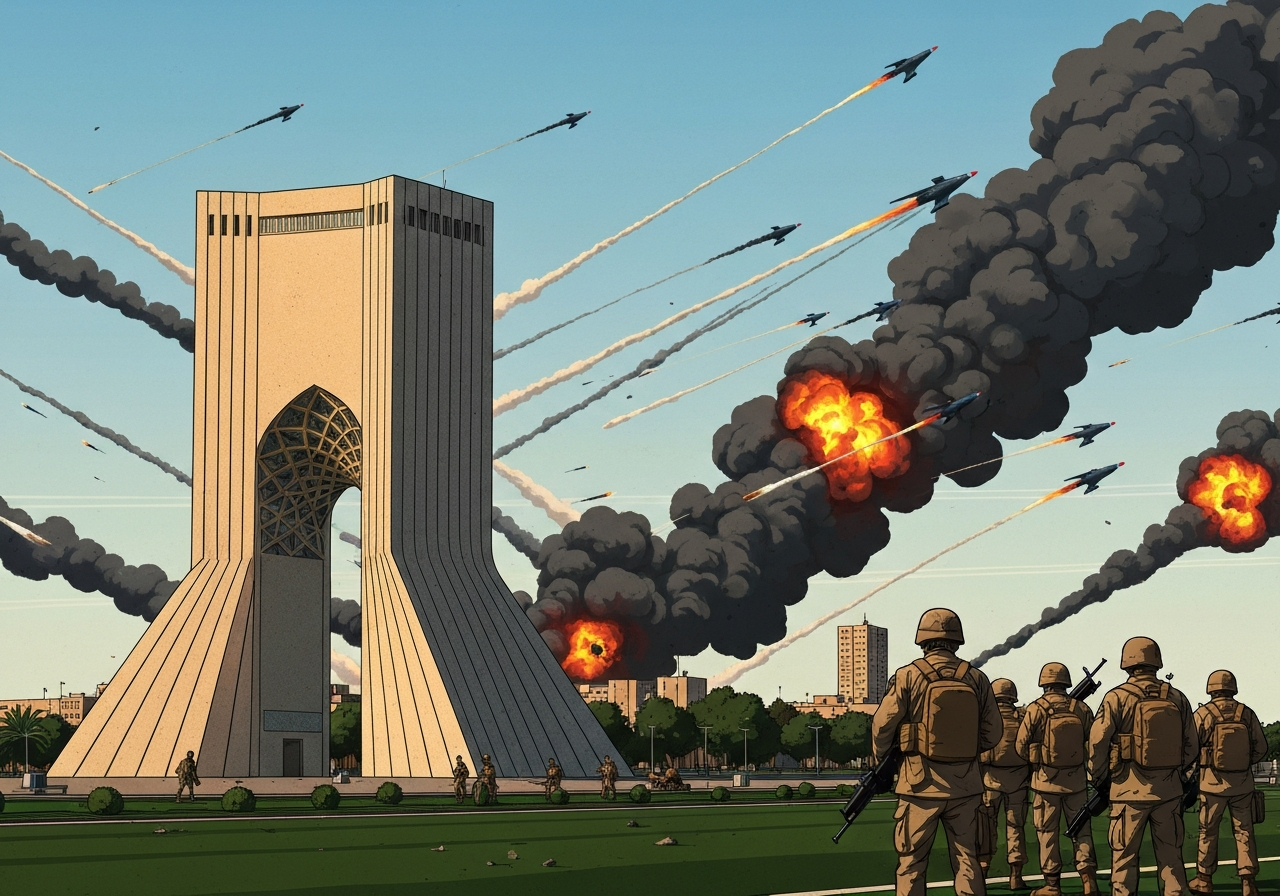
Lead: Tehran was hit by a concentrated series of airstrikes on Saturday that damaged residential districts and parts of Iran University of Science and Technology, Iranian media and aid groups reported. The attacks came as an expeditionary force of roughly 2,500 U.S. Marines arrived in the region aboard an amphibious group, while Israel and U.S. forces said they were striking sites tied to Iran’s weapons and logistics networks. The Houthi movement in Yemen entered the wider conflict with missile and drone launches at Israel, and officials said maritime routes including the Strait of Hormuz remain tense and intermittently disrupted.
Key Takeaways
- Iranian monitors reported 701 strikes in a 24-hour period on Saturday, with at least 24 civilians killed and 88 wounded in that span, most attacks concentrated in Tehran.
- Human-rights tracking groups say at least 1,551 civilians — including 236 children — have died in Iran since the campaign’s start on Feb. 28; other tallies cited by some outlets vary.
- About 2,500 U.S. Marines arrived in the Middle East with the U.S.S. Tripoli amphibious ready group, intended to increase U.S. options in the Strait of Hormuz.
- The Israeli military reported strikes on Tehran targeting weapons storage, production facilities, command centers and air-defence infrastructure.
- The Houthis launched ballistic and cruise missiles and swarms of drones toward Israel on Saturday; at least one wave was intercepted by Israeli defenses.
- Iran’s internet connectivity remained extremely limited, with NetBlocks reporting roughly 1% of typical national levels after 30 days of outages.
- Regional economic and transport impacts were reported: oil prices rose amid fears over the Hormuz chokepoint and parts of Gulf aviation and ports sustained damage.
Background
Fighting that began in late February has expanded beyond the initial Gaza front into a broader confrontation between Iran and a U.S.-Israeli coalition. Israel and U.S. officials say their strikes aim to degrade Iran’s ability to sustain military operations, focusing on facilities they identify as linked to the Islamic Revolutionary Guard Corps and related infrastructure. Iran and its allies reject those characterizations and stress civilian harm and damage to nonmilitary sites.
Regional nonstate actors have already widened the war: Hezbollah in Lebanon has engaged Israeli forces along the shared border, and Yemen’s Houthi movement — aligned with Iran — has intermittently struck shipping and launched missiles toward Gulf states and Israel. The strategic Strait of Hormuz, through which a sizable share of world seaborne oil passes, has been a flashpoint; Iran has intermittently closed or threatened to close passages, creating sharp market reactions.
Main Event
Saturday’s strikes on Tehran were described by Iranian state outlets and aid organizations as among the heaviest single-day bombardments since the conflict began. Iranian reporting and video shared by local emergency services showed damaged residential buildings and university facilities in central Tehran. Authorities and humanitarian workers described multiple waves of explosions through the night and into the following day.
The Israeli military said it carried out strikes against weapons storage and production sites, temporary command centers, air-defence systems and observation posts in the capital. U.S. and Israeli officials framed those operations as aimed at crippling Iran’s military industry and command-and-control capacity; they also said many targets have dual-use functions, complicating assessments of civilian risk.
Concurrently, a Houthi spokesman announced missile and drone attacks directed at Israel; at least one ballistic missile was intercepted by Israeli defenses. The movement said attacks would continue “until the aggression ends.” The arrival of the U.S. amphibious ready group, including 2,500 Marines, was presented by Washington as expanding options to secure maritime lanes and respond to threats around the Gulf.
Analysis & Implications
The consolidation of strikes on Tehran marks an escalation in both tempo and geographic scope of the campaign. Hitting the Iranian capital — including industrial and research facilities in densely populated urban areas — increases the risk of civilian casualties and heightens international pressure on combatant parties to justify target selection under the laws of armed conflict.
The deployment of U.S. Marines is a tactical step to protect navigation through the Strait of Hormuz and reassure regional partners, but it also raises the stakes for direct U.S.-Iran encounters. While Iran’s larger naval forces have been degraded by earlier strikes, Tehran retains asymmetric options such as fast-boat attacks, mines and missile salvos from island and coastal positions.
Economic ripple effects are already apparent: insurers, shippers and energy markets are pricing higher risks for Gulf transit and Gulf ports. If strikes continue to threaten major export and refining nodes—or if state or proxy forces successfully interdicted shipping — global oil and commodity markets could remain volatile for weeks to months.
Comparison & Data
| Metric | Reported Figure |
|---|---|
| Strikes in 24 hours (HRANA) | 701 |
| Civilians killed in that 24-hour span | At least 24 |
| Injured in that 24-hour span | 88 |
| HRANA cumulative civilian deaths since Feb. 28 | ~1,551 (including 236 children) |
| U.S. Marines deployed | ~2,500 |
These figures come from rights monitors and official statements; discrepancies remain between outlets for cumulative totals. The 701 strikes figure refers to one 24-hour monitoring window reported by HRANA, while cumulative casualty counts vary by source. Accurate on-the-ground verification is constrained by communication outages and limited independent access.
Reactions & Quotes
“The attacks from Yemen will continue until the aggression ends.”
Yahya Saree, Houthi military spokesman
The Houthi statement frames their strikes as retaliatory and open-ended, signaling a sustained threat to Israel and to regional maritime safety unless hostilities abate.
“Very strong talks” are underway with Iranian leaders, and a diplomatic channel remains active.
President Donald J. Trump (public remarks)
U.S. officials have described parallel diplomatic efforts even as they reinforce military postures in the region; how those parallel tracks intersect will shape near-term escalation risk.
“We completed a wide-scale wave of strikes targeting naval and military infrastructure in Tehran.”
Israeli military statement
Israeli forces framed the operation as precision work against military and dual-use sites. Independent verification of each target’s function is limited amid ongoing hostilities.
Unconfirmed
- The precise function of each struck facility in Tehran (military versus civilian research) remains unverified by independent inspectors.
- Conflicting cumulative casualty figures reported by monitoring groups and state media—some tallies report about 1,492 total civilian deaths, others 1,551—require further consolidation.
- Israel’s public accusation that a slain Lebanese correspondent was an active Hezbollah intelligence operative has not been publicly supported with independently verified evidence.
Bottom Line
Saturday’s concentrated strikes on Tehran and the arrival of U.S. Marines signal both an intensification of kinetic pressure on Iran and a deepening of regional military postures. The timetable and success of parallel diplomacy remain uncertain, while escalation risks persist because of proxy actions, miscalculation at sea, and attacks in densely populated urban settings.
For civilians across the region, the immediate costs are growing: casualties, damaged infrastructure, disrupted communications and constrained maritime commerce. International monitoring groups and humanitarian organizations will need more secure access and communications to verify harms and coordinate relief as the situation evolves.