
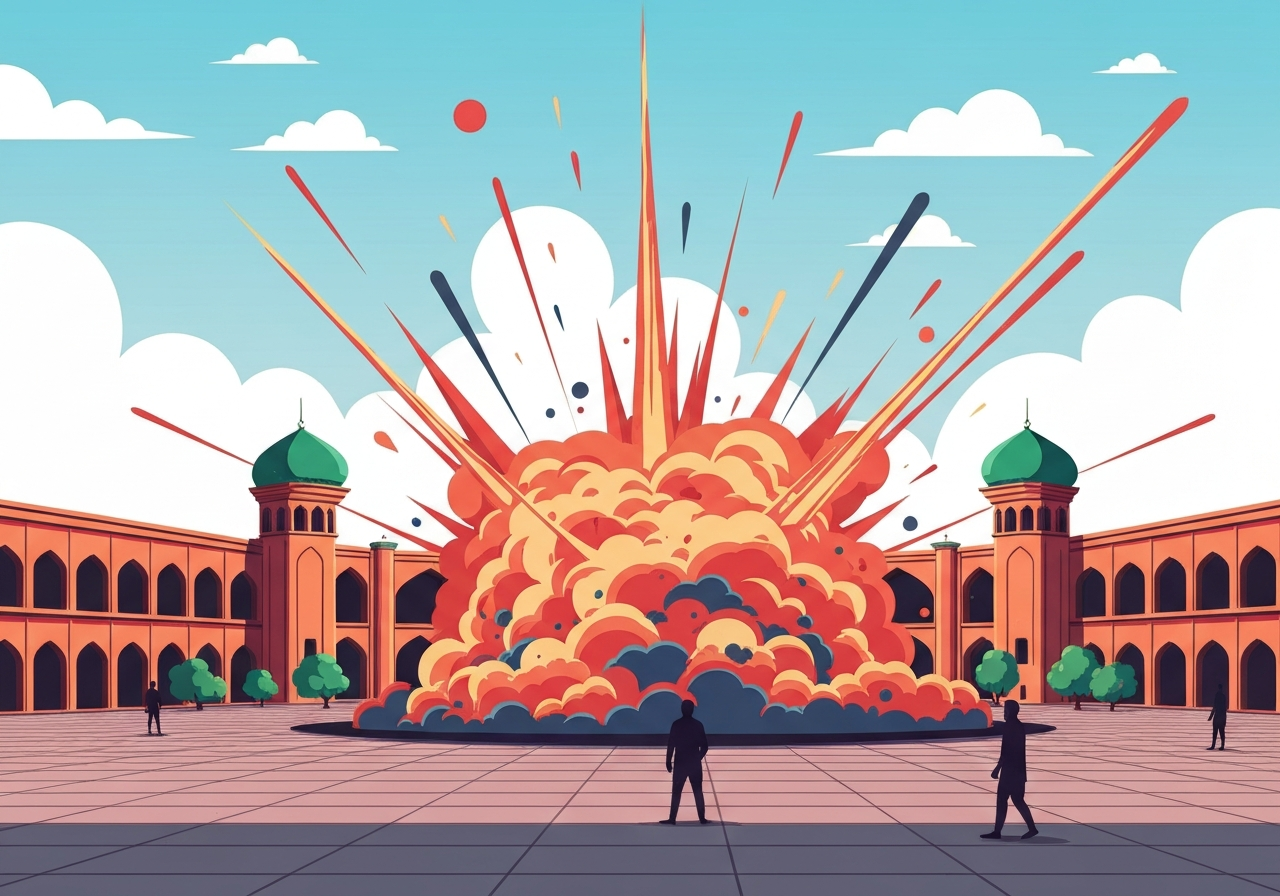
Lead: A large explosion struck Ferdowsi Square in central Tehran on Friday, March 13, 2026, as thousands gathered for annual Quds Day rallies, Iranian state television reported. The blast occurred after an Israeli warning that strikes could take place near Tehran University; Iranian officials provided no immediate casualty figures. The incident comes amid a rapid escalation across the region — including reported missile launches from Iran, NATO air defenses intercepting projectiles over Turkey, and ongoing airstrikes on Iranian infrastructure. U.S. and allied forces are simultaneously managing unrelated incidents, including a KC-135 refueling plane crash in western Iraq that left four of six crew confirmed dead.
Key Takeaways
- A large explosion occurred in Ferdowsi Square, Tehran, on March 13, 2026, during Quds Day demonstrations attended by thousands, according to Iranian state TV and semiofficial outlets.
- Israel issued a prior warning that it might strike areas near Enghelab Street and Tehran University; Israeli military declined immediate comment on the blast.
- Israel’s military said it struck more than 200 targets across western and central Iran in recent operations, targeting missile launchers, air defenses and weapons production sites.
- Four of six crew on a U.S. KC-135 refueling aircraft that crashed in western Iraq have been confirmed dead; U.S. Central Command said the loss was not due to hostile or friendly fire.
- NATO air defenses intercepted a ballistic missile over Turkey — the third such interception since the start of the Iran war; no casualties were reported in that incident.
- Global energy markets remain tight: Brent crude stayed above $100 per barrel amid disruptions linked to the conflict and Strait of Hormuz tensions.
- China announced a $200,000 aid package via the Iranian Red Crescent for families of children killed in a missile strike on a school, condemning attacks on schools as violations of international humanitarian law.
Background
The explosion in Tehran must be seen against a monthslong spiral of tit-for-tat strikes that intensified after Hezbollah fired rockets into northern Israel on March 2, 2026, and subsequent Israeli responses. Iran and its regional proxies have been targeted in air and drone strikes that Israel says aim to degrade missile capabilities and weapons production sites. Tehran, for its part, has warned regional states against hosting foreign military facilities and has increasingly signaled that financial and infrastructure targets may be at risk.
Quds Day — observed since Iran’s 1979 Islamic Revolution on the last Friday of Ramadan — traditionally draws large pro-Palestinian demonstrations in Tehran and other cities. The concentration of demonstrators along Enghelab Street and near Tehran University places civic gatherings adjacent to government buildings and security installations, raising the potential for collateral harm when military warnings and strikes overlap with public events. The presence of top theocratic and security figures at Friday’s gatherings heightened political stakes.
Across the wider region, states and international organizations are reacting to the conflict’s spillover. NATO has deployed additional air defenses to eastern Mediterranean areas and intercepted missiles over Turkey. Western capitals are split over energy and sanctions policy: the United States temporarily eased rules to allow purchases of Russian oil already at sea, provoking criticism from some G7 partners while Moscow said the move would help stabilize markets.
Main Event
Shortly before the explosion, Israeli authorities circulated a Farsi-language warning urging civilians to evacuate parts of Enghelab Street near Tehran University and said operations could take place in the area in coming hours. Video published by semiofficial outlets showed a gray plume rising over Ferdowsi Square as demonstrators shouted slogans and fled the scene. Multiple local accounts described panic and frantic efforts by bystanders and rescue teams.
State television identified the location as Ferdowsi Square, a busy thoroughfare close to government offices and Tehran University. Footage from the square included chants of “Death to Israel” and “Death to America,” and images of senior figures at the rally, including security officials and judiciary head Gholamhossein Mohseni Ejehi. The Iranian security apparatus moved quickly to secure visible senior figures at the demonstration.
Iranian officials and state media did not immediately confirm the cause of the blast or offer casualty totals. Israeli military sources were not immediately available for comment when the explosion was first reported. Iranian outlets also reported strikes in Qazvin earlier that day, in areas that Israel had warned it might target, complicating attribution in real time.
Meanwhile, the Israeli air force said it had struck scores of sites across western and central Iran in the last 24 hours, naming targets such as ballistic missile launchers, air-defense systems and weapon production facilities. The pattern of targeting and warnings suggests a campaign intended to degrade Iranian long-range strike capabilities while signaling pressure on Tehran’s leadership.
Analysis & Implications
The timing and location of the explosion — at a major demonstration day and near university and government buildings — amplify the political risk for Tehran. If the blast is attributed to an external strike, it could intensify nationalist sentiment and harden public support for retaliation, complicating any internal dissent that might have grown from economic strain. Conversely, civilian casualties at a mass rally would likely increase international scrutiny and calls for restraint.
Regionally, the incident underscores how the conflict threatens to draw neighboring countries and international institutions into wider engagements. NATO interceptions over Turkey and patrols around the eastern Mediterranean indicate allied concern about missile trajectories and the protection of bases used by multinational forces. Attacks that damage commercial or financial centers, such as the reported damage at Dubai’s DIFC after a claimed interception, also raise contagion risks for trade and investment flows.
Economically, persistent disruptions to shipping in the Strait of Hormuz and sustained strikes on Iranian infrastructure are keeping Brent crude above $100 per barrel, pressuring import-dependent economies and complicating global inflation and energy security calculations. The U.S. decision to relax restrictions on some Russian oil sales was framed by officials as a market-stabilizing step, but it has drawn political pushback from some Western allies who view the move as sending the wrong signal amid the crisis.
From a military standpoint, repeated interceptions of missiles and drones indicate improving integrated air defenses in the region but also raise the risk of miscalculation. The presence of senior Iranian officials at public events increases the chance of symbolic strikes intended to signal vulnerability at the top of theocratic leadership — a development that could rapidly escalate if either side perceives an existential threat.
Comparison & Data
| Item | Reported Figure |
|---|---|
| KC-135 crew confirmed dead | 4 of 6 |
| Brent crude price | Over $100 per barrel |
| Interceptions over Turkey since war start | 3 ballistic missiles intercepted |
| Iranian sailors’ remains returned by Sri Lanka | 84 |
The table above places Friday’s Tehran explosion alongside other high-impact developments reported the same day. The confirmed deaths aboard the KC-135 are domestic U.S. military losses distinct from Iranian casualty reporting; the oil-price figure reflects global market pressure; and repeated missile interceptions over Turkey show a widening geographic scope for active air-defense engagements.
Reactions & Quotes
“The problem with Trump is that he is not smart enough to see that the Iranian nation is a mature, strong and determined nation. The more pressure he puts on the people, the greater their willpower becomes.”
Ali Larijani, Iranian security official (state media)
Larijani described the suspected strike as a sign of desperation and framed Iranian public reaction as likely to harden. His comments were broadcast as footage showed senior officials at the rally.
“My strong appeal to both parties, to Hezbollah and Israel, is for a ceasefire to stop the war.”
António Guterres, U.N. Secretary‑General
Guterres, on a visit to Beirut, called for de-escalation and emphasized the civilian toll in Lebanon as well as the wider region’s need for a return to peace.
“Four of six crew members on board the aircraft have been confirmed deceased as rescue efforts continue.”
U.S. Central Command (official statement)
U.S. Central Command said the KC-135 loss was under investigation and stated initial assessments did not point to hostile or friendly fire as the cause.
Unconfirmed
- Attribution of the Ferdowsi Square explosion: responsibility for the blast has not been independently verified and Israeli authorities had not confirmed involvement when initial reports emerged.
- Casualty and injury numbers from the Tehran explosion remain unverified by independent medical or emergency sources at the time of reporting.
- Reports that Ayatollah Mojtaba Khamenei was wounded earlier in the conflict remain contested; Iranian diplomats in some briefings asserted he is “safe and in good health,” but alternative accounts circulated as unconfirmed.
Bottom Line
The explosion in central Tehran during mass Quds Day demonstrations marks a dangerous escalation in an already volatile conflict. The overlap of public gatherings, military warnings, and active strikes increases the risk of large-scale civilian harm and unpredictable retaliation cycles. Observers should watch for independent casualty confirmations, formal claims or denials of responsibility, and any rapid changes in allied military postures that could widen the conflict.
In the short term, expect continued diplomatic pressure from the United Nations and regional actors for a pause or ceasefire, even as military operations and defensive interceptions continue. Economic effects — notably on oil markets and shipping through the Strait of Hormuz — will likely persist until a clear de-escalation pathway emerges.