
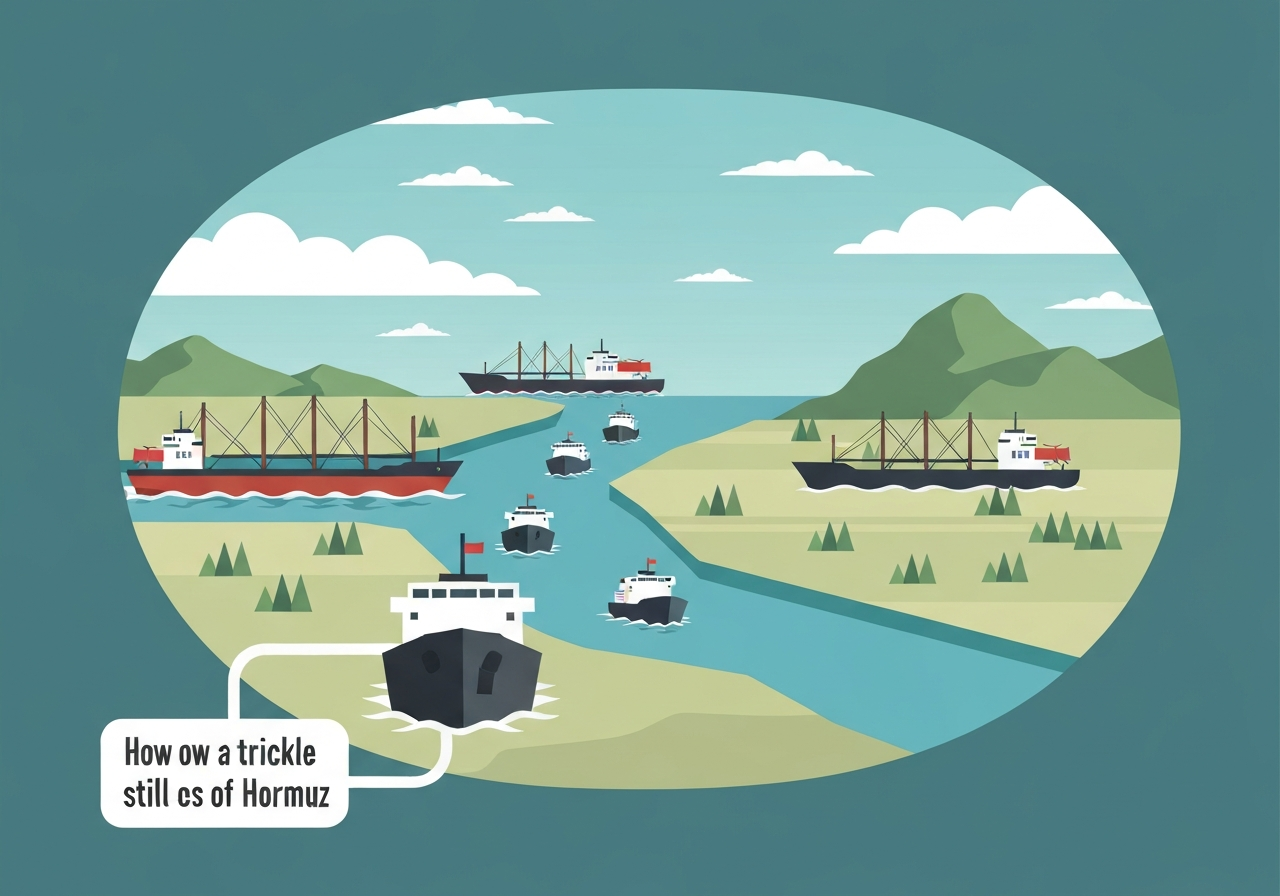
In the four weeks since the US-Israel war on Iran began, threats at sea have effectively stalled normal traffic through the Strait of Hormuz, the narrow waterway that normally carries about a fifth of the world’s oil and gas. Global energy flows and prices have been disrupted as most commercial transits halted, but a small number of vessels continue to cross by taking alternative tracks and by seeking approval from Iranian authorities. Analysts report that many ships remain at anchor or in port rather than risk the passage, while others have accepted visual inspection and sequencing through a Tehran-controlled corridor. The result is a greatly reduced, highly managed flow rather than open commercial navigation.
Key Takeaways
- Pre-conflict traffic averaged about 138 ships per day through the strait; in March roughly that many vessels appear to have transited in the whole month, per Lloyd’s List Intelligence (about 100 exiting the Gulf and 40 entering).
- More than 20 ships have been attacked in the wider region during the conflict, with some incidents causing fatalities; the Palau-flagged tanker Skylight was the first struck off Oman, killing two Indian crew members.
- According to Lloyd’s List, no vessels have been recorded as damaged since 22 March, but analysts expect normal trading patterns to take months to recover once hostilities end.
- About 1,000 vessels and their crews—mainly oil and gas tankers—are estimated to be at anchor or in port rather than transiting, and the IMO warns roughly 20,000 seafarers are stranded in stressful conditions.
- Tehran has offered a northern “safe corridor” inside Iranian territorial waters and told the IMO it will allow “non-hostile” vessels to pass; analysts call this arrangement “Tehran’s tollbooth.”
- There are reports from analysts that some vessels have paid for transit—one payment for a VLCC was reported as high as $2m—apparently made in Chinese yuan, likely to avoid sanctioned channels.
- Data-provider Windward observed a small number of vessels transmitting positions while crossing recently, but many ships have moved with transmitters off or hugged the Oman coast, complicating counts of actual transits.
Background
The Strait of Hormuz is a strategic choke point linking the Persian/Arabian Gulf with global sea lanes; in normal times tankers carry about one-fifth of the world’s oil and gas through the narrow channel, and a significant share of global dry-bulk fertiliser shipments also pass there. Historical incidents—ranging from mine attacks to vessel seizures—have previously raised insurance costs and prompted naval escorts, but none have produced a sustained near-shutdown on the scale seen in the current period. Key stakeholders include flag states, vessel owners and charterers, insurers, coastal states such as Iran and Oman, and international bodies including the UN and the International Maritime Organization. The current crisis is layered atop existing sanctions, regional rivalries and the complex command structure of Iran’s security services, particularly the Islamic Revolutionary Guard Corps (IRGC), which exerts effective control over much of Iran’s coastal security activity.
Before the present escalation, shipping companies relied on established international lanes and automated systems such as AIS (Automatic Identification System) for safe, predictable routing and insurance cover. The IMOs role is to monitor maritime safety and to coordinate international responses; it has sounded alarm over seafarer welfare and supply shortages on anchored vessels. Commercial stakeholders were already sensitive to geopolitical risk; the recent spike in attacks and the emergence of an Iran-defined “safe corridor” have materially changed operational decision-making for shipowners and charterers. Governments from more than 30 countries have issued statements seeking to safeguard the waterway and coordinate measures to reopen normal navigation.
Main Event
After the outbreak of hostilities four weeks ago, many ship operators halted transits through the conventional central commercial lane of the strait. Iran promoted a more northerly route inside its territorial waters, between Larak island and the mainland, and said it would permit passage for vessels it classifies as “non-hostile.” The corridor places vessels within visual range of Iranian authorities and the IRGC, which can verify identities and approve or delay movement—hence the analysts’ label of a de facto tollbooth.
Data from marine intelligence providers show a trickle rather than a flow. On a recent Tuesday Windward logged four vessels transmitting positions through Hormuz—three exiting the Gulf and one entering—and other days have shown little to no traffic on standard commercial lanes. On 24 March Windward observed two cargo ships entering the Gulf while hugging the Oman coast and sailing without AIS transmissions, indicating attempts to avoid detection or formal sequencing.
Maritime analysts report more than 20 attacks across the region during the conflict, including near-misses and minor damage, with several crew fatalities overall. The first vessel hit this month was the Skylight off Oman’s Musandam peninsula, where two Indian nationals—its captain and a crew member—died. Lloyd’s List reports that no vessels have been recorded as damaged since 22 March, but uncertainty about the future persists and many owners are reluctant to expose crews to perceived high risk.
There are also reports that some operators have accepted Iranian clearance and have paid intermediaries to transit; analysts say at least two payments were reported, one reportedly as high as $2m for a VLCC and reportedly in Chinese yuan. Whether payments represent sanctioned entities or other intermediaries is unclear, and payments do not guarantee immune passage since IRGC factions can still act autonomously, analysts warn.
Analysis & Implications
The near-closure of Hormuz has immediate and direct implications for global energy markets: the strait normally carries a substantial proportion of seaborne oil and liquefied gas, and supply disruptions push spot and futures prices higher. Even if hostilities halt, analysts expect months for trading patterns and port rotations to normalize because owners, charters and insurers must regain confidence in safe, predictable passage. The result will likely be persistent premium costs in freight and insurance, which can propagate into higher energy and fertilizer prices worldwide.
The emergence of an Iran-controlled corridor reshapes the balance of maritime control in the Gulf. By moving traffic into territorial waters and requiring visual verification, Tehran gains leverage: it can sequence vessels, inspect identities and, according to analysts, extract payments. This creates a legal and operational gray zone—vessels operating under Iranian approval are technically in sovereign waters, potentially exposing them to different legal and security dynamics than those in international lanes. That shift complicates multinational efforts to keep routes open without ceding de facto control to a single coastal authority.
For global governance, the situation raises questions about collective action and burden-sharing. More than 30 countries have pledged to cooperate on safeguarding the strait, and Britain has offered to host a summit to devise a “viable, collective plan.” But assembling naval, legal and insurance responses that restore routine commerce without escalating military confrontation will be delicate and time-consuming. Commercially, the insurance market reports cover remains available but at elevated premiums; the limiting factor for shipowners is crew safety and the acceptability of operating under conditions where state approval may be uneven or reversible.
Comparison & Data
| Metric | Pre-conflict (typical) | March 2026 (observed/reported) |
|---|---|---|
| Average daily transits | 138 ships/day | ~138 ships in whole month (100 exits, 40 entries reported) |
| Attacks recorded during conflict | — | More than 20 (including near-misses and minor damage) |
| Vessels choosing to remain anchored/in port | — | Approximately 1,000 vessels estimated |
| Seafarers reported stranded | — | About 20,000 (IMO) |
The table places measured pre-conflict averages beside observed activity during March. The contrast shows a collapse in routine daily traffic and the emergence of anchoring, sequencing and alternative routing as principal behaviors. Analysts caution that AIS-based counts understate activity when vessels deliberately turn off transmitters or hug coastlines to avoid formal lanes.
Reactions & Quotes
International institutions and private analysts have responded with concern about seafarer welfare and the integrity of global supply chains.
“The situation in the Gulf has put tens of thousands of seafarers under severe strain and has disrupted normal maritime operations.”
International Maritime Organization (official)
The IMO statement underscores humanitarian and operational pressures recorded by UN agencies and shipping bodies.
“Iran’s alternative corridor effectively allows the state to verify and sequence vessels, a mechanism some analysts have described as a tollbooth on Hormuz.”
Lloyd’s List analysts (industry analysis)
Lloyd’s List commentary frames the corridor as an instrument of control, highlighting potential for sequencing, inspection and reported payments.
“We are pursuing cooperative measures with partners to restore safe and open navigation through the strait and will host consultations to develop a collective plan.”
United Kingdom (government statement)
The UK offer to convene a security summit has been presented as an attempt to forge a multilateral operational and political response without unilateral militarization of the channel.
Unconfirmed
- Whether Iran is formally charging transit fees as a state policy remains unverified; some reports of payments exist but their recipients and official sanction are unclear.
- The exact number of vessels that have transited with AIS switched off or via unreported routes is unknown; observed AIS crossings likely undercount total movements.
- It is not confirmed whether reported payments are being made directly to IRGC entities, third parties, or other intermediaries.
Bottom Line
The Strait of Hormuz remains functionally constrained: large-scale commercial navigation has not resumed and a handful of vessels are transiting under new, Iran-defined procedures that place control in coastal hands. That shift elevates operational, legal and economic risks for shipowners, seafarers and global supply chains dependent on Gulf hydrocarbons and bulk goods.
Restoring normal traffic will require a mix of de-escalation, clear international arrangements for safe passage, and credible guarantees for crew safety and insurance. In the near term, expect continued sequencing, elevated freight and insurance costs, and a close watch on whether Iran’s corridor becomes a durable mechanism for controlling Gulf maritime traffic.
Sources
- The Guardian (media: reporting and synthesis)
- Lloyd’s List (industry analysis: maritime intelligence)
- International Maritime Organization (IMO) (official: UN maritime agency)
- Windward (private maritime intelligence provider)