
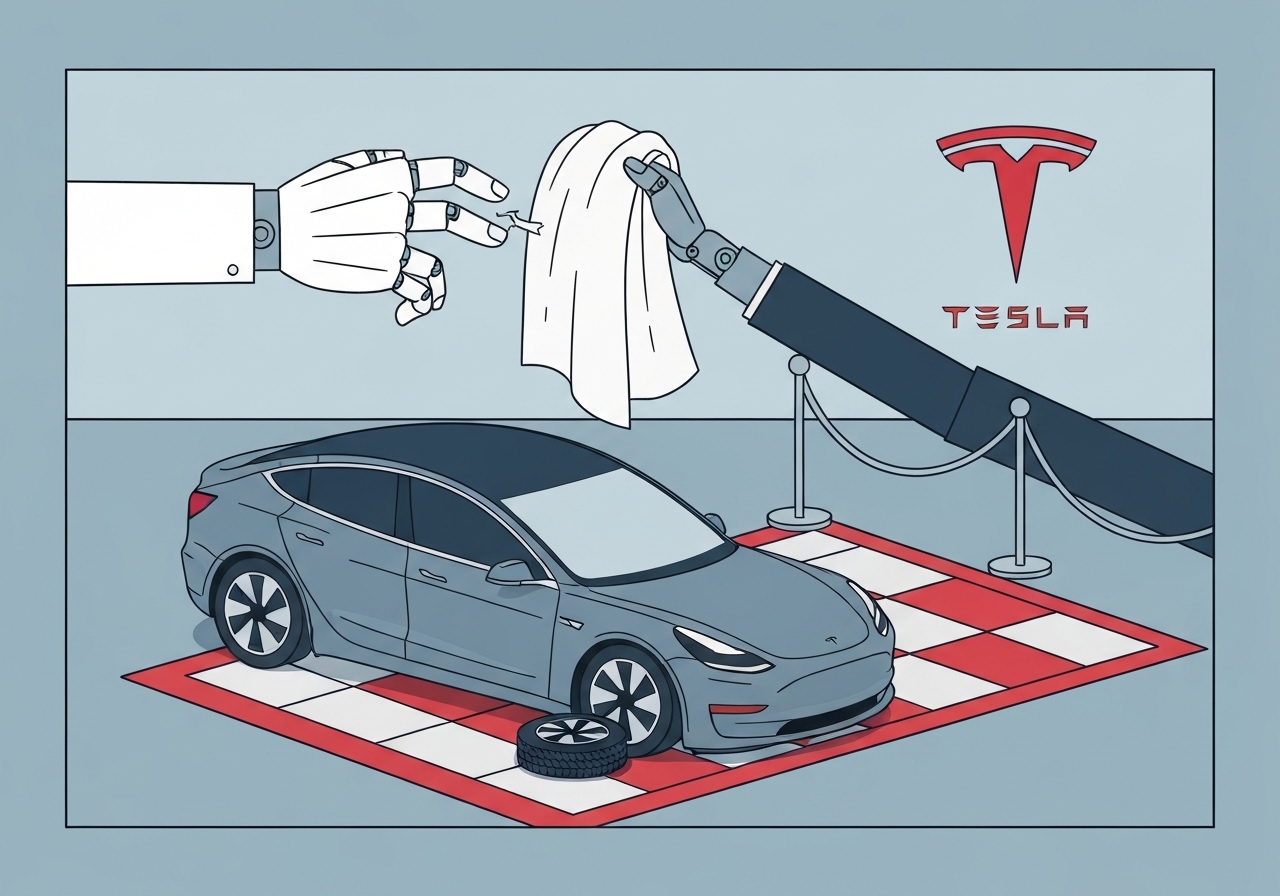
Lead: Tesla signaled a decisive shift away from its traditional vehicle business during its latest quarterly earnings call, as CEO Elon Musk and senior executives outlined a future centered on autonomy, robotics and subscription services. The company retired the Model S and Model X lines to free capacity for humanoid robot production and said it will prioritize autonomous vehicles and robotaxis. In 2025 Tesla reported $94.8 billion in revenue, with $69.5 billion (73%) from car sales, even as automotive revenue declined 10% year-over-year. Management announced heavy capital spending plans and framed the company as moving from automaker to “transportation as a service.”
Key Takeaways
- Tesla reported $94.8 billion in revenue for 2025, with automotive sales contributing $69.5 billion, or roughly 73% of total revenue.
- Automotive revenue fell about 10% year-over-year in the most recent reporting period, while energy and services streams are growing.
- The company disclosed 1.1 million active Full Self-Driving (FSD) subscriptions, a 38% increase versus Q4 2024, and plans to move FSD to subscription-only sales.
- Tesla lost its 2025 global EV sales crown to BYD and its Model 3/Model Y programs are showing declining volumes despite new lower-cost trims.
- Management announced planned capital expenditures near $20 billion for 2026—up from about $8.5 billion the prior year—to fund robot, Cybercab, semi, and battery capacity.
- Executives described a strategic pivot toward autonomous robotaxis and Optimus humanoid robots, with mass-production targets for later this decade.
- Musk reiterated a view that the overwhelming majority of future miles will be driven autonomously, presenting a dramatic long-term product shift.
- Shareholders and the board have backed Musk’s AI-and-robotics vision, linking executive compensation to ambitious autonomy and robot production milestones.
Background
Tesla grew in the 2010s and early 2020s as an electric-vehicle pioneer, combining battery technology, software and direct sales to scale quickly. Its product lines—particularly the Model S, Model X, Model 3 and Model Y—were central to that rise, supported by regulatory incentives and rising consumer demand for EVs. Over recent years, incentives and tax credits that helped expand EV adoption have been scaled back in some markets, removing tailwinds that aided earlier growth.
Concurrently, Tesla expanded into adjacent businesses: energy storage and generation, software services, and advanced driver-assistance systems marketed as Full Self-Driving (FSD). Company strategy increasingly emphasized software-defined products and subscription revenue, mirroring a broader automotive industry trend away from one-time vehicle sales toward recurring monetization.
Elon Musk’s public profile and political activities have also affected the brand: some customers and observers cite his political donations and rhetoric as a factor reducing Tesla’s appeal to progressive buyers. Industry competitors such as BYD and Waymo have advanced in sales or autonomy, compressing Tesla’s previous advantages in product leadership.
Main Event
On the most recent earnings call, Tesla executives announced the end of the Model S and Model X as current-volume programs, reallocating assembly capacity toward production lines for Optimus humanoid robots and a fully autonomous “Cybercab.” Management framed that move as part of a larger transition from making cars to delivering autonomous mobility services. CEO Elon Musk argued that future vehicle demand will be dominated by autonomous mileage rather than owner-driven use, and suggested the company will focus on vehicles built for autonomy.
Financial disclosures on the call underlined the commercial reality: automotive revenue is shrinking even as overall revenue remains near $95 billion. Tesla revealed 1.1 million active FSD subscriptions and said it will stop selling FSD as a one-time purchase, shifting to subscription-only access. Executives presented subscription growth as a strategic priority but acknowledged that subscriptions are unlikely to immediately replace lost automotive margins.
Management detailed a step-up in capital spending: roughly $20 billion planned for 2026, largely to build factory lines and upstream materials capacity—including battery and lithium facilities—and to ready mass production for new product lines. CFO Vaibhav Taneja characterized much of that investment as necessary to secure supply chains and enable the company’s envisioned transformation.
Analysis & Implications
Tesla’s pivot reflects both technological ambition and economic reality. Making and selling cars is capital- and labor-intensive with relatively low margins; shifting toward software, services and robotics promises higher recurring revenue and larger long-term margins if the technology matures. That trade-off explains investor willingness to support bold spending and strategic risk even as near-term vehicle sales slip.
However, the bet on autonomy and humanoid robots carries material execution risk. Development of truly reliable, general-purpose autonomy has proven slower and costlier than many early forecasts; regulatory scrutiny, litigation over safety claims, and real-world crash data complicate market rollout. Optimus has struggled with basic tasks in trials and many autonomy goals remain distant, raising doubts about timing and cost-to-complete.
Financially, the company faces a dual challenge: sustaining revenue while funding an expensive pivot. Even aggressive subscription growth (1.1 million FSD users today) will need to scale dramatically to substitute for billions in lost vehicle sales. The announced $20 billion capex plan increases the company’s execution burden and heightens exposure to supply-chain and commodity risks—especially for battery raw materials.
Strategically, Tesla’s board and investors have effectively endorsed Musk’s long-term vision, tying substantial equity incentives to ambitious product and market milestones. That alignment permits radical change but concentrates governance risk: if technology or market adoption lags, shareholder value could be pressured despite initial optimism.
Comparison & Data
| Metric | 2025 | Change |
|---|---|---|
| Total revenue | $94.8 billion | — |
| Automotive revenue | $69.5 billion (73%) | Down ~10% YoY |
| Active FSD subscriptions | 1.1 million | +38% vs Q4 2024 |
| Planned 2026 capex | $20 billion | vs $8.5 billion prior year |
The table summarizes the company’s recent financials and strategic metrics. Automotive sales still compose the majority of revenue but are declining, while services and subscription figures—though growing—remain small relative to vehicle sales. The capex jump to $20 billion underscores the scale of the company’s investment in new product lines and supply-chain verticalization.
Reactions & Quotes
“The vast majority of miles traveled will be autonomous in the future,”
Elon Musk, CEO
Musk reiterated his long-term forecast that human-driven miles will become a tiny fraction of overall travel and that Tesla will concentrate on producing autonomous vehicles.
“We estimate about $20 billion of capital expenditures in 2026,”
Vaibhav Taneja, CFO
Taneja linked the capex plan to production lines for robotaxis, Optimus robots, battery plants and material refineries—investments the company says are required to realize its autonomy and robotics goals.
“Think of Tesla less as an automaker and more as transportation-as-a-service,”
Senior Tesla executive (company comment)
A senior executive framed the strategic shift as a move from one-time vehicle sales to recurring mobility and software revenue, echoing the management narrative during the earnings call.
Unconfirmed
- Musk’s timeline for robot mass production by the end of 2027 is a company target but remains unverified and subject to change.
- The claim that Tesla will deploy robotaxis in “dozens” of U.S. cities this year is an aggressive projection that has not been independently confirmed.
Bottom Line
Tesla’s management has emphatically pivoted company strategy from building and selling a broad lineup of cars toward creating autonomous vehicles, robotaxis and humanoid robots supported by subscription services. That shift is backed by large planned capital expenditures and an investor base willing to accept near-term margin pressure for potential long-term upside tied to autonomy and robotics.
Execution risk is substantial: autonomy remains technically and regulatory challenging, Optimus has yet to demonstrate reliable factory utility, and subscription revenue will need to scale enormously to replace declining automotive receipts. For stakeholders, the coming 12–36 months will be decisive in proving whether Tesla can convert its ambition into durable, profitable new businesses or whether the core vehicle franchise will continue to erode.