
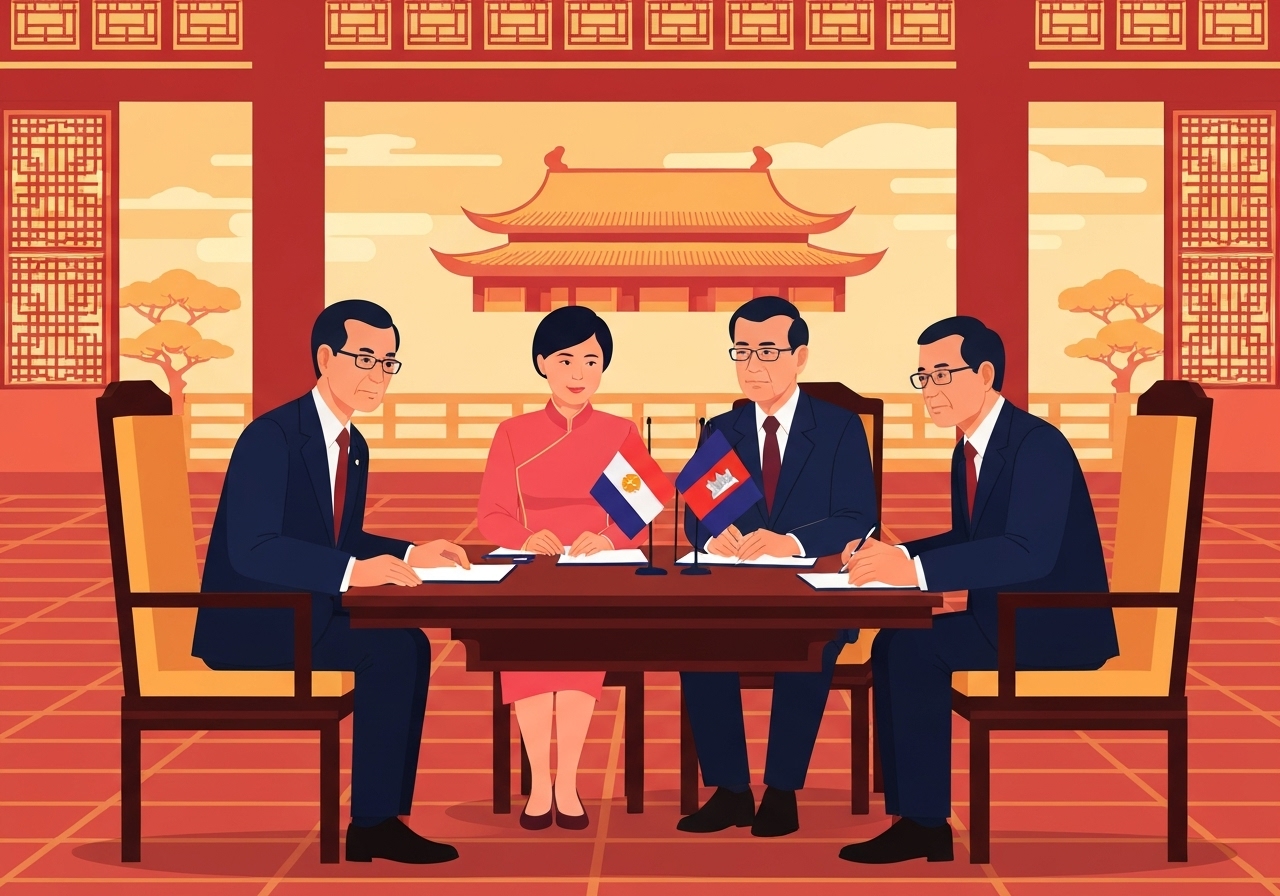
Lead: Senior diplomats from Thailand and Cambodia began two days of talks in southwestern China on Sunday after signing a ceasefire the previous day, aiming to halt weeks of border fighting. The accord, reached on Saturday, pauses combat that has killed more than 100 people and displaced over 500,000 across both countries. Meetings in Yunnan are being mediated by Chinese Foreign Minister Wang Yi and are intended to turn the ceasefire into a sustained lull and open humanitarian access. Officials said the deal includes a 72-hour observation window and arrangements for the repatriation of 18 Cambodian soldiers held by Thailand.
Key Takeaways
- The ceasefire was signed on Saturday and talks began on Sunday in Yunnan, China, mediated by Wang Yi.
- Fighting along the Thailand-Cambodia border has killed more than 100 people and displaced over 500,000 civilians in both countries.
- The agreement includes a 72-hour observation period and a pledge by Thailand to return 18 Cambodian soldiers detained since July.
- China announced 20 million yuan (about $2.8 million) in emergency humanitarian aid to Cambodia and dispatched initial supplies including food, tents and blankets.
- China, the United States and Malaysia have all played roles in brokering earlier pauses; Malaysia and U.S. pressure helped secure a July ceasefire.
- Chinese officials intend to host bilateral sessions with each foreign minister and a trilateral meeting to monitor implementation.
Background
The border dispute between Thailand and Cambodia flared repeatedly in 2023 following competing claims and episodic armed clashes. Localized skirmishes and a second wave of heavier fighting in early December followed months of propaganda and mutual accusations, contributing to a humanitarian crisis near the border. Regional mediators, including Malaysia, previously helped negotiate a July ceasefire that eased tensions temporarily after diplomatic pressure from the United States.
Both capitals have domestic political imperatives that complicate de-escalation: nationalist sentiment and military concerns feature in public discourse in Bangkok and Phnom Penh, and each side has demanded concessions such as the return of detained personnel. China has moved to position itself as a central interlocutor by hosting talks and providing humanitarian aid, framing its role as facilitating communication and stability in its neighborhood.
Main Event
The two-day diplomatic sessions began with separate bilateral meetings between Chinese Foreign Minister Wang Yi and each visiting minister, followed by a planned trilateral meeting intended to agree operational steps to uphold the ceasefire. Delegations focused on mechanisms for freezing front lines, safeguarding civilians, and establishing verification measures during the 72-hour observation period. Officials emphasized humanitarian access for displaced populations and the safe return of noncombatants to homes near the frontier where security conditions permit.
One explicit element of the weekend agreement was Thailand’s commitment to repatriate 18 Cambodian soldiers detained during clashes in July; Phnom Penh had made their return a central demand. China simultaneously announced immediate relief: 20 million yuan in emergency aid and an initial shipment of tents, blankets and food items that reached Cambodia during the talks. Beijing said it would continue providing a platform for sustained dialogue and more detailed communication between the parties.
Thai Foreign Minister Sihasak Phuangketkeow told officials he expects China to both support a durable ceasefire and signal to Cambodia against renewing hostilities. Cambodian Foreign Minister Prak Sokhonn expressed appreciation for China’s role after his talks, and both sides described the weekend sessions as steps toward stabilizing front lines and enabling returns of displaced civilians.
Analysis & Implications
Short-term, the ceasefire and the observation window reduce immediate risks of further mass displacement and civilian casualties, and the repatriation of detained soldiers addresses a central bilateral sticking point. Humanitarian assistance from China can help relieve urgent needs among more than half a million displaced people, but aid deliveries do not address root causes of the border dispute. Sustained monitoring and neutral verification will be crucial to prevent localized flare-ups from reigniting broader combat.
Regionally, Beijing’s active mediation strengthens its diplomatic influence in Southeast Asia by demonstrating capacity to convene and assist neighbours in crisis. That role may complicate Western diplomatic influence at a moment when the United States and Malaysia have also been involved; competing external patrons could either cooperate to stabilize the situation or inject rival pressures that complicate long-term settlement. Thailand’s appeal for China to send a strong signal to Cambodia indicates Bangkok views Beijing as a lever of regional authority.
Politically, both governments face incentives to show firmness domestically while avoiding an open-ended conflict that would damage economies and invite external scrutiny. Economic effects could emerge in border trade and in local agricultural markets disrupted by displacement. If the ceasefire holds and confidence-building steps follow — such as prisoner returns and coordinated humanitarian work — there is a path to de-escalation. Conversely, weak verification, continued nationalist campaigning or incidents along poorly demarcated stretches of the frontier could quickly erode trust.
Comparison & Data
| Metric | Estimate | Source |
|---|---|---|
| Fatalities | More than 100 | ABC News (media) |
| Displaced | Over 500,000 | ABC News (media) |
| Humanitarian aid from China | 20 million yuan (~$2.8M) | ABC News (media) |
| Prisoners to be repatriated | 18 Cambodian soldiers | ABC News (media) |
The table summarizes core, reported figures from the ongoing negotiations and humanitarian response. These numbers reflect estimates and official announcements reported by media and governments during the initial post-ceasefire phase.
Reactions & Quotes
“China stands ready to continue to provide the platform and create conditions for Cambodia and Thailand to have fuller and more detailed communication.”
Chinese Foreign Ministry statement (official)
This statement framed Beijing’s role as facilitator and signaled a willingness to host follow-up sessions focused on implementation. It accompanied announcements of humanitarian aid and the hosting of bilateral and trilateral meetings in Yunnan.
“Thailand does not see China merely as a mediator in our conflict with Cambodia but wants China to play a constructive role in ensuring a sustainable ceasefire by sending such signals to Cambodia as well.”
Sihasak Phuangketkeow, Thai Foreign Minister (official)
Sihasak’s comment underscores Bangkok’s expectation that China will help enforce terms beyond brokering talks, including practical measures to discourage renewed operations by Cambodian forces.
“We appreciate China’s vital role in supporting the ceasefire and the humanitarian assistance provided to displaced people.”
Prak Sokhonn, Cambodian Foreign Minister (official)
Prak’s remark emphasized Cambodia’s public gratitude for Beijing’s mediation and material support, and reinforced Phnom Penh’s interest in using the ceasefire period to secure the return of its detained personnel and to stabilize border communities.
Unconfirmed
- Whether displaced civilians have already begun significant returns to homes near the border remains unclear and depends on local security and services.
- Longer-term verification arrangements and the presence of neutral monitors beyond the 72-hour window have not been fully detailed publicly.
- Reports on the precise chain of events that led to the December escalation remain partially disputed in official statements from both sides.
Bottom Line
The weekend ceasefire and follow-up talks in China reduce the immediate risk of expanded fighting and provide breathing room for urgent humanitarian relief. Concrete steps — notably the 72-hour observation window and the agreed repatriation of 18 Cambodian soldiers — address some immediate sources of tension and create conditions for further confidence-building.
However, the durability of the pause will depend on clear verification, impartial monitoring and political willingness in Bangkok and Phnom Penh to de-escalate nationalist pressures. China’s prominent mediating role strengthens Beijing’s regional influence but does not by itself resolve underlying territorial disputes that will require sustained diplomacy and, potentially, neutral third-party verification.
Sources
- ABC News — (international news wire reporting)
- Ministry of Foreign Affairs of the People’s Republic of China — (official government)
- Ministry of Foreign Affairs, Thailand — (official government)
- Ministry of Foreign Affairs and International Cooperation, Cambodia — (official government)