
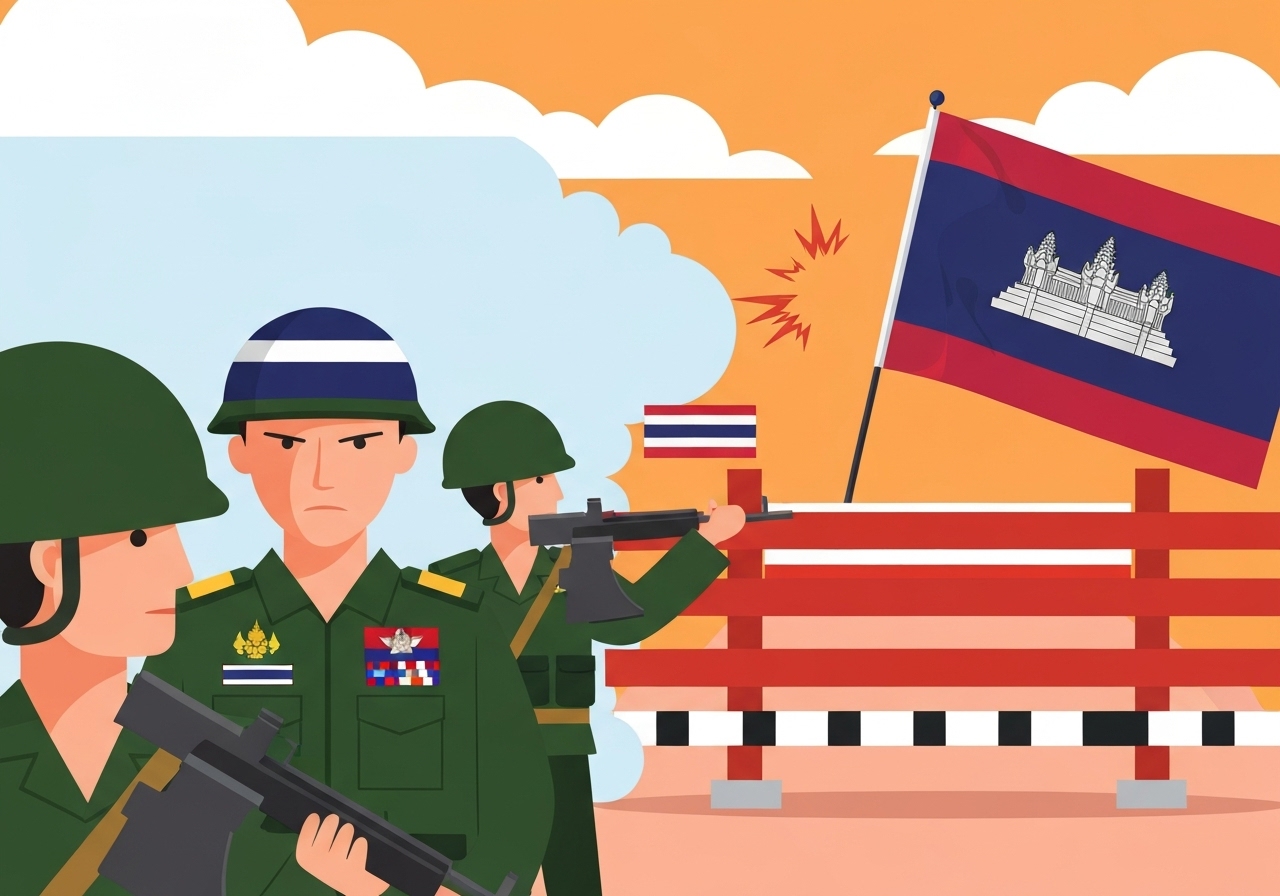
Lead: On 14 December 2025, Thailand’s military launched a fresh operation along the Trat province frontier, saying it moved to reclaim sovereign territory after recent skirmishes. Cambodia responded by closing all border crossings the previous day as violence continued across several sectors of the 800km shared boundary. Officials from Thailand say forces have seized and held contested positions, while Phnom Penh has not issued a parallel battlefield statement. The clashes have compounded a humanitarian crisis that has killed at least 25 people and displaced more than 500,000 on both sides.
Key Takeaways
- Thailand announced a military operation early on 14 December 2025 in Trat province to “reclaim Thai sovereign territory,” according to a Royal Thai Navy spokesman.
- Cambodia announced a full suspension of entry and exit at all Cambodia–Thailand border crossings late on 13 December 2025, citing security risks.
- At least 25 soldiers and civilians have been reported dead in recent weeks of fighting; over 500,000 people have been displaced in both countries.
- Thai sources say forces raised the national flag after driving out opposing units and that army, navy and air force operations continued into Sunday.
- Unverified reports claim Thai F-16s and artillery struck locations in Pursat and Banteay Meanchey provinces; international media could not independently confirm those strikes.
- Thailand imposed a curfew in Trat province as part of its security measures; no comprehensive casualty figures from the latest engagements have been released.
- Diplomatic mediation efforts, including statements by U.S. President Donald Trump asserting a renewed ceasefire, were disputed by Thai officials who said no pause had been agreed.
Background
The confrontation traces back to an enduring dispute over a colonial-era demarcation of the roughly 800km (500-mile) border between Thailand and Cambodia. Boundary lines drawn during the colonial period have long been contested, with recurring flare-ups around monuments, villages and disputed land parcels. Both sides have alternately pressed territorial claims through military patrols and civilian administration, escalating tensions periodically into deadly clashes.
In July 2025, a five-day bout of heavy fighting prompted international concern and a brokered ceasefire, which regional leaders formalized in October at a meeting in Malaysia. That July pause was promoted by Malaysia and secured under external diplomatic pressure, with public figures — including U.S. representatives — urging compliance. The ceasefire appeared fragile; a skirmish on 7 December 2025 that wounded two Thai soldiers is cited as the immediate trigger for the latest round of hostilities.
Main Event
On 14 December 2025 the Royal Thai Navy publicly stated its forces had launched an operation in Trat province to reclaim what it termed sovereign Thai territory. Rear Admiral Parach Rattanachaiyapan was quoted by Thai media as saying the assault began in the early morning with heavy clashes and was conducted under principles of self-defence and protection of national sovereignty. Thai public broadcaster reports said troops placed Thailand’s national flag in retaken areas, and military spokesmen reported joint operations by army, navy and air force units.
Cambodian authorities announced late on 13 December that they were suspending all cross-border movements, an escalation that effectively shut formal crossings between the neighbours. Cambodian official channels did not immediately provide a detailed military account of the 14 December clashes; independent confirmation from Phnom Penh of Thai claims was not published at the time of reporting. State and independent outlets on both sides described sporadic fighting in multiple sectors, including Surin province on the Thai side and Pursat and Banteay Meanchey on the Cambodian side.
Media reports attributed air and artillery strikes to Thai forces in some Cambodian provinces, including an allegation that an F-16 dropped munitions in Thma Da commune (Pursat province) and that artillery struck Boeung Trakoun village (Banteay Meanchey). Al Jazeera and other international outlets said they could not independently verify those strike reports at publication time. Thai authorities imposed a curfew across Trat province and established evacuation centres for displaced civilians as the situation evolved.
Analysis & Implications
The renewed offensive highlights the fragility of agreements backed by outside mediators when underlying territorial disputes remain unresolved. Past ceasefires have reduced immediate violence but failed to address the legal and practical mapping issues — the core drivers of recurring clashes — leaving both sides politically incentivized to hold ground. The latest operation shows Thailand is willing to apply military means to press claims, a posture that risks further institutionalizing armed responses instead of judicial or diplomatic settlement.
Humanitarian consequences are acute. With more than 500,000 displaced across border provinces, local services are strained; shelter, food, water and medical access are immediate priorities. Displacement also raises cross-border contagion risks for public health, and prolonged population movements can deepen socio-economic instability in already marginalised border communities. International aid coordination will be essential, but access may be constrained while crossings remain closed.
Regionally, the clashes complicate ASEAN’s capacity to manage intra-member disputes. Repeated reliance on third-party actors — whether Malaysia or influential external leaders — to pressure both capitals exposes limits in institutional conflict-resolution mechanisms. The public claims by high-profile international figures about ceasefires can create false expectations if not accompanied by verifiable on-the-ground monitoring and mutual, written commitments from both governments.
Comparison & Data
| Metric | Most Recent Period | July 2025 Ceasefire Period |
|---|---|---|
| Reported deaths | 25+ (soldiers and civilians) | Part of five-day combat (July) — multiple fatalities reported |
| Displaced people | 500,000+ across both countries | Large-scale local displacement reported, lower than current totals |
| Border length | Approx. 800 km (500 miles) | Same |
| Notable military assets reported | Alleged use of F-16s, artillery, drones | Conventional arms and ground clashes |
The table summarizes the public figures available from official and media reporting. Data come from government statements and press coverage; independent verification remains incomplete in several contested claims, particularly those concerning air strikes and weapon types used. Numbers for displaced persons are aggregated from cross-border reporting and evacuation centre tallies reported by local authorities.
Reactions & Quotes
Thai government and military spokespeople framed the operation as lawful self-defence to restore sovereignty. Cambodian official channels emphasized border security and moved to suspend crossings to control civilian movement and assess threats. International actors urged restraint while offering mediation — with divergent public narratives about whether a ceasefire had been agreed.
“The operation began in the early morning hours with heavy clashes, conducted under the principles of self-defence according to international law and the preservation of national sovereignty.”
Rear Admiral Parach Rattanachaiyapan (Royal Thai Navy spokesman)
This statement was published by Thai media outlets and cited by state and private broadcasters as justification for the operation. It frames the action as defensive and lawful, a position intended to solidify domestic support and international legitimacy.
“The Royal Government of Cambodia has decided to fully suspend all entry and exit movements at all Cambodia–Thailand border crossings, effective immediately and until further notice.”
Cambodia Ministry of Interior (official statement)
Cambodia’s formal suspension of crossings is a security measure with immediate humanitarian and economic implications, constraining movement for civilians, commerce and aid deliveries. The ministry presented the step as necessary to protect civilians amid active hostilities.
“Some of the public remarks do not reflect an accurate understanding of the situation on the ground.”
Sihasak Phuangketkeow (Thailand’s Foreign Minister)
Thailand’s foreign ministry spokesman and the prime minister later sought to correct externally circulated accounts, including statements by international figures claiming a renewed ceasefire. Officials said no bilateral pause had been authorised by Bangkok at that time.
Unconfirmed
- Reports that Thai F-16 jets dropped bombs in Thma Da commune (Pursat province) have not been independently verified by neutral observers as of publication.
- Claims that Thai artillery struck specific villages such as Boeung Trakoun are reported by local media but lack on-the-ground confirmation from impartial monitoring groups.
- Public assertions by third-party leaders that both countries agreed to a new ceasefire were contradicted by Thai officials and remain uncorroborated by joint written agreements.
Bottom Line
The 14 December 2025 operation and Cambodia’s border shutdown mark a significant escalation in a long-running frontier dispute that previous ceasefires have failed to resolve. Immediate priorities are protecting civilians, ensuring humanitarian access and preventing a broader destabilisation of border provinces on both sides. The mixed public narrative — with rival official accounts and unconfirmed reports of air strikes — complicates efforts to establish an impartial, verifiable ceasefire and deploy monitors.
Longer term, durable peace will require technical boundary work, legal clarity and sustained diplomacy that reduces incentives for military solutions. Regional institutions and neutral observers will need robust access and mandate to verify any future commitments; without that, episodic mediations will likely be followed by renewed clashes. For now, the humanitarian toll and the risk of further escalation make immediate, verifiable de-escalation and international facilitation essential.
Sources
- Al Jazeera (international news outlet) — primary reporting and synthesis of official statements and regional media coverage.
- Matichon Online (Thai newspaper) — quoted Royal Thai Navy spokesman on the operation and conduct.
- Thai PBS (public broadcaster) — reported on flag-raising and military movements in retaken areas.
- Cambodianess (Cambodian news site) — reported alleged strikes in Pursat and other provinces; cited as media reporting.
- Thailand Ministry of Foreign Affairs (government source) — statements from foreign ministry officials clarifying the government position.