
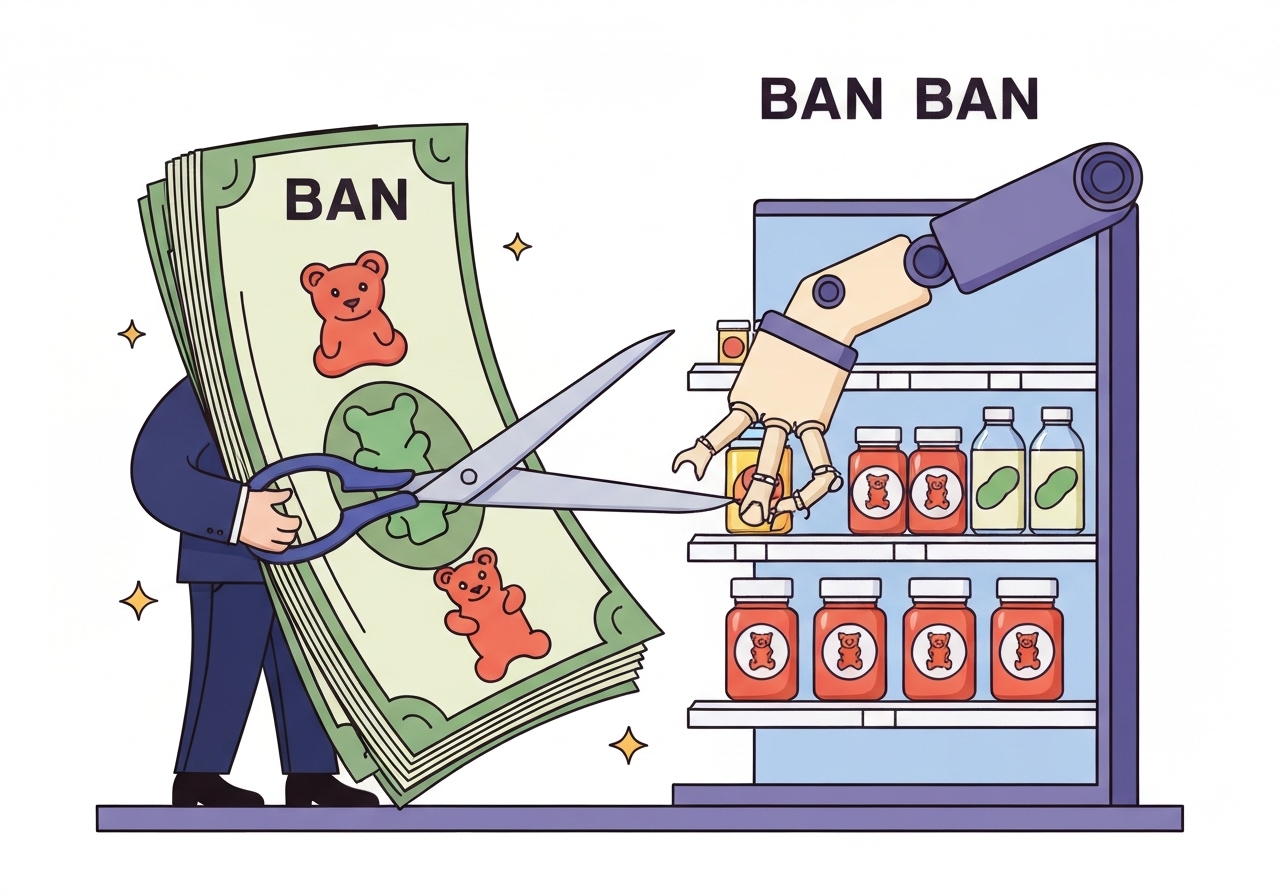
A provision tucked into a federal spending bill signed by President Trump would bar many hemp-derived THC products sold today, including gummies, beverages, topicals and some vapes. The language sets a 0.4 milligram THC limit per container, a threshold industry groups say would remove most retail products from the market. Supporters in Congress and a coalition of state attorneys general say the change closes a loophole from the 2018 Farm Bill; the hemp sector warns of widespread job and revenue losses. Senate debate included an unsuccessful effort by Sen. Rand Paul to remove the provision.
Key takeaways
- The spending bill provision prohibits hemp-derived products that contain more than 0.4 milligrams of THC per container, regardless of labeling.
- The U.S. Hemp Roundtable says the rule threatens a $28.4 billion industry and more than 300,000 American jobs, estimating a 95% market loss if enforced as written.
- Industry groups estimate state tax receipts could fall by roughly $1.5 billion if product sales collapse.
- Sen. Rand Paul offered an amendment to strike the language, but the Senate voted overwhelmingly to table his proposal.
- Supporters, including Sen. Mitch McConnell and multiple state attorneys general, argue the limit addresses exploitation of the 2018 Farm Bill and public-safety concerns.
- Small retailers, farmers and processors say they would need to wind down operations within about a year and face supply-chain disruption.
Background
The 2018 Farm Bill federally legalized hemp, defined by low levels of delta-9 THC, and opened a commercial market for hemp-derived products. That federal change, combined with state-level regulatory gaps, allowed manufacturers to produce low-dose THC items—gummies, drinks, topicals and vape cartridges—that reached mainstream retail, from gas stations to wellness shops. Regulators and some state attorneys general have argued that the law’s text was used by some companies to create intoxicating products or synthetic analogues and that enforcement lagged behind the market’s growth.
Industry trade groups say most consumer hemp products were formulated to stay within federal hemp definitions while meeting consumer demand for pain relief, sleep aids and mild recreational effects. Over recent years the sector grew rapidly, attracting small farms, processors and specialty retailers as well as mainstream distributors. That expansion created political pressure from both sides: public-health officials and law enforcers concerned about unregulated products, and businesses seeking stable federal rules that permit legitimate commerce.
Main event
The spending bill provision sets a specific cap: no more than 0.4 milligrams of THC per container. Lawmakers who supported the language say it closes an exploit in the 2018 Farm Bill that allowed trace THC to be concentrated into consumer goods that can produce intoxicating effects. On the Senate floor, Sen. Mitch McConnell defended the change as necessary to stop companies from transforming small legal amounts of hemp THC into intoxicating substances.
Sen. Rand Paul proposed an amendment to remove the provision, arguing the measure would devastate farmers and small businesses; the Senate voted to table his amendment by a large margin. The U.S. Hemp Roundtable and other industry groups immediately warned of massive economic harm. The Roundtable said more than 90% of non-intoxicating hemp products exceed the new 0.4 mg-per-container limit and that the rule would force many producers and retailers to close.
On public media and C-SPAN, hemp business owners and farmers described the provision as a sudden, existential threat. A hemp farmer identified as Stacy from Woodstock, Illinois, told a live program that topical salves she sells—products she said do not produce a high—would be banned under the new measure and that her company could be shuttered. Photographs from retail outlets, including a scene at Vapor Maven in Aurora, Colorado on August 7, 2025, show THC gummies and related products displayed on shelves prior to the spending bill debate.
Analysis & implications
If enforced as written, the cap would reconfigure the hemp consumer market by removing popular products that currently rely on low-dose THC formulations. Businesses that built supply chains around these items—farmers, processors, manufacturers, wholesalers and retailers—would face rapid inventory losses and legal uncertainty. The industry’s $28.4 billion valuation and 300,000-job estimate offered by trade groups frames the scale of potential disruption, though the precise economic impact will depend on enforcement scope and regulatory interpretations.
Public-health and law-enforcement advocates frame the provision as corrective: tightening a federal definition to limit intoxicating products and protect minors and communities from unregulated THC sources. That argument has traction among governors and dozens of state attorneys general, who told Congress the Farm Bill was being misused by bad actors. Adoption of the new limit may reduce some forms of illicit product distribution but could also push consumers toward untested or black-market alternatives if legal options disappear.
The legal picture remains unsettled. The statutory change in the spending bill alters federal standards but leaves many implementation details to federal agencies and state regulators. Courts may be asked to weigh in on contested interpretations, and companies might pursue compliance strategies—new formulations, package sizing below the limit, or clearer labeling—if regulators permit adjustments. The timing and clarity of agency guidance will be decisive for firms trying to adapt.
Comparison & data
| Metric | Reported figure |
|---|---|
| Industry value (U.S. Hemp Roundtable) | $28.4 billion |
| Jobs supported (estimated) | 300,000+ |
| Projected market loss (industry claim) | 95% |
| Estimated state tax revenue impact | $1.5 billion |
| THC cap in bill | 0.4 mg per container |
Those figures come from industry estimates and legislative text cited during debate. The $28.4 billion valuation and the 300,000-jobs estimate are reported by the U.S. Hemp Roundtable; the 95% market-loss figure is the Roundtable’s projection if enforcement excludes the current product base. Independent verification of those projections will require formal economic analysis and agency rulemaking timelines.
Reactions & quotes
Supporters of the provision described it as a necessary correction to a regulatory gap that allowed questionable products to proliferate. Opponents called attention to immediate harms to small businesses and consumers who use hemp products for health needs.
“They have exploited the loophole by turning legal amounts of THC into intoxicating substances,”
Sen. Mitch McConnell
Sen. McConnell framed the measure as closing exploitation of the 2018 Farm Bill. His remarks were presented to justify federal tightening as a public-safety step rather than a punitive action against legitimate hemp commerce.
“This could not come at a worse time for America’s farmers,”
Sen. Rand Paul
Sen. Paul argued the provision threatens farms and small businesses, urging colleagues to remove the language; his amendment was tabled in the Senate. Industry representatives echoed that concern in media appearances and in calls to congressional staff.
“My business is completely over,”
Stacy, hemp farmer, Woodstock, Illinois (on C-SPAN)
Farmers and small retailers described the practical effects: inventory stranded, contracts disrupted and payroll at risk. Public statements from trade groups emphasized economic ripple effects across rural economies.
Unconfirmed
- The exact share of current retail products that would be illegal under enforcement is based on industry estimates and has not been independently verified.
- How federal agencies will test, measure and enforce the 0.4 mg-per-container limit is not yet publicly specified; implementation details remain pending.
- Potential consumer-protection outcomes—whether the change will reduce youth access or drive products underground—are disputed and lack conclusive evidence at this stage.
Bottom line
The spending-bill provision imposes a sharp new federal limit that, if applied broadly, would remove many legally sold hemp-derived THC products from the market and trigger significant economic pain for farmers, manufacturers and retailers. Proponents call the move a necessary fix to prevent exploitation of the 2018 Farm Bill and to protect public health and law enforcement interests.
The ultimate impact will depend on agency rulemaking, judicial review and whether Congress or regulators offer clarifications or exemptions for medical or therapeutic uses. For consumers who rely on hemp products for pain or sleep, lawmakers and regulators will face pressure to balance access, safety and enforcement in the months ahead.