
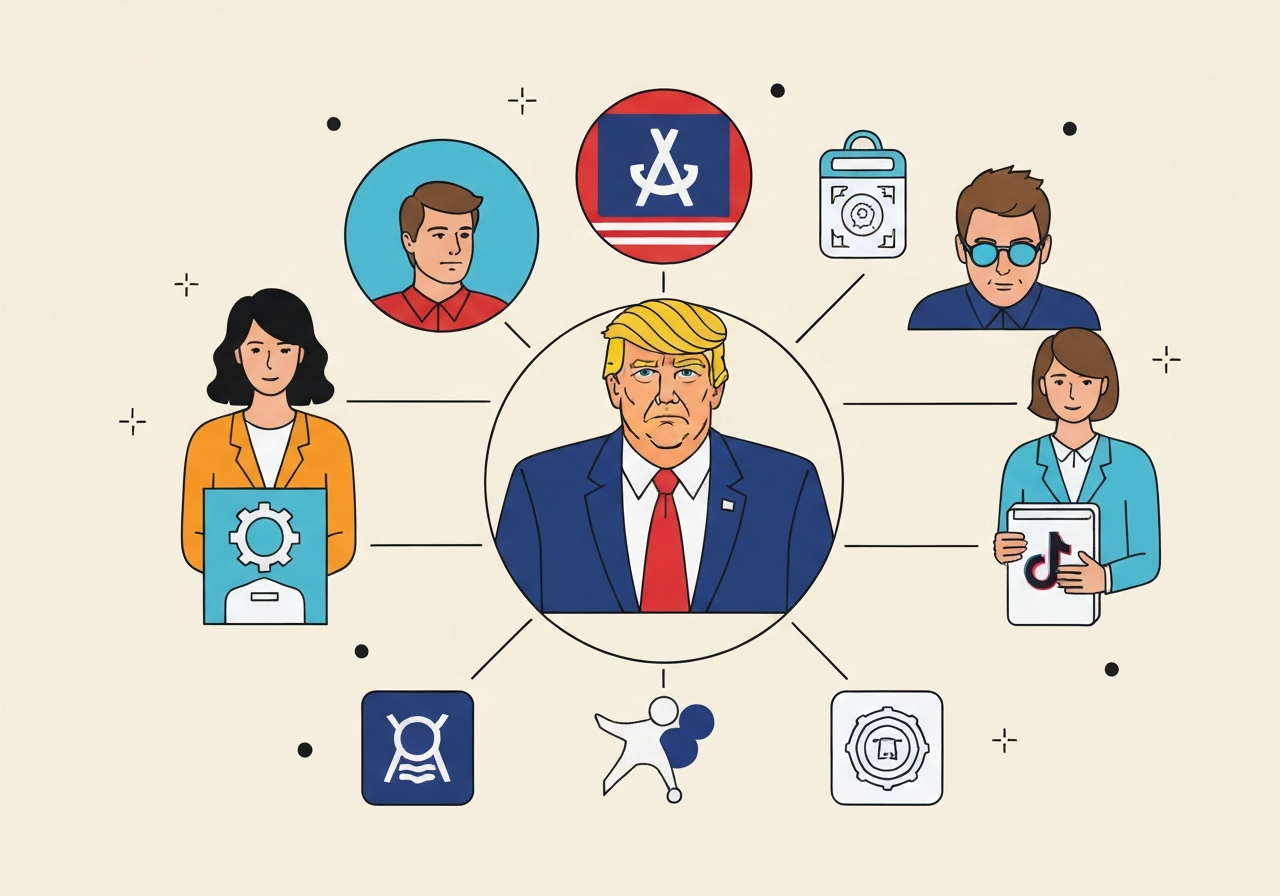
An anti-corruption legal group has sued President Donald Trump and Attorney General Pam Bondi over the agreement that transferred control of TikTok’s U.S. operations to a consortium of administration-backed investors. Filed Thursday in the U.S. Court of Appeals for the District of Columbia Circuit, the complaint argues the transaction flouts a 2024 law designed to block Chinese government political influence and that several participating firms have financially benefited Trump or his circle. The plaintiffs, two California software engineers who say they lost value as shareholders in major tech companies, seek enforcement of the statute and review of the executive actions that paved the deal.
Key takeaways
- The Public Integrity Project filed the lawsuit Thursday in the U.S. Court of Appeals for the D.C. Circuit challenging the TikTok sale and related executive action.
- Congress in 2024 passed a law prohibiting TikTok distribution in the U.S. unless ByteDance placed the app under an American corporate owner by the day before Trump returned to office; the Supreme Court later upheld that law.
- The complaint alleges President Trump issued a September executive order effectively extending the deadline and directed non-enforcement to Attorney General Pam Bondi.
- Investors named in the transaction include Oracle, MGX, and affiliates of Susquehanna International Group and General Atlantic, among others, which the suit ties to the President.
- Plaintiffs are two California software engineers, one saying losses as an Alphabet shareholder and the other as a Meta shareholder, noting concrete financial harm from the alleged non-enforcement.
- The suit notes prior ties between Trump and some investors, including a reported $100,000-per-person fundraiser hosted by Oracle co-founder Larry Ellison.
- Public Integrity Project says the arrangement leaves ByteDance with control of TikTok’s algorithm while U.S. investors control data, creating a split-security arrangement the plaintiffs call risky for users and national security.
Background
TikTok has been the focus of U.S. national security concerns for several years, with legislators and regulators citing the potential for foreign influence through content algorithms and data flows. In response, Congress and the White House moved in 2024 to force a structural separation or U.S.-based ownership for TikTok’s American operations; that statute set a hard deadline tied to the presidential transition. The law was litigated and ultimately upheld by the Supreme Court, narrowing the executive and agency options for managing the platform.
Pressure to resolve TikTok’s status intensified amid competition over user attention, geopolitical tensions with China, and growing scrutiny of the data practices of social platforms. ByteDance, TikTok’s China-based parent, negotiated with potential buyers and partners as U.S. officials pushed for remedies aimed at protecting Americans’ data and reducing the risk of foreign-directed content manipulation. At the same time, private investors and technology companies have pursued transactions and strategic stakes that intersect with regulatory approvals.
Main event
The Public Integrity Project, a newly formed law firm-style advocacy group focused on corruption, brought the suit against President Trump and Attorney General Bondi, arguing that executive direction prevented enforcement of the 2024 statute and enabled the investor-backed transfer. The complaint asserts that after the statutory deadline passed, the President issued an order in September that functionally extended the time for ByteDance to secure a U.S. corporate home and instructed the Justice Department not to pursue the law’s remedies.
According to the filing, the acquisition package names investors including Oracle, MGX, and affiliates of Susquehanna International Group and General Atlantic, among others. The complaint alleges close financial or personal ties between those parties and the President, and it contends those relationships amount to improper enrichment or preferential treatment that the law was meant to prevent.
Two named plaintiffs are California-based software engineers who hold shares in Alphabet and Meta and say they suffered measurable losses because the law was not enforced as written. Their complaint asks the appeals court to review the administration’s actions, enforce the statute, and examine whether the executive directive and non-enforcement are lawful and consistent with the Supreme Court’s interpretation of the 2024 law.
Analysis & implications
Legally, the suit raises separation-of-powers and administrative-law questions about when and how a President can instruct an executive agency not to enforce a statute that Congress passed and the Supreme Court upheld. If the court finds that the executive exceeded lawful authority, the decision could require renewed enforcement or unwind parts of the investor arrangement. Conversely, a ruling for the administration would broaden executive discretion in similar national-security-adjacent disputes.
Politically, the case spotlights potential conflicts between national security goals and private-sector influence. The complaint frames investor involvement as creating a possible feedback loop in which firms with political ties receive regulatory favors; that narrative could intensify scrutiny of future transactions involving politically connected buyers and regulatory approvals tied to the executive branch.
For TikTok users and platform governance, the arrangement alleged in the suit matters because it separates algorithmic control from data control between different owners. That division, if accurate, complicates oversight: U.S. data hosts could restrict information flows while an overseas algorithm steward determines content ranking. Regulators and security experts will debate whether that structure reduces or merely redistributes risk.
Comparison & data
| Investor | Role in deal | Noted ties cited in suit |
|---|---|---|
| Oracle | Data partner/lead investor | Co-founder hosted a high-dollar fundraiser for Trump |
| MGX | Financial investor | Named as participant in acquisition group |
| Susquehanna affiliates | Financial investor | Listed among investor affiliates |
| General Atlantic | Investor | Listed among investor affiliates |
The table summarizes parties identified in the complaint and the types of ties the plaintiffs highlight. While the suit lists concrete incidents, such as a fundraiser with reported $100,000-per-person tickets, it does not itself resolve whether those connections amount to unlawful enrichment; that is a question for courts and potentially for further factual discovery.
Reactions & quotes
The Justice Department declined to comment to reporters, and a TikTok U.S. spokesperson did not immediately respond to requests for comment. The Public Integrity Project emphasized the national-security rationale for the 2024 law and framed the administration action as undermining that statute.
The complaint says the statutory deadline was never enforced, and that executive steps effectively provided an extension that undercut Congress’s mandate
Public Integrity Project filing
The group’s CEO described the resulting structure as one that risks both content control and data control falling under different, potentially hostile, interests
Brendan Ballou, Public Integrity Project
Legal analysts note that the case combines administrative law claims with allegations of improper influence, meaning courts will need to parse statutory text, executive authority, and factual assertions about investor relationships. Public comment from involved private investors has been limited to brief statements or no comment at press time.
Unconfirmed
- Allegations that specific investor transactions directly and personally enriched President Trump are asserted in the complaint but remain to be proven through discovery or other evidence.
- Claims that the post-deal structure will lead to coordinated censorship by separate algorithm and data controllers are plausible points of concern but require technical and operational evidence to confirm.
- Reports that a lead investor is actively seeking additional media acquisitions with administration support are mentioned in filings and public reports but have not been adjudicated in court.
Bottom line
The lawsuit places the TikTok deal at the intersection of national security policy, executive authority, and allegations of political favoritism. The appeals court will be asked to weigh statutory text against executive actions taken after the deadline passed, and its ruling could have implications beyond this specific transaction.
Observers should watch for the court’s approach to remedies: whether it orders enforcement of the statute, pauses aspects of the transaction, or defers to the executive branch. The case also keeps questions about platform governance and investor influence on the national agenda, likely prompting further scrutiny by lawmakers and regulators.
Sources
- NBC News (news report)