
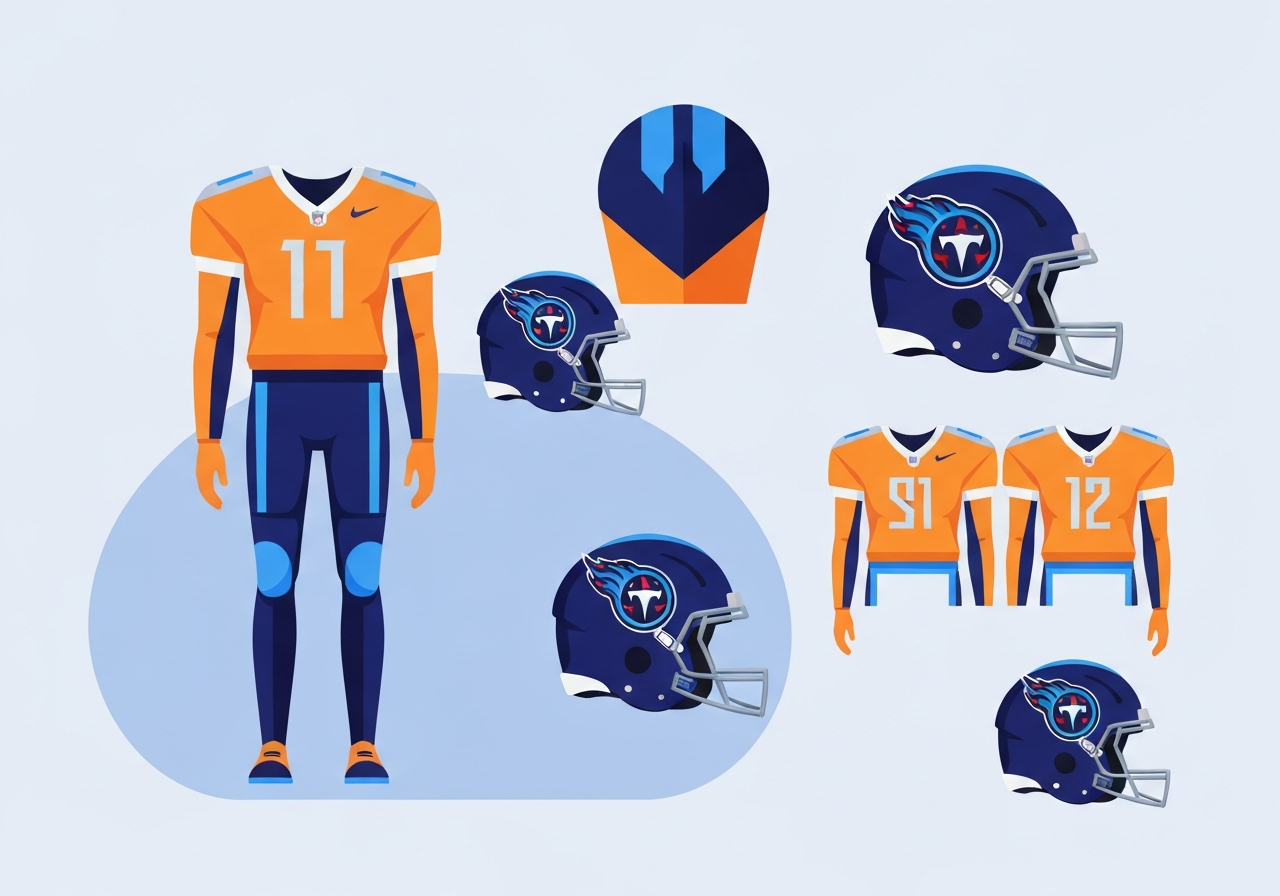
Lead: On Thursday night in Nashville, No. 1 overall pick and new franchise face Cam Ward stepped from a shadowed locker room onto a spotlighted field as the Tennessee Titans formally revealed redesigned logos, helmets and uniforms. The overhaul pairs contemporary styling with deliberate nods to the Oilers-era light blue associated with the late 1970s “Luv Ya Blue” era. Team leaders framed the rollout as the start of a new organizational chapter tied to coaching changes, roster turnover and a planned stadium project. The presentation concluded with the franchise moving forward under a refreshed visual identity while keeping explicit ties to its past.
- New primary look: Home uniform now features blue jerseys with white pants; the primary road set uses white tops with white or light-blue pants, and chest plates read “TITANS” at home and “TENNESSEE” on the road.
- Color palette: A red-white-and-light-blue scheme is central, with light-blue home elements and numerals outlined in red on both sets.
- Logo change: The side-of-helmet emblem drops the flame motif in favor of a circular badge: a stylized “T” over three stars on a blue field inside white and red rings.
- Hidden details: Jerseys include interior markings such as the word “WE,” reflecting a “We Over Me” team mantra embedded into the kit.
- Presentation setting: The reveal took place Thursday night in Nashville and starred 2025 No. 1 overall pick Cam Ward as the visual centerpiece for the franchise’s next era.
- Organizational context: The redesign coincides with a new coaching staff under Robert Saleh, roster changes including key players Jeffery Simmons and Pro Bowl rookie Chimere Dike, and plans for a new stadium.
Background
The Tennessee franchise has long balanced continuity and reinvention since its Oilers origins, and the latest identity work leans intentionally into that duality. For decades the franchise’s palette and some motifs evoked the Houston Oilers’ light blue; designers and team officials say the new aesthetic intentionally references that visual lineage while removing the flame element used for 25-plus years. The change arrives amid high-profile roster moves and front-office transitions, making the rebrand part of a broader organizational reset rather than a purely cosmetic update. Internally, officials framed the rollout as both an homage and an attempt to set a visual course for the franchise over coming decades.
Brand refreshes in professional sports typically serve multiple purposes: merchandising revenue, civic identity, and alignment with strategic shifts on and off the field. The Titans’ decision follows a period of sustained national attention—drafting a No. 1 overall pick, hiring a new coaching staff, and publicly discussing a stadium project—so the timing links identity to commercial and competitive objectives. Past NFL rebrands demonstrate that visual change can rejuvenate fan interest, but they also invite scrutiny from longtime supporters who prioritize historical continuity. Team leadership has emphasized that the redesign is an evolution rather than a rupture with the franchise’s past.
Main Event
The reveal unfolded with theatrical elements: Cam Ward emerged from a dim locker-room set into a spotlight on the field as new helmets, jerseys and logo art were displayed to fans and media. Officials framed the design as synthesizing best elements of previous looks—particularly Oilers-era light blue—while streamlining the emblem to a circular “T”-and-star device in place of the flame. Home jerseys feature a blue top with white pants; road uniforms favor white tops and either white or light-blue pants, and the chest plate lettering switches between “TITANS” (home) and “TENNESSEE” (away). Red trim and outlining accompany light-blue numerals to emphasize a patriotic trio of colors across the set.
Technical details surfaced during the presentation: the helmet bears the new circular badge with three stars atop a blue field framed by white and red rings, and several interior or hidden design elements—most notably the embedded “WE”—underscore a team slogan. Team president Burke Nihill described the work as taking the franchise’s strongest visual cues and refining them to fit current and future needs. The rollout included staged player appearances and multimedia elements that highlighted the uniform materials, cut, and expected on-field look under game lighting. Merchandise previews and retail timelines were shown for fans and partners, indicating an immediate commercial push tied to the debut.
Organizational communications tied the visual identity change to other strategic moves: a new coaching staff led by Robert Saleh, roster shifts including veterans and rookies expected to shape play on the field, and plans for a forthcoming stadium that officials say will be part of the franchise’s next phase. Team media noted that some elements—such as the absence of the flame—represent a stylistic simplification intended to increase logo legibility across digital platforms and merchandise. Fans in attendance posted immediate reactions on social platforms, where responses ranged from enthusiastic praise for the Oilers homage to mixed feelings about removing longtime motifs.
Analysis & Implications
From a branding perspective, the Titans’ redesign follows a familiar playbook: retain recognizability while offering new visual stimuli to boost engagement and retail sales. The deliberate nods to the Houston Oilers-era light blue seek to tap into nostalgia—an effective commercial lever—while the simplified circular badge addresses modern legibility and cross-platform use, especially in smaller digital icons and social avatars. Removing the flame may reduce a distinctive visual cue for some fans, but it also minimizes complexity in reproductions for apparel, broadcast graphics, and helmet decals.
Economically, a rebrand can produce immediate revenue spikes from merchandise sales and renewed sponsorship interest, but sustained financial benefit depends on on-field performance and broader market strategy. The timing—aligned with a high-profile No. 1 pick and organizational turnover—suggests the franchise aims to convert heightened attention into longer-term fan loyalty and brand momentum. For corporate partners and local stakeholders planning around an eventual new stadium, a unified, contemporary brand identity can be leveraged in naming-rights negotiations, design schemes, and community-facing campaigns.
Politically and socially, the franchise must manage fan sentiment: long-tenured supporters may view removal of legacy motifs as erasure, while newer or casual fans may welcome a cleaner, modern mark. The team’s inclusion of explicit historical references and interior details such as the “WE” mantra signal an attempt at balance—preserving lineage while updating appearance. How that balance is perceived will be visible in season-ticket renewals, secondary-market merchandise sales, and social-media discourse across the coming months.
Comparison & Data
| Element | Previous Design | New Design |
|---|---|---|
| Helmet emblem | Flame motif (25+ years) | Circular “T” with three stars; no flame |
| Primary home colors | Dark/navy blue and light blue accents | Light/Titans blue jerseys with white pants |
| Number treatment | Varied outlines | White or light-blue numbers outlined in red |
The table summarizes the most visible shifts: emblem simplification, a stronger emphasis on light-blue heritage, and consistent red outlining across numerals. These changes align with contemporary design trends that prefer scalable marks and palette cohesion. The franchise has indicated an immediate merchandise release schedule tied to the reveal, which will provide first-party sales data to measure initial market reception. Longer-term indicators will include retail sell-through rates, social engagement metrics, and in-stadium signage rollouts tied to the new stadium timeline.
Reactions & Quotes
Team leadership framed the redesign as an evolutionary step intended to honor history while preparing for future chapters. Below are selected short excerpts from the team’s public statements and media coverage, each presented with context.
Burke Nihill, the team president, emphasized continuity and future orientation in the official announcement; his comments were used by team channels to explain the design intent.
“An evolution of the best of who we’ve always been and who we want to be going forward.”
Burke Nihill / Tennessee Titans (team president, official statement)
Team media coverage positioned the redesign alongside organizational change, noting the timing with coaching and roster shifts and the forthcoming stadium conversation.
“The redesign coincides with changing times in the organization.”
Jim Wyatt / TennesseeTitans.com (team writer)
The franchise also highlighted an internal motto embedded in the uniforms to signal cultural intent to players and staff, a detail the team used to explain the symbolic aims of the redesign.
“WE” — a representation of the ‘We Over Me’ mantra included inside the jersey.
Tennessee Titans (team release)
Unconfirmed
- The precise timeline and funding terms for the planned new stadium remain unspecified; public statements describe it as “soon” but offer no firm schedule.
- Exact merchandise release quantities and the scale of initial retail production were presented at the reveal but have not been independently verified by third-party retailers.
- Long-term fan acceptance metrics—season-ticket renewal impact or secondary-market resale trends tied to the redesign—are not yet available and will require multi-month data to assess.
Bottom Line
The Titans’ identity refresh is a calculated mix of homage and modernization: it foregrounds Oilers-era light blue while removing a long-standing flame motif and introducing a simplified circular badge intended for broader digital and physical use. By timing the rollout with a No. 1 overall pick, a new coaching staff, roster turnover and stadium planning, the organization sought to make the visual change part of a narrative about institutional renewal rather than a standalone marketing event. Early indicators—fan chatter, immediate merchandise previews and team messaging—suggest the franchise will measure success across commercial uptake and how well the new look resonates with both long-term supporters and newer audiences.
Expect the most concrete verdicts in the months ahead: retail sell-through will show whether nostalgia-tinged design choices translate to revenue, while on-field performance and community engagement will determine whether the refreshed identity becomes an accepted chapter in the franchise’s history. For now, the Titans have signaled a clear intent to link their visual identity to a multi-year organizational reset; how fans and partners respond will shape whether this becomes a turning point or a transitional moment.
Sources
- NFL.com — sports news report covering the team reveal and quotes (media)
- TennesseeTitans.com — official team site and release detailing design intent and internal commentary (official/team)