
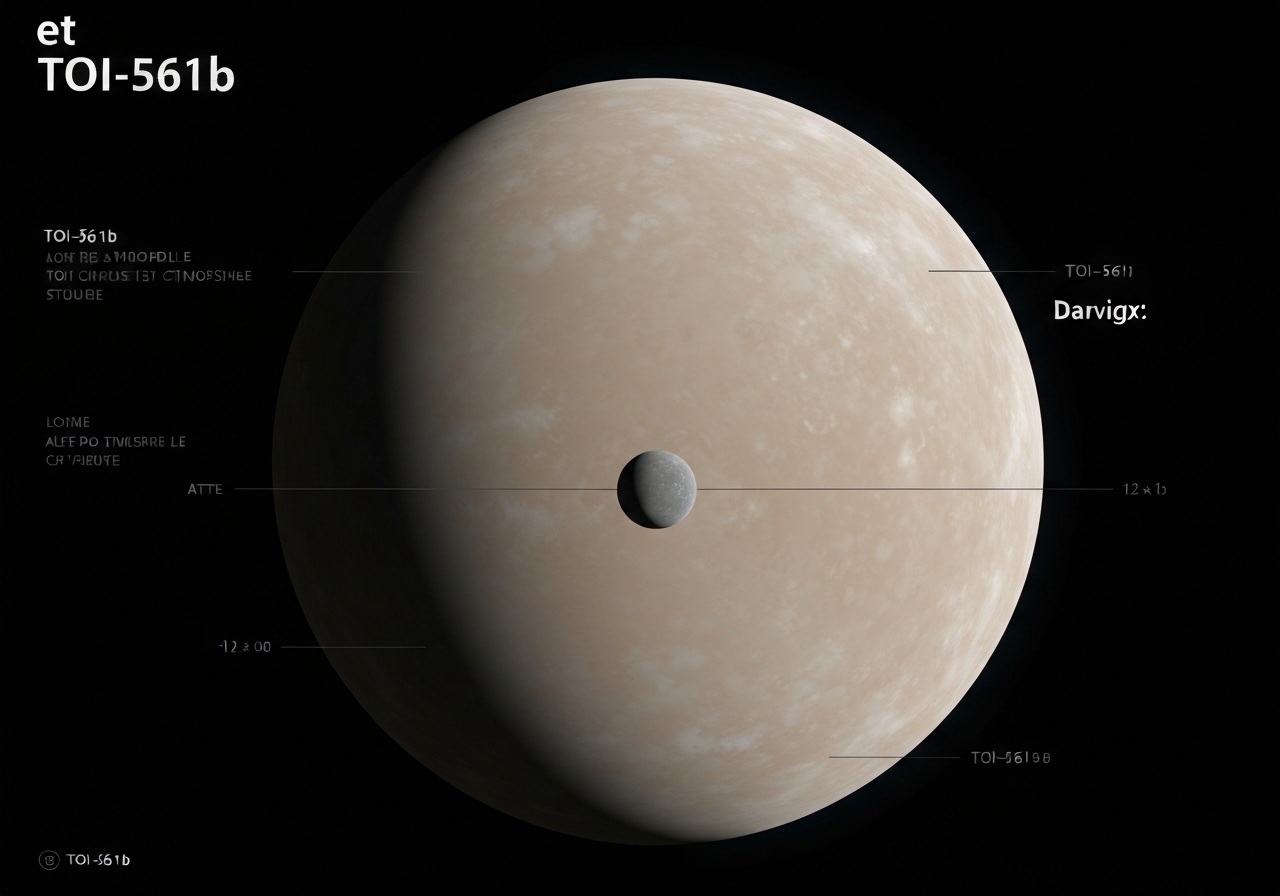
Lead: New observations from NASA’s James Webb Space Telescope indicate that the ultra-hot super-Earth TOI-561b — discovered in 2020 and located outside our solar system — is cooler on its dayside than expected, a result consistent with the presence of a substantial atmosphere. Researchers measured the planet’s dayside temperature during Webb’s Near-Infrared Spectrograph observations and found values near 3,200°F on a world only about 1.4 times Earth’s radius that completes an orbit in roughly 11 hours. The planet orbits a Sun-like star at a distance about 40 times closer than Mercury is to our Sun, a proximity that makes an atmosphere unexpected but not ruled out. The team says the data are best explained by a volatile-rich atmosphere interacting with a global magma ocean — a scenario they describe as a “wet lava ball.”
Key takeaways
- TOI-561b is a hot super-Earth discovered in 2020; its radius is about 1.4 times Earth’s and its orbital period is ~11 hours.
- Webb/NIRSpec measured the planet’s dayside temperature near 3,200°F, substantially cooler than the ~4,900°F predicted for an airless body.
- The planet orbits a star similar in size and temperature to the Sun but lies ~40 times closer than Mercury is to the Sun, accounting for extreme irradiation.
- Low bulk density measured for TOI-561b surprised scientists and suggests an unusual composition or a significant gaseous envelope.
- Authors argue a thick, volatile-rich atmosphere plus reflective silicate clouds or rock vapor exchange with a magma ocean best reconcile the observations.
- Webb observed TOI-561b for more than 37 hours; additional mapping and spectroscopic analysis are planned to constrain atmospheric composition.
Background
TOI-561b was first identified in 2020 and quickly classified as a super-Earth because its radius is modestly larger than Earth’s. Its extremely short orbital period — just under half a day — places it so close to its host star that surface temperatures are expected to vaporize many minerals, producing global magma oceans on the dayside. Planets in this regime are generally thought to be depleted in volatiles due to intense irradiation and early atmospheric escape, making any persistent thick atmosphere an unexpected finding.
Prior ground-based and spaceborne measurements established TOI-561b’s radius and orbital period and suggested a lower-than-anticipated bulk density. Those early results prompted hypotheses ranging from a metal-poor composition to a primordial or secondary gas layer. The James Webb Space Telescope was tasked with deeper characterization because its infrared sensitivity can measure thermal emission and spectral signatures that probe atmospheric gases and clouds on hot exoplanets.
Main event
Researchers used Webb’s Near-Infrared Spectrograph to measure thermal emission from TOI-561b’s dayside over a continuous observing campaign exceeding 37 hours. If the planet lacked an atmosphere, radiative equilibrium models predicted a dayside temperature near 4,900°F (about 2,700°C). Instead, the NIRSpec data indicate a dayside brightness temperature close to 3,200°F (about 1,760°C), roughly 1,700°F cooler than the airless expectation.
That discrepancy led the team to evaluate alternative cooling mechanisms. They considered heat redistribution by magma-ocean circulation and cooling by a thin rock-vapor envelope, but modeling showed neither effect is likely to account for the full temperature difference. The authors therefore favor a model in which a substantial, volatile-rich atmosphere absorbs and redistributes stellar energy, and reflective silicate clouds also play a role in moderating dayside temperatures.
The team proposes a dynamic equilibrium between the atmosphere and a global magma ocean: volatiles outgas into the atmosphere and are partly reabsorbed by the molten surface. Co-author Tim Lichtenberg described the process as simultaneous supply and sink, saying the planet must contain far more volatiles than Earth to match observations. Lead author Johanna Teske emphasized that the new dataset raises further questions about composition and formation rather than providing final answers.
Analysis & implications
Finding evidence consistent with a thick atmosphere on such an intensely irradiated planet challenges simple models of volatile loss and planetary composition for close-in super-Earths. If volatiles persist on TOI-561b, it suggests either a formation pathway that retained or delivered large volatile inventories, or efficient replenishment mechanisms after initial loss. Both possibilities have implications for models of planet formation and migration in inner planetary systems.
An atmosphere with absorbers like water vapor or other volatile species would alter the planet’s thermal emission spectrum and could produce molecular bands that Webb can detect with further observations. Reflective silicate clouds would also affect the planet’s albedo and thermal balance; distinguishing cloud effects from gaseous absorption requires multiwavelength phase-curve and spectral mapping. Those measurements are technically challenging but within Webb’s capabilities given the long observation time already obtained.
On a broader level, TOI-561b expands the diversity of known exoplanet atmospheres and compositions, illustrating that proximity to a star does not always preclude substantial volatile inventories. The result will prompt re‑examination of atmospheric escape rates, interior chemistry, and disk processes that set volatile budgets during planet formation. However, the presence of a thick atmosphere on a 3,200°F dayside does not imply habitability and is of interest primarily for comparative planetology and atmospheric physics.
Comparison & data
| Property | Value |
|---|---|
| Radius | ~1.4 × Earth |
| Orbital period | ~11 hours |
| Proximity to star | ~40× closer than Mercury–Sun distance |
| Predicted dayside (no atmosphere) | ~4,900°F (~2,700°C) |
| Measured dayside (Webb/NIRSpec) | ~3,200°F (~1,760°C) |
The table summarizes the core numeric constraints discussed in the paper and press materials. The measured brightness temperature differs from the airless prediction by roughly 35 percent in absolute Fahrenheit terms and about 940°C in Celsius, a large mismatch that drives the atmospheric interpretation. Future retrievals combining emission spectra and phase mapping are needed to convert these brightness temperatures into constraints on molecular abundances, cloud properties, and the pressure levels of emitting layers.
Reactions & quotes
Researchers framed the result as surprising but physically plausible given the Webb data and modeling efforts. The following short quotes were singled out by the study team and contextualized for readers.
“We really need a thick volatile-rich atmosphere to explain all the observations.”
Anjali Piette, University of Birmingham (co-author)
Piette emphasized that atmospheric absorbers, such as water vapor, can mask wavelengths and reduce the inferred brightness temperature, creating the cooler-than-expected signal seen by NIRSpec. She also noted that bright silicate clouds could reflect starlight and contribute to cooling, a possibility the team includes in some of their models.
“At the same time that gases are coming out of the planet to feed the atmosphere, the magma ocean is sucking them back into the interior.”
Tim Lichtenberg, University of Groningen (co-author)
Lichtenberg used this wording to describe an equilibrating cycle between outgassing and sequestration. That mechanism would require TOI-561b to be far more volatile-rich than Earth to maintain a substantial atmosphere in the face of intense stellar heating and long-term loss processes.
“What’s really exciting is that this new data set is opening up even more questions than it’s answering.”
Johanna Teske, Carnegie Science Earth and Planets Laboratory (lead author)
Teske highlighted that, while the current dataset is compelling, it is only a first step; follow-up analysis of the 37+ hour Webb time series and additional observations will be necessary to identify specific molecules and test competing cooling scenarios.
Unconfirmed
- The precise composition of any atmosphere on TOI-561b — whether water vapor, metal oxides, or other species — has not been directly detected and remains unconfirmed.
- The role and optical depth of silicate clouds versus gaseous absorbers in producing the cooler dayside temperature are not yet constrained.
- Models suggesting magma–atmosphere equilibrium are plausible but dependent on interior composition and volatile inventory, which are not measured.
- Long-term retention of volatiles given the planet’s extreme irradiation is uncertain and depends on escape rates that have not been fully quantified for this object.
Bottom line
Webb’s thermal measurements of TOI-561b present strong evidence that the planet is cooler than an airless model predicts, a discrepancy most naturally explained by a substantial, volatile-rich atmosphere interacting with a global magma ocean and possibly reflective clouds. If confirmed, this would expand the known variety of close-in super-Earths and require revisions to models of volatile survival and interior–atmosphere exchange for intensely irradiated worlds.
Definitive identification of atmospheric constituents and the pressure structure will require further analysis of the existing 37+ hour Webb dataset and additional multiwavelength observations. Regardless of the final interpretation, TOI-561b will become a key laboratory for understanding how atmospheres and molten surfaces interact under extreme conditions, informing theories of planet formation and evolution across the galaxy.
Sources
- CBS News — News report (December 12, 2025)
- NASA / James Webb Space Telescope — official mission pages (agency)
- Carnegie Science — Earth and Planets Laboratory (research institution; lead author’s affiliation)
- University of Birmingham — academic institution (co-author affiliation)
- University of Groningen — academic institution (co-author affiliation)