
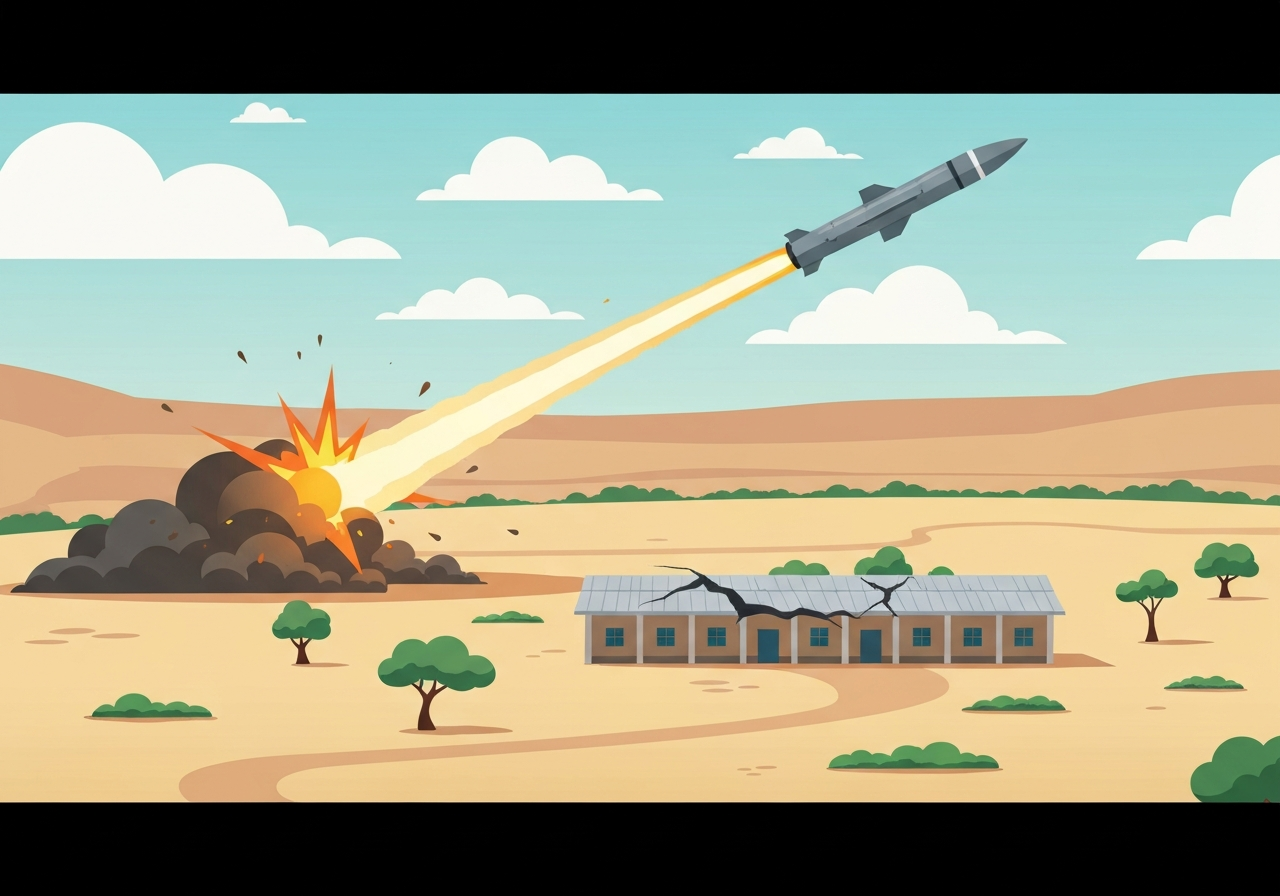
On Feb. 28, 2026, video released by Iran’s semiofficial media and verified by independent researchers suggests a Tomahawk cruise missile struck a naval base adjacent to the Shajarah Tayyebeh elementary school in Minab, Iran, at the same time the school was heavily damaged and local officials reported 175 people killed, many of them children. The footage and corroborating satellite imagery point to a precision strike on the base; the United States is the only party in the current conflict known to operate Tomahawk missiles. U.S. officials, including President Trump and Defense Secretary Pete Hegseth, have said they do not believe U.S. forces struck the school and have questioned other parties’ culpability while an investigation continues.
Key Takeaways
- Video and imagery: A video uploaded by Mehr News Agency and reviewed by open-source investigators shows a missile impact on a naval base beside the Shajarah Tayyebeh school on Feb. 28, 2026.
- Casualties: Local officials reported 175 people killed in the incident, with many victims described as children; those figures remain the official toll disclosed to date.
- Weapon attribution: Tomahawk cruise missiles are currently used only by U.S. forces in this conflict, a central point in attributing the strike.
- U.S. statements: President Trump publicly asserted Iran was responsible; Defense Secretary Pete Hegseth said the Pentagon is investigating and accused Iran of targeting civilians.
- Verification sources: The new video complements satellite imagery and several previously verified clips cited by investigative groups and newspapers.
- Timing and alignment: Evidence indicates the strike on the naval base and the damage to the school occurred concurrently, consistent with a single precision attack affecting both targets.
Background
The town of Minab sits in southern Iran and hosts a naval facility operated by the Islamic Revolutionary Guards Corps (IRGC). The Shajarah Tayyebeh elementary school is adjacent to that base, placing a civilian structure within close proximity of a military target. In recent months, the conflict in the region has led to heightened strikes on military infrastructure, and concerns over civilian exposure near such facilities have been raised by humanitarian groups.
Tomahawk cruise missiles are long-range, precision-guided weapons with a history of use by the U.S. military; within the present theater of operations, they are associated with American forces. Open-source investigators and news organizations have increasingly relied on satellite imagery, metadata, and multiple independent videos to reconstruct events when access on the ground is limited. Those methods have become crucial for verifying incidents where combatants dispute responsibility.
Main Event
The footage at the center of the reporting shows a missile strike that impacts a compound identified as a naval base located immediately beside the elementary school. Analysts compared visual features in the clip with satellite images taken days after Feb. 28 and found damage patterns consistent with a precision strike on the base and severe structural harm to the nearby school building. Local emergency responders and officials reported a high death toll, stating 175 people were killed, many described as children.
Following the emergence of the video, U.S. officials were asked about American involvement. President Trump rejected that U.S. forces had bombed the school, saying in a public remark that, based on what he had seen, Iran was responsible and characterizing Iranian munitions as inaccurate. Defense Secretary Pete Hegseth, standing beside the president, said the Pentagon was investigating and reiterated a claim that Iran targets civilians.
Independent investigators, including open-source research groups, traced the clip to a release by Mehr News Agency and cross-referenced it with other open material, including additional social-media posts and satellite imagery. That body of evidence, while not a closed legal attribution, indicates a Tomahawk-class strike on the naval base at the same time the school was struck.
Analysis & Implications
If the strike on the naval base was delivered by a Tomahawk missile, attribution would point to U.S. forces because no other party in the current fighting is known to deploy that system. Such a finding would complicate diplomatic messaging from Washington, which has sought to limit direct accusations while also supporting certain regional partners. A confirmed U.S. strike with high civilian casualties would raise immediate legal and political questions under the laws of armed conflict about target selection and proportionality.
For Iran, the civilian deaths—especially of children—could harden public sentiment and provide a rallying point for political leaders who oppose negotiations or restraint. Regionally, the incident risks escalating tensions, prompting condemnations, possible retaliatory rhetoric, and pressure on third-party states to take public positions or adjust military assistance. Humanitarian organizations would likely intensify calls for investigations and enhanced civilian protections near military facilities.
Operationally, the episode underscores the risk of locating military assets adjacent to civilian infrastructure. Militaries that position forces or weapons close to schools and markets increase the chance that precision strikes on those military assets will cause disproportionate civilian harm, even if the weapon functions as designed. That dynamic fuels legal, ethical, and strategic debates about force posture and the mitigation of civilian risk in contested environments.
Comparison & Data
| Date | Location | Target | Reported deaths |
|---|---|---|---|
| Feb. 28, 2026 | Minab, Iran | Naval base beside elementary school | 175 (official local report) |
The table above summarizes the confirmed date, location and the official casualty figure released by local authorities. Open-source verification linked the timing of the naval base strike with damage to the adjacent school; that temporal overlap is central to debates about whether two proximate effects resulted from a single precision engagement. Analysts caution that while imagery and video can strongly suggest a strike type and impact location, full legal attribution typically requires weapon fragments, munitions serials, or access to munition logs—items not publicly available at this time.
Reactions & Quotes
No, in my opinion and based on what I’ve seen, that was done by Iran.
President Trump, public remark
President Trump publicly suggested Iran was responsible and questioned the accuracy of Iranian munitions, framing the incident as evidence against U.S. culpability. His statement came before the wider assembly of imagery and video was circulated by investigators.
The Pentagon is investigating, but the only side that targets civilians is Iran.
Pentagon Secretary Pete Hegseth
Defense Secretary Hegseth reiterated an accusation against Iran while stating the U.S. would review the available information. That position contrasts with open-source investigators who say the footage indicates a Tomahawk-class impact on the naval base.
We have located footage showing an impact at the naval base adjacent to the school that aligns with post-strike satellite imagery.
Open-source investigative groups and media verification teams
Independent verification groups described a convergence of visual evidence and satellite data that supports a timeline in which the base strike and the school damage occurred contemporaneously.
Unconfirmed
- No publicly available munition fragments or launch logs have been produced that conclusively confirm the missile type and origin.
- The chain of custody for all circulated videos and posts has not been independently verified to the standard required for legal attribution.
- Some local casualty reports have yet to be independently corroborated by neutral humanitarian organizations on the ground.
Bottom Line
The newly surfaced video and supporting satellite imagery significantly strengthen the case that a precision strike hit a naval base immediately adjacent to an elementary school in Minab on Feb. 28, 2026, and that the attack coincided with extensive damage to the school and a high civilian death toll reported at 175. Because Tomahawk missiles are, in this theater, associated with U.S. forces, the evidence raises difficult questions about attribution and civilian harm; however, investigators and officials still lack the direct munition-level proof that would constitute incontrovertible legal confirmation.
Short-term, expect intensified diplomatic exchanges, calls for an independent inquiry, and renewed scrutiny of military force postures that place combat assets near civilian structures. Longer-term, the incident may shape debates on targeting practices, the responsibilities of occupying or intervening forces, and the role of open-source verification in establishing public fact in conflict zones.
Sources
- The New York Times (international newspaper; investigative reporting and verification)
- Mehr News Agency (Iran semiofficial news agency; original video release)
- Bellingcat (independent investigative collective; open-source analysis)