
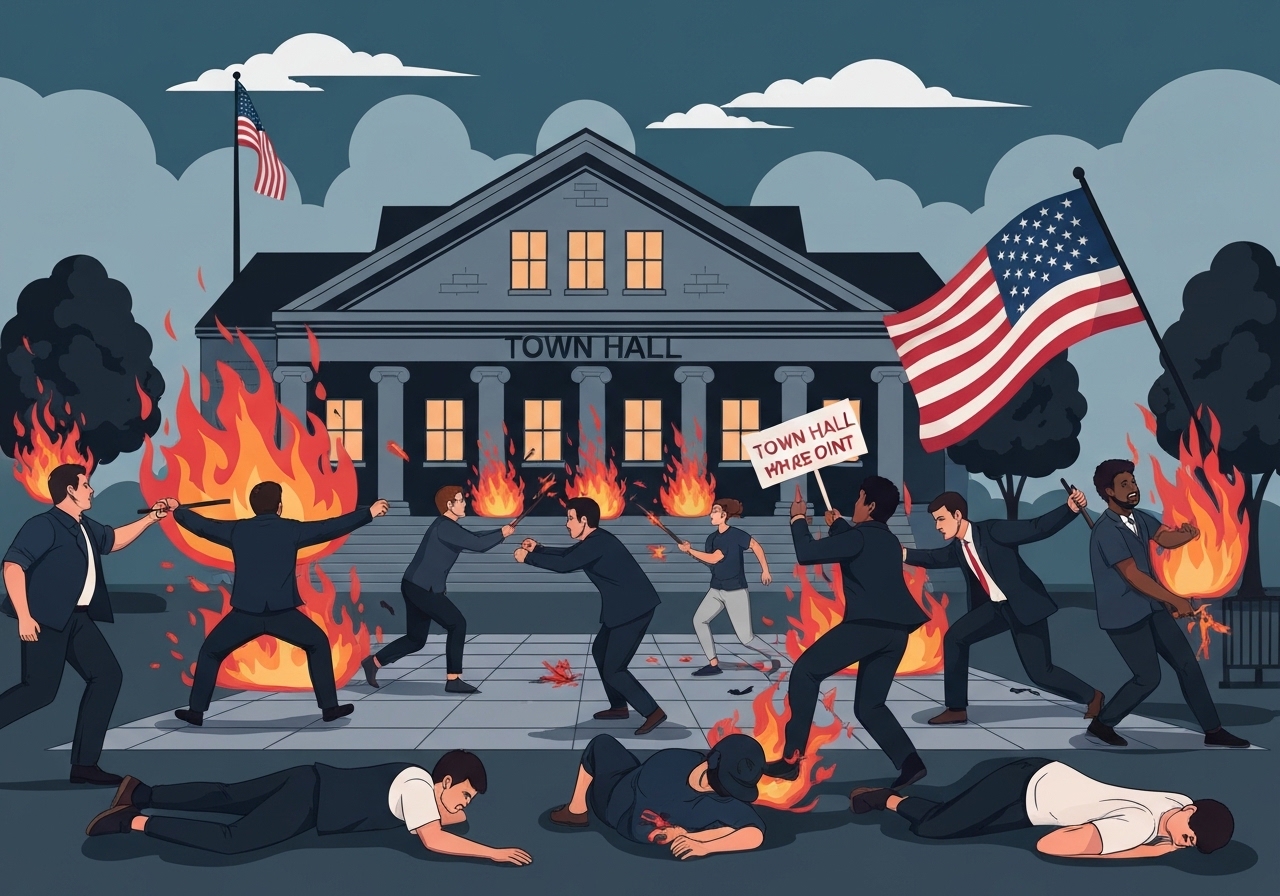
Lead: On the evening of Jan. 28, 2026, Representative Ilhan Omar was assaulted at a Minneapolis town-hall meeting when an attendee rushed the stage and used a syringe to spray a vinegar-scented liquid before being subdued by security. The incident came as U.S. Capitol Police data show threats against lawmakers surged to 14,938 last year, up from 9,474 in 2024. The attack, set against a day of heated political rhetoric and protests, has intensified concern about the growing overlap between partisan conflict and real-world violence.
Key Takeaways
- Representative Ilhan Omar was sprayed with a foul-smelling liquid delivered from a syringe at a Minneapolis town hall on Jan. 28, 2026; the assailant was tackled and detained immediately.
- U.S. Capitol Police recorded 14,938 threats against members, staff and families in 2025, up from 9,474 in 2024, a roughly 57% year-over-year increase.
- The episode followed a day in which former President Donald Trump campaigned in neighboring Iowa and criticized Ms. Omar on national television earlier the same day.
- The attack occurred amid broader unrest tied to protests over immigration enforcement and the recent killings of two American citizens by federal agents; those events have inflamed public debate.
- Security officials, lawmakers and civil-society groups warn that the escalation in threats is straining protective resources and chilling public engagement with elected officials.
- Local law enforcement and the Capitol Police have opened investigations; toxicology and motive remain under active inquiry.
Background
Political tension in the United States has risen across multiple fronts through 2025 and into January 2026. Immigration enforcement operations, high-profile law-enforcement shootings and polarized messaging from major political figures have combined to heighten anxiety among both officials and constituents. In recent months, demonstrations and counter-demonstrations over federal immigration actions have appeared in state capitals and congressional districts, increasing the frequency of confrontations at public events.
Historically, threats to members of Congress have ebbed and flowed with national crises; however, the latest U.S. Capitol Police figures indicate an acute uptick in both quantity and severity of reported cases. Lawmakers from both parties increasingly report menacing correspondence, in-person harassment and organized attempts to disrupt constituent events. These developments coincide with constrained security budgets and a public appetite for in-person access to elected officials, creating a tension between outreach and officer safety.
Main Event
According to witnesses and local law enforcement, the Minneapolis town-hall began as a scheduled constituent meeting. Midway through the event, a man approached the stage and sprayed Representative Omar with a liquid from a syringe that attendees described as smelling like vinegar. Security personnel and nearby attendees quickly tackled the individual and restrained him while paramedics and police responded.
Ms. Omar was treated at the scene and was not transported for life-threatening injuries, officials said. Law enforcement officers collected the syringe and detained the suspect; investigators later said preliminary tests were ongoing to determine the composition and potential toxicity of the substance. The suspect was charged under local statutes; federal authorities are coordinating aspects of the probe.
Earlier the same day, a high-profile political rally and television appearance had raised the temperature of national discourse. Officials and outside observers noted the town-hall attack within hours of that rhetoric, prompting debate about the role of inflammatory political language and its link, if any, to violent acts. Minneapolis police, the U.S. Capitol Police and federal prosecutors have each indicated they will examine possible connections as part of parallel inquiries.
Analysis & Implications
The spike in threats against lawmakers complicates democratic practice. When elected officials face persistent menacing behavior, they may curtail in-person events, reducing direct accountability and constituent access. The 57% increase in reported threat cases from 2024 to 2025 suggests both a higher volume of incidents and possibly greater reporting—but either interpretation has consequences for civic norms and the mechanics of representation.
Security resources are finite. Local police departments and the U.S. Capitol Police must allocate officers to protect many potential targets, from legislators to public events. That reallocative pressure can leave other community policing needs underserved and raise costs for municipalities and the federal government. Agencies may respond by raising protective postures or by advising more virtual or controlled engagements, which further alters the relationship between representatives and constituents.
Politically, incidents like the Minneapolis attack deepen partisan fault lines. Opposing camps interpret causation differently—some stressing incendiary rhetoric as a precipitating factor, others emphasizing individual criminality or extremist influences. Either reading can drive further polarization in policy and messaging, which, in turn, may sustain or intensify threats and protests across jurisdictions.
Comparison & Data
| Year | Reported Threat Cases (U.S. Capitol Police) |
|---|---|
| 2024 | 9,474 |
| 2025 | 14,938 |
Those figures, released by the U.S. Capitol Police, show a marked year-over-year increase. Analysts caution that an uptick in reporting can reflect heightened awareness as much as a rise in incidents; nevertheless, the absolute increase places added operational strain on protection services and has prompted congressional and law-enforcement reviews of protocols and resources.
Reactions & Quotes
Officials and outside observers offered immediate responses that illustrate the breadth of concern.
“This kind of violence has no place in our politics—elected officials should be able to meet constituents safely.”
Minneapolis Police Department (official statement)
The Minneapolis Police Department emphasized the need for an orderly investigation and public safety, while noting that the incident is being treated as a criminal assault. Local leaders called for calm and patience while toxicology results and motive assessments proceed.
“Threats against members of Congress and their staff surged last year, and the safety of public servants is a matter of national concern.”
U.S. Capitol Police (data release)
The U.S. Capitol Police framed the numerical rise as the basis for reassessing protective measures. Agency leaders signaled intentions to brief Congress on resource needs, protective posture adjustments and interagency coordination to counter growing risks.
“We must de-escalate rhetoric and recommit to civic norms that allow disagreement without danger.”
Civic-watch group (independent analyst)
Nonpartisan civic organizations urged leaders across the political spectrum to temper language and restore clearer lines between political debate and violent action, warning that continued escalation could further impair democratic engagement.
Unconfirmed
- Whether the liquid used in the attack was chemically harmful remains unconfirmed pending laboratory analysis.
- Direct causation between political rhetoric earlier that day and the assailant’s motive has not been established by investigators.
- Any broader plot or organized coordination behind the individual attacker has not been publicly substantiated as of this writing.
Bottom Line
The Minneapolis attack on Representative Ilhan Omar is the latest concrete marker of an increasingly hazardous environment for public officials. With threat reports to the U.S. Capitol Police rising sharply, both protective agencies and lawmakers face difficult choices about how to balance safety with open constituent engagement. The immediate facts remain partial—laboratory results and investigative findings are still forthcoming—but the broader pattern underscores a national challenge: preserving democratic access while countering a rising tide of threats and politically charged violence.
Policymakers, law-enforcement leaders and civic groups must now weigh short-term security responses against longer-term efforts to reduce incendiary messaging and strengthen public norms. The coming days and weeks of official reports and local investigations will better define responsibility and causation; for now, the incident has already reshaped conversations about access, safety and the limits of political rhetoric in American public life.
Sources
- The New York Times (news report)
- U.S. Capitol Police (official data release)
- Office of Representative Ilhan Omar (official congressional office)