
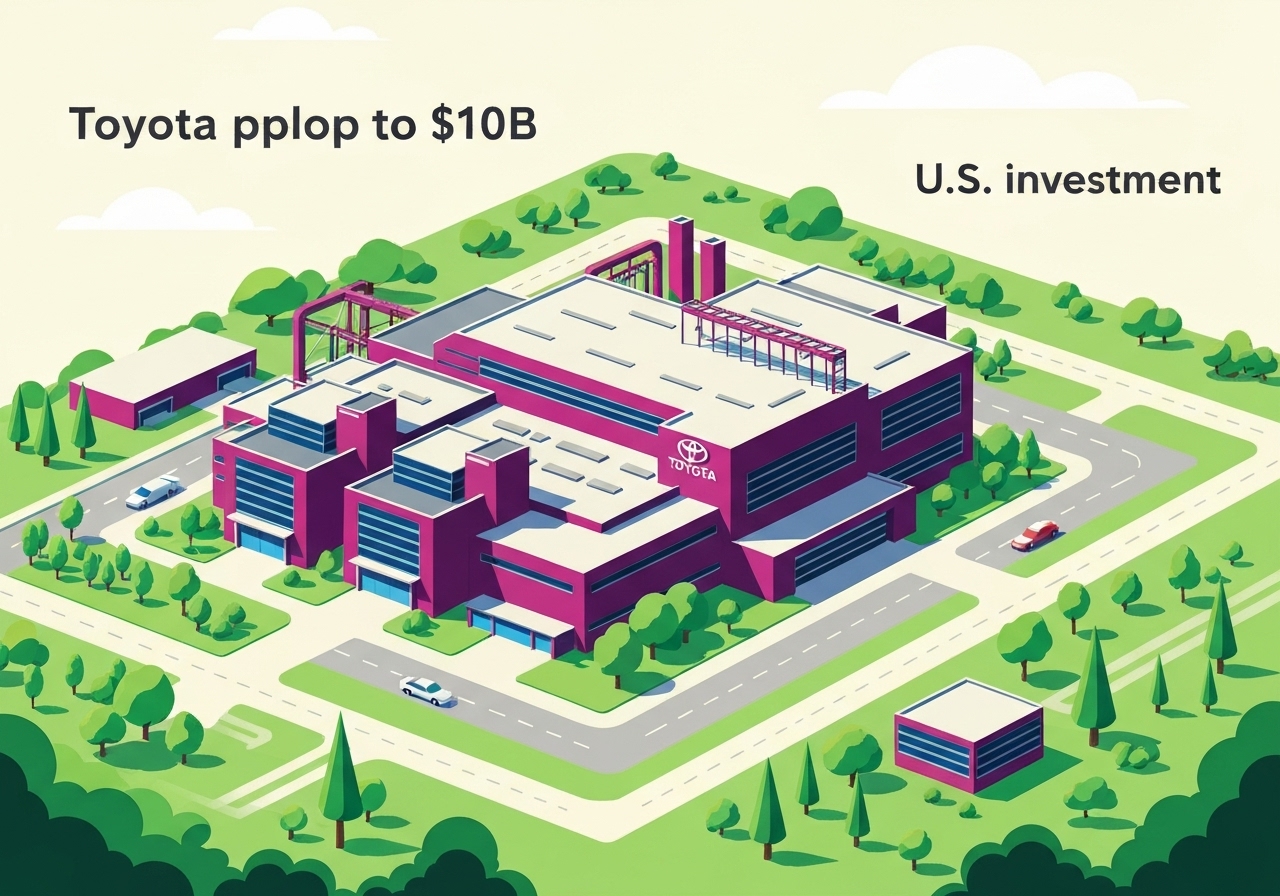
Lead: Toyota began producing battery cells this week at a newly completed $13.9 billion facility in North Carolina and announced plans to increase U.S. investment by as much as $10 billion over the next five years. The move marks Toyota’s first in-house battery factory outside Japan and arrives amid shifting demand away from full battery-electric vehicles toward hybrids. Company executives called the development a pivotal step for Toyota’s U.S. operations. The announcement also follows public comments last month from President Donald Trump about a planned Toyota investment in the United States.
Key Takeaways
- Toyota has started production at a $13.9 billion battery plant in North Carolina, its first in-house battery site outside Japan.
- The company confirmed it will invest up to $10 billion more in the U.S. over the next five years; details on the additional spending were not disclosed.
- Tetsuo Ogawa, CEO of Toyota Motor North America, described the plant and the added investment as a “pivotal moment” for the company.
- The plant was first announced in December 2021 amid U.S. policy pushes to onshore battery production for electrified vehicles.
- Through the third quarter of this year, Toyota held more than 51% of U.S. hybrid sales and reported U.S. sales up 9.9% to over 1.3 million vehicles.
- Market conditions for full EVs have softened recently while demand for hybrids has risen, a trend favourable to Toyota’s product mix.
- The company and the broader auto industry continue to adjust plans as U.S. trade and regulatory policy evolves, including tariffs and incentives that affect sourcing.
Background
The North Carolina battery plant was announced in December 2021 as part of a broader push by U.S. policymakers to bring critical EV and hybrid supply chains onshore. Federal incentives and state-level offers since then have encouraged automakers to site battery production in the United States, reducing reliance on overseas suppliers. Toyota’s decision to build an in-house plant reflects that strategic shift; until now the company relied largely on external suppliers for large-scale battery cell manufacturing.
Since the plant’s announcement, the U.S. market for electrified powertrains has evolved: sales growth for full battery-electric vehicles has cooled from earlier projections while hybrid vehicles have seen accelerating demand. Toyota has remained the U.S. leader in hybrid sales, holding a majority share through the third quarter. At the same time, global and domestic policy — from the Inflation Reduction Act incentives to recent tariff announcements — has added layers of complexity to automakers’ investment calculus.
Main Event
Toyota confirmed on Wednesday that cell production has begun at the $13.9 billion facility in North Carolina. Company materials and the North American CEO framed the start of operations and the new investment guidance as a major milestone in the company’s U.S. strategy. Toyota did not publish detailed schedules for ramping capacity, nor did it break down how the up-to-$10 billion figure is allocated across projects or states.
The plant is Toyota’s first vertically integrated battery manufacturing site outside Japan, intended to supply cells for the company’s electrified lineup, with an emphasis on hybrids as well as battery packs for plug-in and full-electric models where appropriate. Toyota executives have repeatedly emphasized a multi-path electrification approach — hybrids, plug-in hybrids, fuel cells and battery-electric vehicles — and this facility fits into that broader manufacturing plan.
The investment announcement comes against a backdrop of public attention: last month President Donald Trump said Toyota would invest $10 billion in the U.S., and Toyota’s confirmation formalizes a substantial increase in planned U.S. spending, though the company did not specify which projects are new versus previously planned. The industry continues to manage uncertainty tied to trade policy, proposed tariffs, and changing consumer preferences.
On the sales side, Toyota reported U.S. deliveries through the third quarter rose 9.9% to more than 1.3 million vehicles, reinforcing its market position during the transition to a more hybrid-focused consumer base. The company’s hybrid market share in the U.S. exceeded 51% through Q3, according to industry data, underscoring why the automaker is doubling down on domestic battery capacity.
Analysis & Implications
Toyota’s investment accelerates a trend of automakers moving critical parts of the EV and hybrid supply chain to North America. Domestic battery production can shorten supply chains, reduce exposure to import tariffs, and increase eligibility for federal incentives that require local content. For Toyota, a strong hybrid lineup means domestic cell capacity could be deployed flexibly across product types as market demand shifts.
Financially, a $13.9 billion plant plus up to $10 billion in additional U.S. investment represents a major capital commitment that could reshape supplier relationships and regional manufacturing footprints. The immediate economic benefits — construction spending, supplier contracts and long-term manufacturing jobs — will be closely watched by state and federal officials, though Toyota has not released a full jobs estimate tied to the announcements.
Strategically, the move hedges against policy and trade risks. Tariffs or sourcing restrictions can raise costs for imported batteries and components; onshoring mitigates that exposure and improves Toyota’s ability to qualify for domestic incentives. It also raises the bar for competitors seeking scale in the U.S. battery market, particularly for manufacturers that have relied heavily on third-party cell suppliers.
Comparison & Data
| Metric | Figure |
|---|---|
| Battery plant cost | $13.9 billion |
| Additional U.S. investment announced | Up to $10 billion over 5 years |
| Toyota U.S. sales (through Q3) | More than 1.3 million vehicles, +9.9% |
| U.S. hybrid market share (through Q3) | More than 51% |
The table above summarizes the headline figures disclosed by Toyota and referenced industry data. These numbers position Toyota for stronger domestic control of battery manufacturing at a time when policy incentives and trade measures have increased the strategic value of local production. Observers will track how much of the newly disclosed $10 billion is incremental versus previously announced but unfinalized commitments.
Reactions & Quotes
Company leadership framed the plant opening and the expanded investment as central to Toyota’s North American strategy. Executives emphasized continuity with the firm’s long-term electrification approach and the plant’s role in supplying a range of electrified powertrains.
“This is a pivotal moment in our history,”
Tetsuo Ogawa, CEO, Toyota Motor North America (company release)
The CEO’s comment appeared in Toyota’s announcement materials and was cited by media outlets covering the production start. Company spokespeople did not add a detailed breakdown of the $10 billion figure at the time of the release, leaving analysts to seek clarification on timing and allocation.
“Toyota will invest $10 billion in the U.S.,”
President Donald Trump (public statement reported by news media)
That public claim last month drew attention to the automaker’s investment plans; Toyota’s announcement this week confirms a large increase in U.S. spending but stops short of mapping every dollar to specific projects. Industry groups and policymakers welcomed the expanded U.S. investment while asking for more granular details on jobs and supply-chain impacts.
Unconfirmed
- How much of the up-to-$10 billion announced is truly new investment versus previously planned but not publicly detailed remains unspecified.
- Toyota has not published official figures for the plant’s annual cell production capacity or the total number of long-term manufacturing jobs tied to operations.
- Any specific timeline for how the additional $10 billion will be allocated across facilities, EV programs or supply-chain investments has not been disclosed.
Bottom Line
Toyota’s start of production at the $13.9 billion North Carolina battery plant, together with up to $10 billion more in U.S. investment, is a significant commitment to domestic electrified-vehicle supply chains. The move aligns with Toyota’s hybrid-focused sales strength in the U.S. and insulates the company from some trade and policy risks tied to imported battery cells. However, the announcement leaves important details unresolved, including exact allocation, capacity, and employment impacts.
For policymakers and competitors, the development signals that large-scale battery manufacturing is becoming a central component of U.S. auto industry strategy. Observers should expect follow-up disclosures from Toyota about project-level spending, capacity ramp schedules, and supplier partnerships as the company moves from startup to full production.
Sources
- CNBC (news report summarizing company announcement and context)
- Toyota Motor North America Pressroom (official company announcement)
- Motor Intelligence (industry data on hybrid market share and sales)