
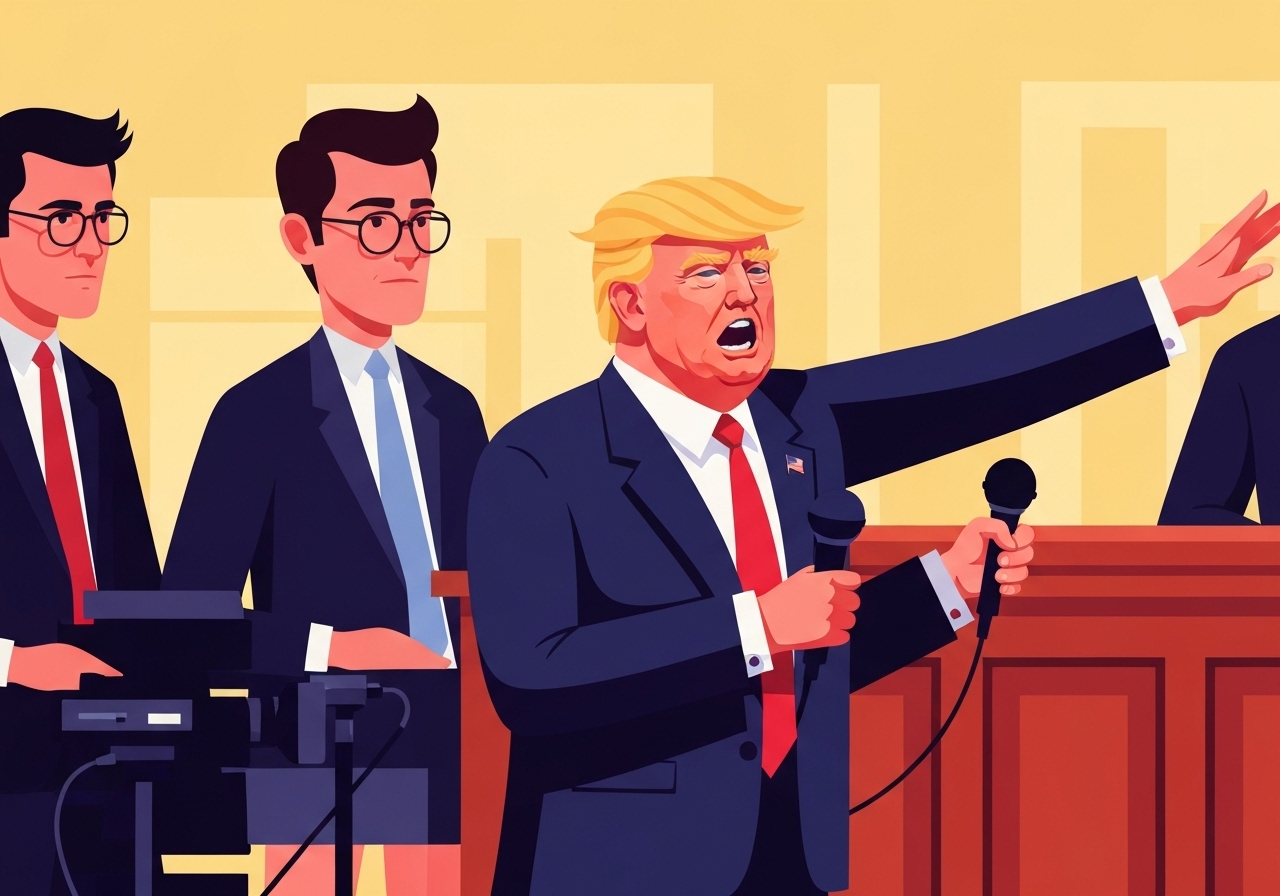
Lead: Former US President Donald Trump has signalled legal action against the BBC after a Panorama programme included what he says were edited clips of his remarks. On Friday, while aboard Air Force One, he raised the prospect of suing for between $1bn and $5bn, a sum that rivals the BBC’s £3.8 billion annual licence-fee income. The corporation has apologised for the edit but insists there was no material harm to Mr Trump and that paying a settlement is not under consideration. The dispute now threatens a costly, high-profile legal confrontation that could distract the BBC as it prepares for a new charter process.
Key Takeaways
- Donald Trump said on Friday that he plans to sue the BBC and has put a damages figure between $1bn and $5bn, according to comments made aboard Air Force One.
- The BBC issued an apology for the Panorama edit but maintains it did not cause harm to Mr Trump and is not offering compensation.
- The BBC’s licence-fee income was £3.8 billion last year, a useful benchmark against the scale of the damages Trump has referenced.
- Senior management turbulence has followed the episode: the director general and the CEO of News resigned in its aftermath.
- BBC chairman Samir Shah described the president as “a litigious fellow,” reflecting Mr Trump’s history of legal action against media organisations.
- Culture Secretary Lisa Nandy publicly defended the BBC, calling its news output broadly trusted and important to national life.
- Corporation lawyers judge a settlement using licence-fee funds to be politically and practically fraught; a protracted court battle would be expensive and distract from the upcoming charter renewal process.
Background
The row stems from a Panorama episode that included two clipped segments of a speech by Donald Trump. The BBC accepts the edit was an error and has apologised, but Mr Trump says the splicing changed the meaning and has publicly demanded accountability. Panorama is a high-profile investigative strand for the BBC; mistakes in such programmes can quickly become reputational flashpoints for an organisation whose remit is built on impartiality.
Trust in institutions, including public broadcasters, has been under pressure in recent years, and the BBC’s claim to impartiality is central to its public purpose and funding model. The corporation is financed largely through the licence fee; last year that brought in £3.8 billion. At the same time, Mr Trump has a documented record of litigating against media outlets in the United States, a pattern BBC chair Samir Shah referenced when describing him as highly inclined to sue.
Complicating matters, two senior executives — the director general and the BBC’s CEO of News — stepped down after the controversy, leaving the organisation in a vulnerable leadership moment as talks over the BBC’s next charter gather pace. The new charter negotiations, due to be finalised in advance of a 2028 start, will determine the broadcaster’s remit, funding and governance for the coming decade.
Main Event
The sequence began with the Panorama programme’s broadcast and the subsequent internal review that identified an editing error. The BBC publicly apologised and said the edit was unintentional, arguing that the programme was not transmitted on US channels and therefore did not harm Mr Trump’s US standing. Despite that response, Mr Trump took to the air on Friday and told reporters on Air Force One that the edit produced a “totally different meaning” and that he would pursue legal remedy.
Mr Trump raised the financial stakes in his comments, citing a potential claim of “anywhere between $1bn and $5bn.” Those figures, while rhetorically large, underscore the symbolic and material scale of the dispute: even the lower bound equals a substantial fraction of the BBC’s licence-fee revenue. Inside the BBC there was early resistance to the idea of using public licence-fee funds to settle what executives viewed as a reputational error rather than demonstrable damage to the former president.
Officials within the corporation have indicated they believe there is a defensible legal position: the programme was not broadcast in the United States, Mr Trump won election after the programme aired, and therefore the BBC assesses no actionable harm. Still, legal advisers warn that litigating with a highly resourced plaintiff could be protracted and expensive, with the added risk of publicly airing editorial processes and internal communications.
Observers have noted the practicalities of any US litigation: the BBC would likely need to engage US-based counsel, possibly in Florida, and prepare for jurisdictional and defamation-related arguments that differ from UK law. The prospect of a high-profile cross-border suit raises questions about costs, legal strategy and the wider political fallout between London and Washington.
Analysis & Implications
Financially, the dispute presents an acute dilemma. Settling could be framed as prudent damage control to avoid mounting legal costs and reputational damage, while litigation risks both large fees and a public trial that might amplify the original error. With the BBC’s annual licence-fee income at £3.8 billion, a multi-hundred-million-pound settlement would be politically sensitive and operationally consequential.
Politically, the case could draw Westminster into an uncomfortable position. The BBC’s governance and funding are set within a political framework; ministers and the prime minister could be asked to intervene informally to diffuse tensions. That raises questions about the independence of the corporation if government channels are deployed to influence a legal dispute involving a former US president.
There are reputational consequences beyond a single case. The BBC’s claim to impartiality is foundational; sustained public perception that it is biased would undermine public trust and could complicate negotiations over remit and funding ahead of the 2028 charter renewal. Conversely, capitulating to litigation threats risk setting a precedent whereby powerful figures can extract settlements to avoid scrutiny.
Internationally, a courtroom fight would be watched closely by other public broadcasters and media organisations. Outcomes — procedural or substantive — could influence editorial risk calculations and how news organisations handle corrections and transparency in future high-stakes investigations.
Comparison & Data
| Item | Amount |
|---|---|
| Trump’s stated potential claim | $1bn–$5bn |
| BBC licence-fee income (last year) | £3.8 billion |
The table highlights the scale of the amounts discussed. Even at the lower end ($1bn), the figure represents a substantial proportion of the BBC’s yearly licence-fee receipts. Legal fees for international litigation can also reach into tens of millions of pounds, especially when specialist US counsel are retained. These numbers help explain why BBC executives judged offering licence-fee-funded compensation to be politically fraught.
Reactions & Quotes
The BBC chair provided a measured public assessment of Mr Trump’s propensity to litigate. The context below clarifies why the corporation flagged the risk early.
“A litigious fellow.”
Samir Shah, BBC Chairman
Culture Secretary Lisa Nandy defended the BBC’s role and public trust in its journalism; her remarks framed the corporation as a national institution with broad public support.
“A light on the hill for people in times of darkness.”
Lisa Nandy, UK Culture Secretary
Donald Trump’s own public comments set out his grievance and the sums he mentioned while speaking to reporters on Air Force One.
“They changed the words coming out of my mouth.”
Donald Trump
Unconfirmed
- Whether Mr Trump will formally file a lawsuit in the United States — his statements signal intent but do not constitute a filed claim.
- The precise damages figure that would be included in any formal claim is unconfirmed; the $1bn–$5bn range comes from Mr Trump’s public remarks.
- Any private interventions by UK government officials or a direct call from the prime minister to Mr Trump have not been reported and remain speculative.
Bottom Line
The BBC now faces a high-stakes decision: engage in potentially expensive US litigation, negotiate a settlement criticized for using public funds, or pursue other exit routes such as diplomatic back channels. Each option carries financial, legal and reputational trade-offs that will shape the corporation’s immediate priorities and its longer-term standing with the public.
Because the case touches on funding, independence and editorial accountability, its resolution will matter far beyond the parties involved. The BBC’s leadership must weigh legal strategy against the imperative of protecting public trust ahead of the 2028 charter renewal, while the UK government will need to consider how — or whether — to engage without compromising the broadcaster’s independence.