
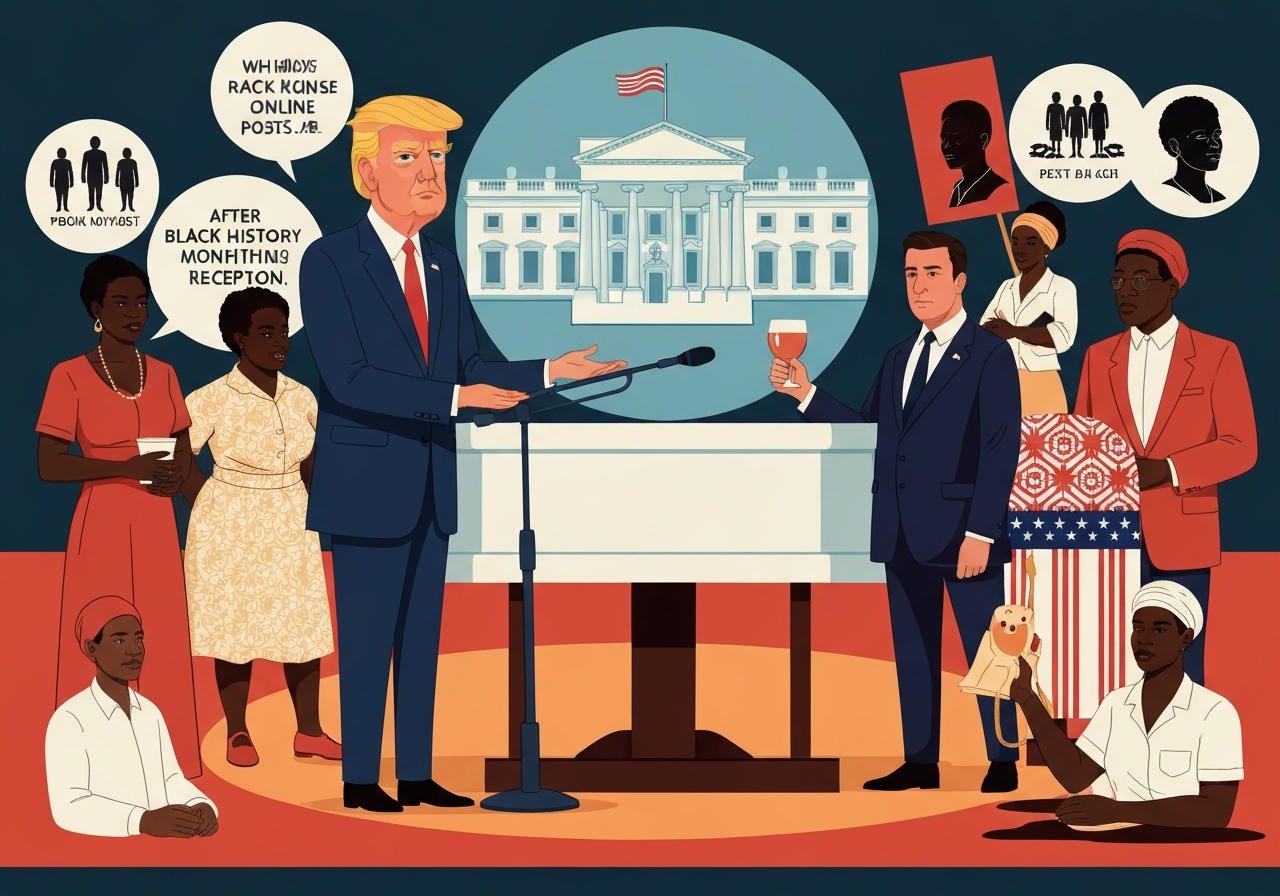
President Donald Trump held a White House reception for Black History Month on Wednesday, less than two weeks after drawing bipartisan condemnation for posting a racist video on social media that depicted former President Barack Obama and Michelle Obama as primates. The president deleted the post amid broad backlash but said he would not apologize for sharing it; his remarks at the reception made no reference to the video or to Barack Obama. Instead, Trump praised a number of high-profile Black supporters and cited administration actions he said benefited Black Americans. The event spotlighted a continuing tension between the White House’s outreach gestures and controversies tied to its rhetoric and policy choices.
Key Takeaways
- Timing: The reception took place on a Wednesday, roughly two weeks after Trump posted and then deleted a racist video that sparked cross-party outrage.
- No apology: Trump publicly declined to apologize for sharing the video and did not address it during his Black History Month remarks.
- Guests and speakers: Administration figures onstage included Housing and Urban Development Secretary Scott Turner and clemency advocate Alice Marie Johnson.
- Policy claims: The president highlighted $500 million steered to historically Black colleges and universities last year and cited other policy moves he said aided Black communities.
- Funding shift: The $500 million for HBCUs was largely reallocated from programs that previously served large shares of Hispanic students; the Education Department said some grant programs were unconstitutional.
- Law-and-order emphasis: Trump cited National Guard deployments to restore safety in cities including Washington, New Orleans and Memphis.
- DEI rollback: The administration’s push to remove diversity, equity and inclusion programs from federal agencies continues to contrast with ceremonial recognition of Black History Month.
Background
Recognition of Black History Month has been a regular annual gesture by Trump during his presidency, but it has often come alongside policy and rhetorical moves that critics say undermine the commitments those ceremonies imply. Early in his second term the president issued an executive order described as aiming to “restore truth and sanity to American history,” an action the administration used to remove certain historical interpretations from federal sites. The White House also directed the Defense Department to stop using official resources to mark cultural awareness months, underscoring a broader administrative shift on how the government acknowledges race and history.
The administration has taken concrete steps that altered federal support patterns for minority-serving institutions. Last year the Education Department redirected roughly $500 million to historically Black colleges and universities; the White House framed that as a targeted boost for HBCUs. That allocation followed the department’s decision to pull about $350 million from other grant programs serving colleges with significant Hispanic student populations and other minority groups, a move the department justified by arguing those programs raised constitutional concerns.
At the same time, the White House has pursued a campaign against diversity, equity and inclusion (DEI) initiatives in both government and private-sector settings, labeling some programs as discriminatory. Supporters say the administration is correcting perceived unfairness, while opponents argue the actions strip resources that helped diversify federal and corporate workforces. The competing narratives set the context for why a Black History Month reception at the White House draws sustained attention and scrutiny.
Main Event
The reception brought a mix of administration officials, advocates and public figures to the White House grounds. Alice Marie Johnson, whose clemency case gained high-profile attention, was among those introduced onstage; other officials included HUD Secretary Scott Turner. Attendees heard remarks that emphasized commemoration and continued progress while the president framed the event as honoring past achievements and ongoing legacies in Black history.
Trump’s prepared comments intentionally avoided mentioning the controversial video or Barack Obama, the nation’s first Black president. Instead he spoke about honoring “those who came before us” and listed policy items he said benefited Black Americans, including legislation affecting tipped income and public-safety actions. He repeatedly presented himself as an ally to Black communities, a claim his supporters echoed at the event.
The president singled out several prominent Black supporters by name, praising boxer Mike Tyson for defending him against accusations of racism and complimenting rapper Nicki Minaj’s appearance while commenting, in passing, on the length of her fingernails. Those moments underscored the event’s mix of political messaging and personal affinity for celebrity endorsers. Separately, the day before the reception Trump posted a message meant to honor the Rev. Jesse Jackson, asserting he had been wrongly labeled a racist by political opponents.
White House press secretary Karoline Leavitt responded to questions about the earlier social-media post by saying the president has done a great deal for Americans of all races and again rejecting charges that he is racist. The administration’s public posture remained focused on policy accomplishments and outreach rather than direct engagement with sustained criticism from across the political spectrum.
Analysis & Implications
The reception illustrates a strategic tension: symbolic outreach can be used to broaden political appeal, but optics become fraught when outreach coincides with controversies that disproportionately affect the communities being courted. Hosting a Black History Month event can signal inclusion, yet failing to acknowledge a high-profile offence — like the deleted racist post — may blunt outreach effectiveness among skeptical audiences. Political operatives will likely weigh whether such ceremonies rebuild trust or further alienate voters who view the controversy as emblematic of deeper patterns.
Policy moves touted at the event — notably the $500 million redirected to HBCUs — carry mixed political and practical consequences. Support for HBCUs is widely popular across party lines, but critics note the money was taken from other minority-serving programs, raising questions about net gains for higher education equity. The Education Department’s legal rationale for altering grant programs also invites litigation and congressional scrutiny, keeping funding and institutional priorities in play for the coming months.
The administration’s rollback of DEI programs touches federal hiring, contracting and workplace practices; eliminating such programs could reshape access and advancement pipelines that helped many Black Americans and other minorities secure employment. Businesses and universities will face decisions about whether to maintain DEI initiatives absent federal encouragement, which could produce divergent outcomes across sectors and regions. Internationally, continued controversies around race and leadership rhetoric affect perceptions of U.S. commitment to racial equity.
For the Republican base, the reception reinforced the president’s narrative of accomplishment and personal loyalty. For opponents and some independents, the juxtaposition of commemoration and controversy may deepen concerns about sincerity and governance priorities. How the White House follows up — with policy detail, legal defense, or outreach that acknowledges critics’ concerns — will shape whether the event has meaningful bridging effects or becomes a momentary ritual amid ongoing polarization.
Comparison & Data
| Item | Amount |
|---|---|
| Funds steered to HBCUs (one-time) | $500 million |
| Funds pulled from other minority-serving grant programs | $350 million |
These figures show the scale and source shift the administration emphasizes: a $500 million one-time boost to HBCUs contrasted with about $350 million rescinded from other grant streams. The White House described the HBCU award as targeted support, while the Education Department framed the rescissions as correcting programs it deemed constitutionally vulnerable. Observers note that headline dollar amounts do not alone indicate whether the net effect increases overall support for minority higher education or simply redistributes existing federal dollars.
Reactions & Quotes
Supporters at the reception framed the event as evidence the president listens to Black Americans and acts on their behalf; their public comments reinforced the administration’s outreach message. Opponents outside the event continued to criticize the timing and the failure to address the offensive social-media post directly.
“As you look out upon this sea of Black Americans, this president hears you. This president cares for you. Don’t let anyone tell you that this president… is not for Black America,”
Alice Marie Johnson, clemency advocate (at White House reception)
White House spokespeople defended the president’s record when pressed about the earlier post and ongoing criticism. Their statements reiterate the administration’s view that policy achievements and targeted initiatives demonstrate commitment despite partisan attacks and public controversy.
“There is a lot this president has done for all Americans, regardless of race. And he has absolutely been falsely called and smeared as a racist,”
Karoline Leavitt, White House press secretary
Unconfirmed
- Whether the $500 million directed to HBCUs represents a net increase in federal support for minority-serving institutions overall is not independently verified.
- Internal deliberations within the White House about why the president chose not to address the deleted video at the reception have not been publicly disclosed.
- Any private assurances offered to attendees or donors at the reception regarding future policy moves have not been independently confirmed.
Bottom Line
The White House reception sought to cast the administration as respectful of Black history while showcasing specific policy claims, notably a $500 million HBCU allocation. But the event occurred amid lingering controversy over a racist social-media post the president deleted and refused to apologize for, undercutting outreach efforts for some audiences. The juxtaposition of ceremonial recognition and contested policy choices — including DEI rollbacks and reallocated education funding — means the reception is likely to register differently across political and civic communities.
Observers should watch whether the administration follows the event with substantive engagement that addresses critics’ concerns, clarifies funding permanence, or expands concrete programs that benefit a broad set of minority-serving institutions. Congressional reactions, potential legal challenges to grant rescissions, and the response of HBCUs and Hispanic-serving institutions will shape the long-term policy impact of the moves highlighted at the reception.
Sources
- Associated Press — news report and event coverage (journalism)
- White House Briefing Room — official statements and press briefings (official government)
- U.S. Department of Education — News — announcements and statements on federal education funding (official agency)