
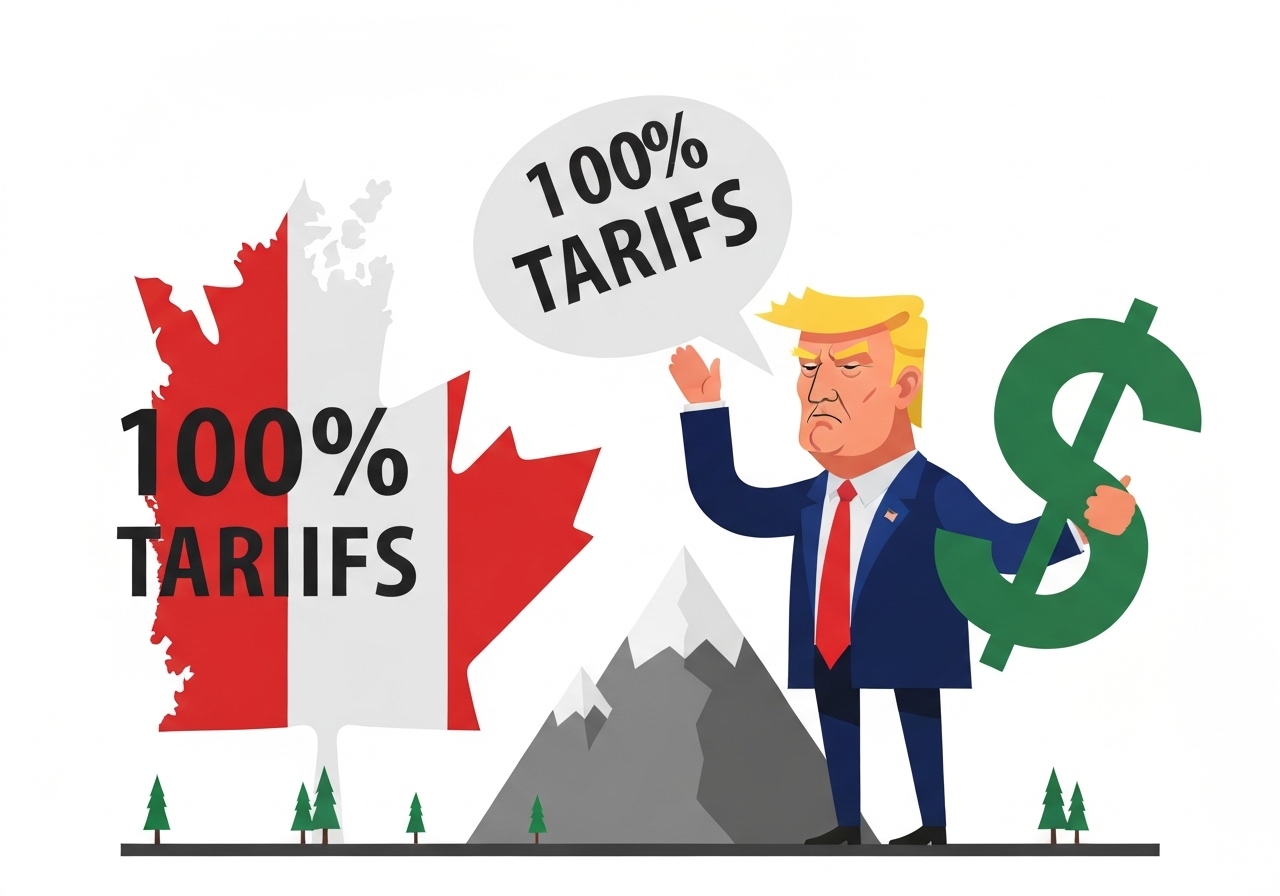
US President Donald Trump warned on social media that he would impose a 100% tariff on Canadian goods if Ottawa concludes a trade arrangement with China, heightening tensions after Canada announced a stepped-up economic partnership with Beijing last week. The post, published on Truth Social, followed remarks by Canadian Prime Minister Carney at Davos and an agreement with China to cut several tariffs on Canadian exports. Canada’s trade minister, Dominic LeBlanc, denied Ottawa is pursuing a free trade agreement with Beijing and described recent progress as limited to resolving specific tariff disputes. Both the White House and Prime Minister Carney’s office were contacted for comment but had not provided further detail at the time of reporting.
Key Takeaways
- President Trump publicly threatened a 100% tariff on all Canadian goods entering the United States if Canada strikes a deal with China, posting the warning on Truth Social.
- Last week Prime Minister Carney and President Xi agreed to cut tariffs: China will reduce canola levies from 85% to 15% by March, and Canada will lower taxes on Chinese electric vehicles from 100% to the most-favoured-nation rate of 6.1%.
- Canada’s Trade Minister Dominic LeBlanc stated there is “no pursuit of a free trade deal with China,” saying the talks resolved discrete tariff issues rather than establishing a broad trade pact.
- Tensions escalated after Carney said in Davos that the US-led global order had been “ruptured,” prompting a sharp response from President Trump and withdrawal of a Canadian invitation to his Board of Peace.
- Canada has been actively diversifying trade away from the United States following prior rounds of unpredictable US tariffs under Trump administration policies.
- A unilateral 100% US tariff would be unprecedented and could trigger legal challenges at the World Trade Organization and reciprocal measures from Ottawa, with significant supply-chain implications.
Background
Canada and the United States are each other’s largest trading partner, with integrated supply chains across agriculture, energy and manufacturing. That interdependence has been tested repeatedly in recent years by US administrations that at times used tariffs and negotiations as leverage, prompting Ottawa to seek new markets and reduce reliance on one partner. Last week’s agreement between Prime Minister Carney and President Xi was framed by Ottawa as a practical step to end long-standing tariff barriers that have limited Canadian canola and other exports to China. For Beijing, the tariff rollbacks open commercial opportunities and could encourage new Chinese investment in Canada after years of strained bilateral ties and tit-for-tat duties.
Prime Minister Carney’s speech in Davos calling the US-led order “ruptured” was aimed at rallying mid-sized democracies to resist economic coercion, a line that resonated in capitals concerned about strategic dependencies. In Washington, the remarks were received less well; President Trump replied directly in his own Davos address and through social media, asserting America’s central economic role and taking steps such as rescinding Ottawa’s invitation to his Board of Peace. Those exchanges have converted a narrow trade arrangement into a broader diplomatic flashpoint between allies.
Main Event
The immediate flashpoint began with a Truth Social post from President Trump declaring that “If Canada makes a deal with China, it will immediately be hit with a 100% Tariff against all Canadian goods and products coming into the U.S.A.” The post singled out what the president described as the risk of Canada becoming a “drop off port” for Chinese goods destined for US markets. The remark offered no legal rationale or timeline for enforcement and did not specify which elements of the Canada-China understanding he was targeting.
Prime Minister Carney’s negotiations with Xi produced specific tariff adjustments: Chinese levies on Canadian canola will fall from 85% to 15% by March, and Canada has agreed to apply the most-favoured-nation rate of 6.1% to Chinese electric vehicles, down from 100%. Ottawa presents those measures as case-by-case fixes to longstanding barriers rather than the start of a comprehensive free-trade agreement. Trade Minister Dominic LeBlanc emphasized that the government’s focus remains on strengthening Canada’s economy and global trade links.
The bilateral rhetoric escalated when Trump characterized Carney’s Davos speech as ungrateful, saying “Canada lives because of the United States,” and withdrew the invitation for Canada to join his new Board of Peace. Ottawa officials pushed back, underlining that the recent arrangements with China addressed discrete tariff disputes and did not amount to ceding strategic alignment with the United States. Outside official channels, business groups and exporters immediately expressed concern about the prospect of sudden US measures that would hit cross-border commerce hard.
Observers noted the timing: Ottawa has been pursuing diversification after years of unpredictable US trade actions, while Beijing is seeking to lock in supply sources for key commodities and expand commercial ties. The sequence of announcements and social-media retaliation transformed a modest tariff rollback into a potential catalyst for a diplomatic rupture between longtime partners.
Analysis & Implications
A US-imposed blanket 100% tariff on Canadian imports would be extraordinary in modern trade practice. Such a levy would dramatically raise costs for US importers and consumers, disrupt integrated manufacturing inputs that cross the border multiple times during production, and likely invite reciprocal Canadian countermeasures. From a legal standpoint, a tariff implemented without a clear national-security or statutory rationale would face challenges at the World Trade Organization and in US courts, where procedural and substantive rules constrain purely protectionist measures.
Politically, the threat signals a willingness to use unilateral economic pressure to influence allied states’ commercial ties, which could push middle powers to accelerate diversification of supply chains and deepen ties with alternative partners. For Canada, the immediate economic winners from the China agreement—canola producers and automakers selling EVs—stand to benefit, but broader uncertainty could chill investment in cross-border projects and complicate North American industrial planning.
Internationally, allies watching the spat may recalibrate diplomatic and trade strategies. If the United States were to act on the tariff threat, other partners would reassess their exposure to US market access as leverage. Conversely, Ottawa’s insistence that no free trade deal with China is underway seeks to limit escalation; much will depend on whether Washington interprets the Canada-China steps as tactical tariff relief or the start of something more systemic.
Comparison & Data
| Item | Previous Tariff | New/Announced Level |
|---|---|---|
| Chinese tariff on Canadian canola | 85% | 15% (by March) |
| Canadian tariff on Chinese electric vehicles | 100% | 6.1% (MFN rate) |
| US threat (if Canada deals with China) | — | 100% on all Canadian goods (threat) |
The table shows the concrete tariff changes agreed between Ottawa and Beijing and the unilateral tariff level President Trump warned he would apply if Canada formalizes broader arrangements with China. The canola cut is large in percentage terms and intended to reopen a market that was effectively blocked; the EV adjustment moves Canada toward standard MFN treatment. The US threat, by contrast, is broad and would affect a far wider set of sectors if enacted, creating asymmetrical economic pain given the size of bilateral trade.
Reactions & Quotes
Domestic Canadian officials sought to de-escalate and clarify the narrow scope of last week’s agreement with China.
“There is no pursuit of a free trade deal with China. What was achieved was resolution on several important tariff issues.”
Dominic LeBlanc, Canadian Trade Minister (official statement)
President Trump framed his response as protecting US economic interests and preventing what he described as near-shipping of Chinese goods through Canada into the United States.
“If Canada makes a deal with China, it will immediately be hit with a 100% Tariff…”
Donald Trump, US President (Truth Social)
Prime Minister Carney’s remarks at Davos about the global order drew the ire of the White House and set the diplomatic backdrop for the trade dispute.
“The US-led world order had been ruptured.”
Prime Minister Carney (Davos speech)
Unconfirmed
- The precise agreement Trump was referencing in his social post is not specified and remains unclear from available public statements.
- Whether a unilateral 100% tariff could be enacted administratively and withstand legal challenge at the WTO or in US courts is uncertain and would depend on the specific legal justification offered.
- Claims that Canada intends to become a “drop off port” for Chinese goods into the United States are asserted by the US president but lack corroborating evidence from Ottawa or trade flows at this time.
Bottom Line
The episode illustrates how even limited tariff rollbacks between Canada and China can become politically charged when interpreted through a broader diplomatic frame. Ottawa says its moves were narrowly targeted to resolve long-standing market access issues, while Washington’s stark warning demonstrates the fragility of trade trust among close allies. Economically, a real 100% US tariff would be highly disruptive and legally contested; politically, it risks pushing Canada to deepen ties with other partners to hedge risk.
Looking ahead, the situation will hinge on clarifications from Washington about enforcement intent and from Ottawa about the scope of its engagement with Beijing. Stakeholders on both sides are likely to press for channelled diplomacy and legal safeguards to avoid escalation, while exporters and investors will watch for concrete policy steps that either stabilize or further unsettle North American trade.
Sources
- BBC News (media report)