
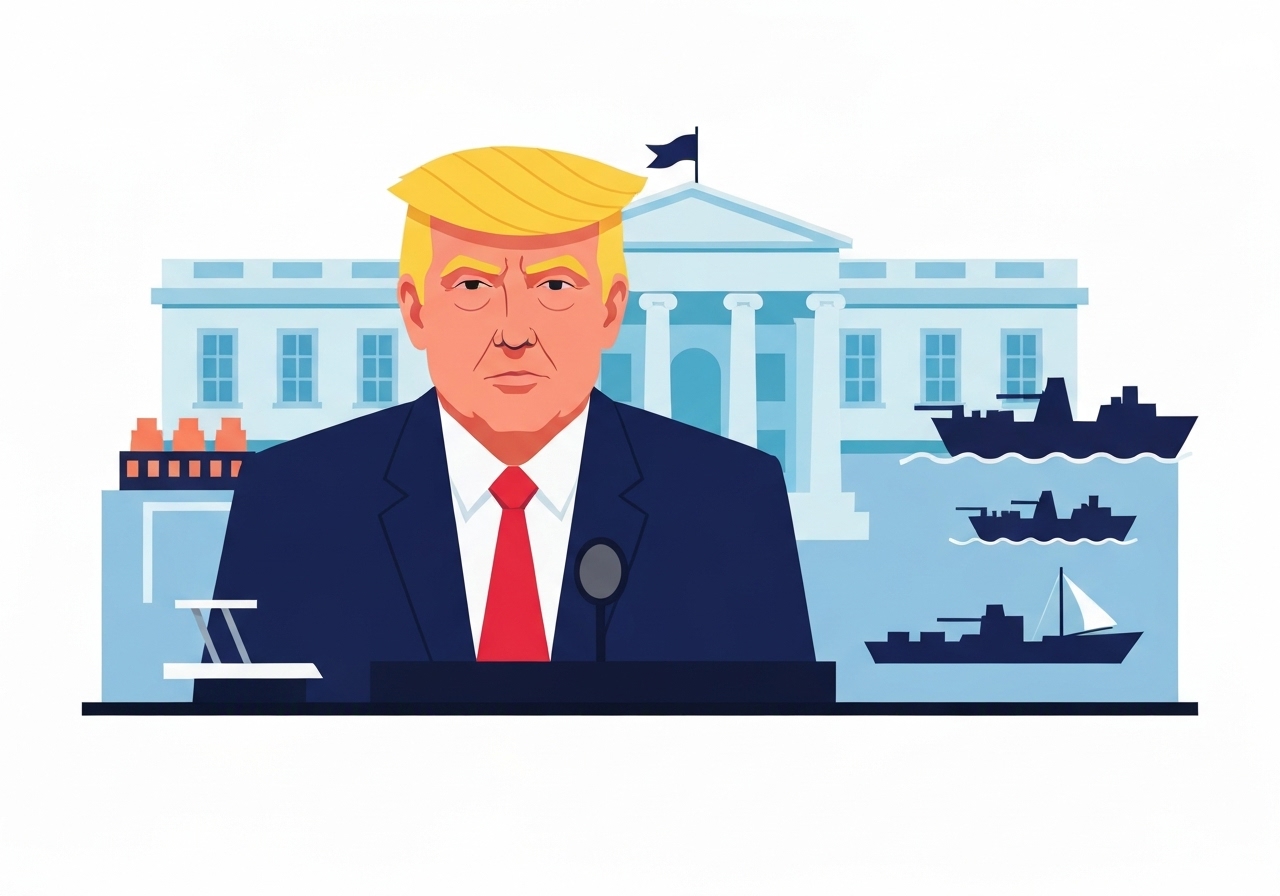
Lead
US President Donald Trump told reporters on Monday that he is not concerned about the Chinese military exercises encircling Taiwan, saying he has a strong rapport with Chinese leader Xi Jinping and that Xi has not raised the drills with him. The two-day war games began that day, after Washington announced a roughly $11bn arms package to Taiwan. Beijing described the exercises as a response to what it called separatism and foreign interference; Taipei called them a challenge to international norms. China plans ten hours of live-fire activity across five locations, deploying surface ships and combat aircraft.
Key Takeaways
- President Trump said on Monday he was not worried about the drills and that Xi Jinping had not informed him of any specific plans; he framed the situation around his bilateral rapport with Xi.
- The exercises began on Monday as a two-day operation and include 10 hours of live firing in sea and airspace around five locations near Taiwan.
- China’s Eastern Theater Command said it deployed destroyers, frigates and fighter-bombers to test sea-air coordination and integrated containment capabilities.
- Beijing characterized the drills as simulating seizure and blockade of key areas of the island to warn against “Taiwan independence” and external interference.
- Taiwan’s presidential office criticized the maneuvers as undermining international norms and reiterated plans to modernize and raise defence spending.
- The US earlier announced an approximately $11bn weapons package to Taiwan, including advanced rocket launchers, self-propelled howitzers and various missile systems.
- China responded to the arms sale with sanctions on several US defence firms and a warning that attempts to use Taiwan to contain China will fail.
Background
China considers Taiwan a breakaway province and has long maintained that reunification is its goal, without ruling out force. In recent years Beijing has increased pressure on Taipei through expanded patrols, airspace incursions and high-profile exercises designed to signal capability and resolve. The Taiwan Strait has therefore become a recurring flashpoint in US‑China relations, where Washington balances official recognition of Beijing with close security ties and weapons sales to Taipei.
Washington’s latest arms package — reported as about $11bn — reflects a pattern of US support intended to bolster Taiwan’s self‑defence. Beijing has repeatedly condemned such transfers, viewing them as interference in its internal affairs. Taiwan, for its part, has signalled plans to modernize its armed forces and increase defence spending in response to perceived threats.
Main Event
The exercises that began on Monday are a two-day drill centered on live-fire training and joint sea-air operations. China’s Eastern Theater Command said it would run 10 hours of live firing across five designated maritime and air zones surrounding the island, and it named the use of destroyers, frigates and fighter-bombers in the operation.
Beijing framed the maneuvers as a rehearsal for seizure and blockade scenarios targeting key parts of Taiwan, presented as a deterrent against island independence movements and foreign interference. Officials emphasized testing of “sea-air coordination” and integrated containment, language used to underline combined-arms planning rather than isolated drills.
President Trump, speaking to reporters on Monday, downplayed the threat. He said he had seen reports of the exercises but expressed confidence in his relationship with Xi and did not portray the drills as alarming. Taipei’s presidential office issued a public rebuke, calling the pattern of drills a challenge to international norms and raising concern among regional partners.
Analysis & Implications
The timing of the drills — shortly after Washington announced a major arms package to Taiwan — underscores the transactional and symbolic interplay between US arms transfers and Beijing’s military signalling. China uses high-profile exercises to demonstrate capability, deter moves toward formal independence, and send political messages both domestically and internationally. For Washington, the arms sale reaffirms commitments to Taiwan’s self-defence while navigating a complex diplomatic arrangement with Beijing.
Operationally, the involvement of surface combatants and strike aircraft in coordinated live-fire exercises suggests a focus on joint logistics, command-and-control, and blockade tactics. If repeated, such drills could degrade routine commercial and military movement in the area, raising risks of miscalculation. Taiwan’s announced plans to upgrade forces and spending indicate Beijing’s pressure campaign may accelerate Taipei’s procurement and force-modernization timelines.
Regionally, neighbours and partners will watch whether Beijing sustains this level of activity; persistent drills could prompt closer consultation between the US, Japan, Australia and other Indo-Pacific states. Economically, extended tensions in the Taiwan Strait carry potential to disrupt shipping lanes and investor confidence, though short, targeted exercises are unlikely by themselves to trigger large-scale market dislocations.
Comparison & Data
| Feature | This Exercise |
|---|---|
| Duration | Two days (began Monday) |
| Live firing | 10 hours across sea and airspace |
| Geographic scope | Five locations surrounding Taiwan |
| Assets named | Destroyers, frigates, fighter-bombers |
Compared with previous rounds of pressure, this exercise follows an established pattern of using multi-domain drills to signal resolve. The stated use of destroyers and strike aircraft indicates a focus on blockade and interdiction scenarios; Taiwan and partners will judge whether the tempo or scale marks a qualitative change from recent years.
Reactions & Quotes
Below are representative official responses and expert perspectives, each followed by context.
President Trump said he was unconcerned about the drills and highlighted his working relationship with Xi, noting that Xi had not briefed him on the exercises.
President Donald Trump / Press conference
Trump’s remarks framed the story primarily as one of personal diplomacy rather than a military crisis. He reiterated that the drills were something he had seen but did not view as a cause for alarm, while the administration concurrently approved a substantial arms package to Taiwan.
China’s Eastern Theater Command described the drills as testing sea-air coordination and capabilities to contain and blockade, characterizing them as a warning against separatism and external interference.
China Eastern Theater Command (military statement)
The command’s language emphasized combined-arms rehearsals and invoked political aims, aligning the exercises with Beijing’s long-standing policy objectives regarding Taiwan.
Taiwan’s presidential office said the maneuvers challenge international norms and reiterated Taipei’s commitment to strengthening its defenses.
Taiwan Presidential Office (official statement)
Taipei’s response framed the drills as destabilizing and used the moment to underline plans for enhanced defence spending and capability upgrades.
Unconfirmed
- Whether Xi Jinping directly coordinated the timing of the drills with other Chinese leadership bodies has not been independently verified.
- The extent to which the exercises were intended as a rehearsal for an immediate blockade or invasion is an interpretation by observers and remains unconfirmed by hard evidence.
- The full operational impact of China’s sanctions on US defence firms connected to the sale has yet to be publicly quantified.
Bottom Line
The two-day Chinese drills around Taiwan, occurring after an approximately $11bn US arms package announcement, are consistent with Beijing’s recent pattern of military signalling. President Trump’s public downplaying of the drills — tied to his personal rapport with Xi — contrasts with the concrete steps taken by Washington and Taipei to shore up Taiwan’s defenses.
In practical terms, the exercise tests sea-air coordination and blockade scenarios that Taipei views as threatening, and they reinforce Taiwan’s stated intent to accelerate defence modernization. For regional actors and markets, the immediate impact is limited but the episode raises the stakes for diplomatic management, contingency planning and long-term force posture in the Indo-Pacific.
Sources
- BBC (news) — original reporting on statements, drills, and the US arms package.