
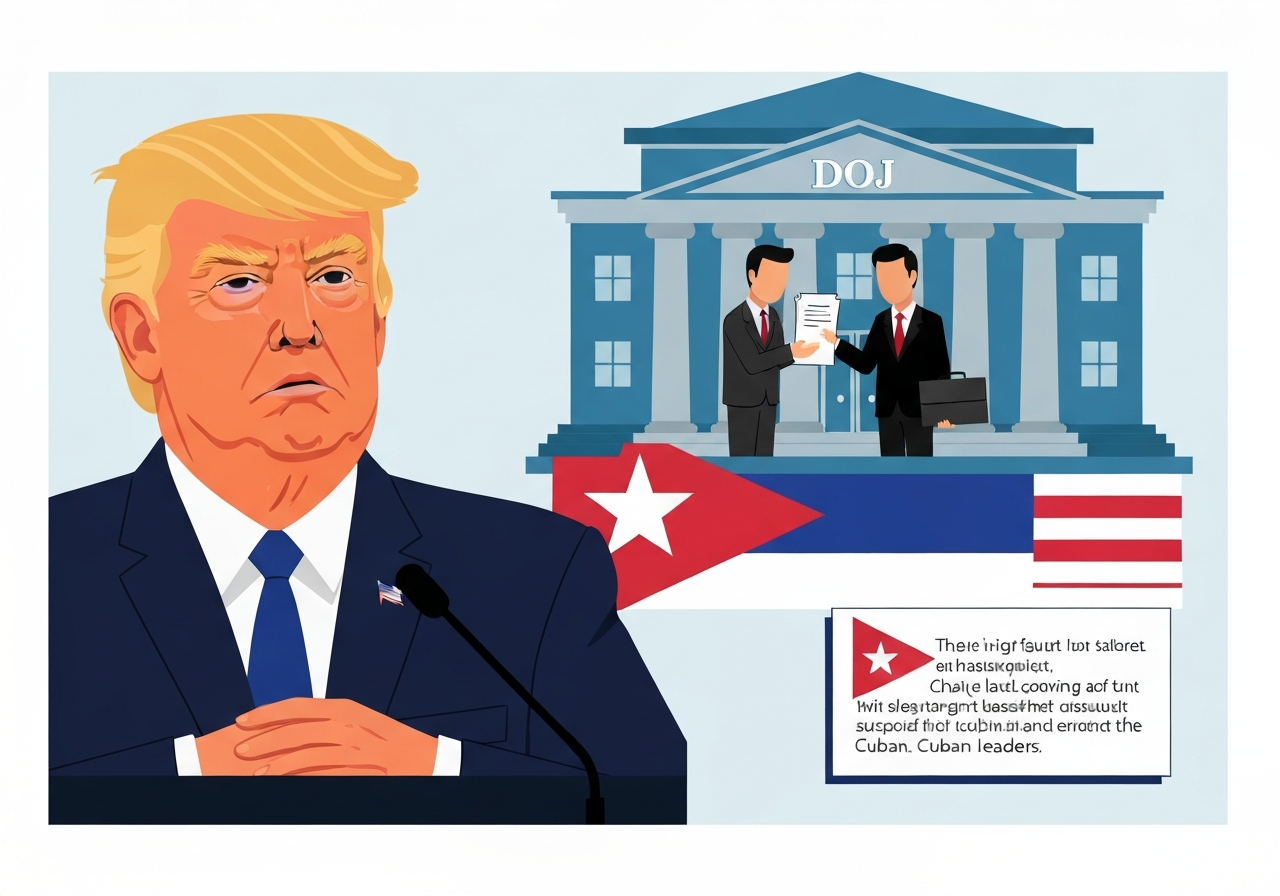
Lead: On March 6, 2026, U.S. law enforcement in South Florida opened a wide-ranging inquiry into senior Cuban and Communist Party officials, aiming to pursue criminal charges tied to drug trafficking, immigration offenses, economic crimes and violent acts. The probe, led by Jason A. Reding Quiñones, U.S. attorney for the Southern District of Florida, comes as President Trump intensifies pressure on Havana with new sanctions and public threats. Officials working on the inquiry seek rapid indictments; the move occurs amid recent U.S. actions that have sharply curtailed Cuba’s oil supply. Taken together, the legal effort and the administration’s economic measures have heightened concerns about U.S. aims toward Cuba and the potential for escalatory outcomes.
Key Takeaways
- On March 6, 2026, a probe led by Jason A. Reding Quiñones in the Southern District of Florida was reported to target Cuban leaders for alleged drug, immigration, economic and violent crimes.
- The administration has taken steps that cut off most foreign oil supplies to Cuba after the U.S. captured Venezuela’s leader, Nicolás Maduro, in early January 2026, and subsequent policy actions prompted Mexico to stop shipments.
- President Trump has publicly discussed a “friendly takeover” of Cuba and suggested aggressive options for the island after the Iran conflict, raising political and diplomatic alarms.
- The Justice Department previously indicted Nicolás Maduro and Cilia Flores; that case was cited in media coverage as precedent for using criminal prosecutions to justify extraordinary actions.
- Investigators in Florida are reportedly seeking a fast timeline for indictments, though official filings and grand-jury steps have not been publicly confirmed as of March 6, 2026.
- Legal and foreign-policy experts warn that criminal cases against a foreign government’s senior officials could complicate diplomacy, risk reciprocal measures and increase regional instability.
Background
Relations between Washington and Havana have long been adversarial since the 1959 Cuban Revolution, with periods of rapprochement and renewed tension. Over recent years, U.S. policy oscillated between sanctions and limited engagement; the current administration has moved decisively back toward a coercive approach. In early January 2026 the United States detained Venezuela’s leader, Nicolás Maduro—a development that reshaped oil flows in the region and disrupted Cuba’s primary energy sources.
The U.S. Justice Department’s prior indictment of Maduro and his wife, Cilia Flores, is a recent high-profile example of criminal law intersecting with geopolitics; that case was publicly linked in media coverage to subsequent law-enforcement actions. Cuba’s economy, already fragile, has been strained further in the weeks before March 6, 2026, by measures that choke off external energy supplies and increase import costs. Various stakeholders—Cuban government officials, U.S. prosecutors, policymakers in Mexico and Venezuela, and international human-rights observers—now face competing priorities between accountability claims and the risks of escalation.
Main Event
According to three people with knowledge of the matter, U.S. attorneys in South Florida have been ordered to examine a broad set of allegations against Cuban leaders, spanning narcotics trafficking, immigration-related schemes, economic mismanagement and violent acts. Jason A. Reding Quiñones, identified in reports as overseeing the inquiry, is described as a relatively new federal prosecutor who has shown political alignment with the administration’s priorities. The reported objective is to produce indictments quickly, a step that would bring immediate legal pressure to bear on top Cuban officials.
Those close to the case say the investigative scope includes financial channels and migration routes that link Cuba to organized-crime networks, though prosecutors have not publicly filed charges or released evidence. Separately, the White House has applied economic leverage: actions that contributed to a sharp reduction in Cuba’s oil imports—initially by cutting off Venezuelan shipments after Maduro’s capture and later by threatening tariffs that led Mexico to stop supplies. Administration officials characterize the broader approach as pressure to force concessions from Havana.
Observers note a pattern: criminal indictments and economic measures have in other contexts been used to isolate regimes and create international support for stronger actions. Advocates of the legal push frame it as law enforcement pursuing accountability for transnational crimes, while critics warn it could be a political instrument aligned with an administration goal of regime change. As of March 6, 2026, no publicly filed indictments against named Cuban leaders in federal court were confirmed in print.
Analysis & Implications
If federal prosecutors bring charges against Cuban officials, the case would blend criminal-law processes with high-stakes foreign policy. A U.S. indictment of senior foreign officials can restrict their travel, freeze assets within U.S. jurisdiction and provide a domestic legal rationale for diplomatic isolation. However, such charges do not, on their own, authorize military action; they do, though, alter the political calculus by signaling intent to pursue punitive measures through courts as well as sanctions.
Regionally, halting oil shipments from Venezuela and Mexico to Cuba has immediate humanitarian and economic effects. Energy shortages can worsen civilian hardship, increase migration pressures toward the U.S., and create openings for adversarial actors to expand influence. Legal action against top Cuban officials could reduce diplomatic outlets for de-escalation while motivating reciprocal steps by Havana or its partners.
Domestically, tying criminal prosecutions to an administration’s geopolitical goal raises rule-of-law questions. Critics worry that rapid indictments framed to support a political objective risk appearing selective or instrumentalized. Supporters argue that enforcing criminal statutes against alleged cross-border crimes is a legitimate law-enforcement function regardless of broader policy aims. The tension between legal norms and strategic aims will shape international responses and potential cooperation with allies.
Comparison & Data
| Actor | Role | Reported Action | Timing |
|---|---|---|---|
| U.S. Southern District of Florida | Investigative authority | Inquiry into Cuban leaders for multiple alleged crimes | Reported March 6, 2026 |
| Venezuela | Former oil supplier | Shipments stopped after leader’s capture | Early January 2026 |
| Mexico | Last significant external oil supplier | Halted shipments after U.S. tariff threats | January–February 2026 |
The table above summarizes the principal actors and reported moves tied to the unfolding pressure campaign against Cuba. These events show a compressed timeline from early January 2026 to March 6, 2026, in which law-enforcement inquiries and economic leverage were applied concurrently. Analysts caution that short-term policy shifts like oil cutoffs can produce outsized humanitarian impacts within weeks, while legal cases typically move more slowly through indictments, grand juries and potential extradition processes.
Reactions & Quotes
“friendly takeover”
President Donald J. Trump / The New York Times
Context: The president’s use of the phrase has been reported widely and cited by analysts as an indication of political aims that go beyond standard sanctions. Observers say such language shapes expectations in Washington and Havana about possible endgames and raises concerns among regional partners.
“grand conspiracy”
President Donald J. Trump / The New York Times
Context: The reported probe head is also overseeing investigations tied to the president’s assertions of a broad political scheme against him. Legal specialists note that conflating politically charged investigations with foreign-prosecutions efforts can complicate the independence perceived in prosecutorial choices.
Unconfirmed
- That the Florida inquiry will immediately produce indictments naming specific Cuban leaders; no public filings or charging documents were confirmed as of March 6, 2026.
- That the investigation is formally coordinated with all White House policy components; public reporting cites individuals with knowledge but does not document an interagency directive.
- That criminal cases are the definitive legal basis for any planned U.S. military action against Cuba; such a link has been asserted in media analysis but remains unproven.
Bottom Line
The reported Florida inquiry, combined with recent U.S. economic measures that curtailed Cuba’s oil supplies, marks a significant escalation in pressure on Havana as of early March 2026. If prosecutors pursue fast indictments against top Cuban officials, the action would harden legal and diplomatic barriers and could narrow channels for negotiation while increasing risks for civilians in Cuba.
Moving forward, key indicators to watch are formal charging documents, official DOJ statements, responses from Havana and Mexico’s policy choices on energy exports. International partners’ reactions and the pace of any judicial process will determine whether this episode becomes a contained legal action or a broader catalyst for political change.
Sources
- The New York Times — U.S. newspaper reporting on the March 6, 2026 article that first detailed the Florida inquiry and related developments.