
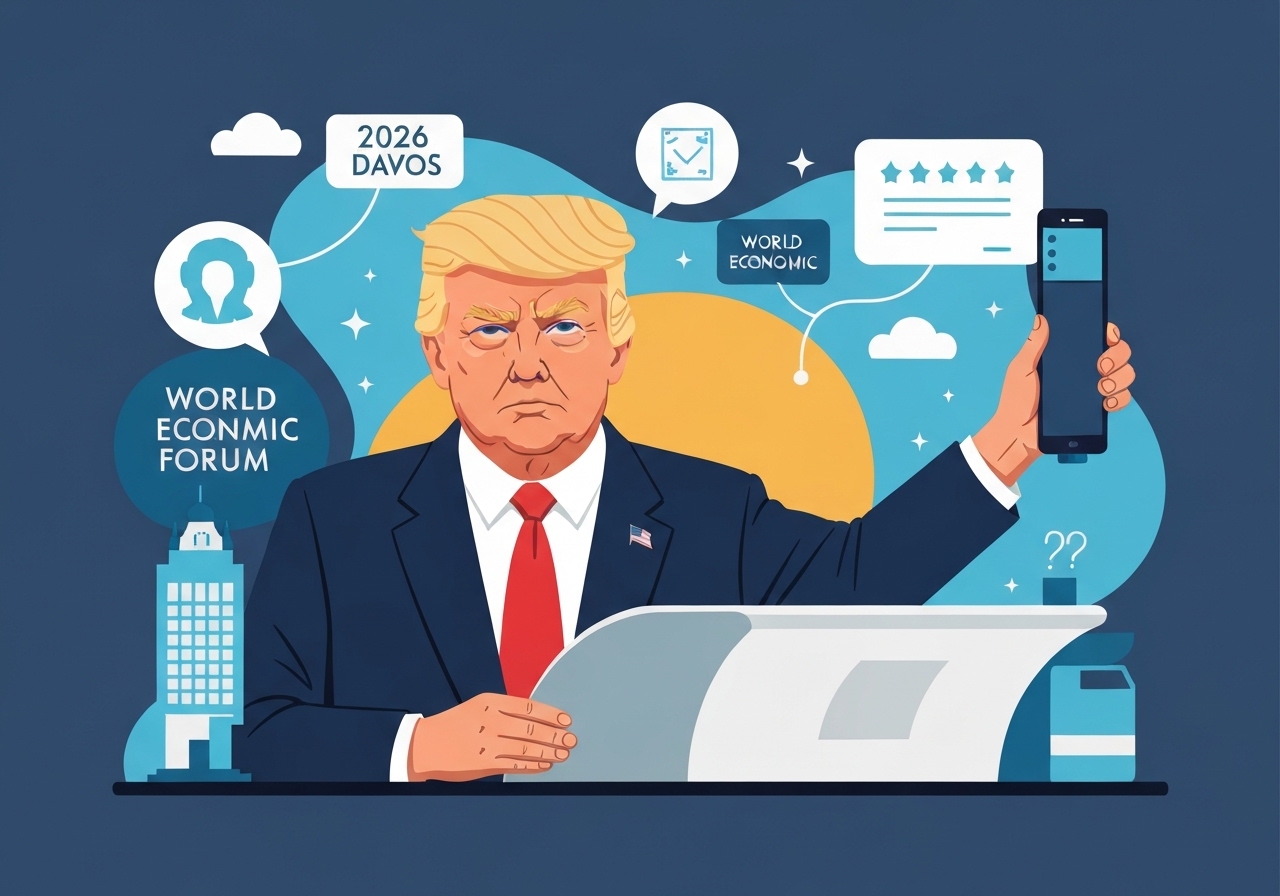
Lead: President Donald Trump will lead a high-profile U.S. delegation to the World Economic Forum in Davos from January 19, 2026, returning in person six years after his last visit. The Swiss Alpine forum will host more than 60 heads of state and government amid sharp debate over the future international order, economic stress and rapid advances in artificial intelligence. Organizers say the theme, A Spirit of Dialogue, seeks to bridge widening geopolitical and technological divides. The U.S. presence and agenda are expected to shape discussions on Ukraine, Venezuela, global trade and AI policy.
Key Takeaways
- More than 60 heads of state and government will attend Davos 2026, including leaders from Germany, Canada, Argentina, China and the EU.
- President Trump is leading the largest-ever U.S. delegation to Davos, which includes five cabinet secretaries and senior advisers.
- The forum runs January 19–23 under the theme “A Spirit of Dialogue,” with geopolitical order and geoeconomic rivalry prominent on the agenda.
- WEF projects global growth of 3.1% for 2026; organizers warn high global debt levels are a major constraint on recovery.
- AI features strongly—top executives from Microsoft, Nvidia and Google will attend—and speakers warn of major labor disruption and inequality risks.
- The WEF Global Risks Report highlights economic confrontation, misinformation and cybersecurity among the top near-term threats.
- Leadership changes at WEF follow Klaus Schwab’s April 2025 resignation; interim co-chairs Larry Fink and André Hoffmann now lead the organization.
Background
The World Economic Forum has convened global leaders in Davos since 1971 as a forum for public-private dialogue. This year’s meeting arrives against a backdrop of rising geoeconomic friction: trade barriers and unilateral policies are increasingly common, and major powers are revising long-standing alliances and multilateral commitments. Those shifts have renewed debate about the post–World War II rules-based order, a recurring theme at Davos gatherings.
U.S. policy under President Trump has amplified those tensions through trade interventions, stepped-up unilateral initiatives, and contentious positions on international institutions. At the same time, rapid investment in artificial intelligence—centered in the United States—has reshaped economic forecasts and fiscal priorities, buoying growth in some advanced economies even as many countries and workers face growing vulnerabilities.
Main Event
Davos 2026 will bring heads of state, corporate leaders and technologists together for panels and bilateral meetings across five days. Officials say the U.S. delegation—unusually large and senior—will pursue talks on security guarantees for Ukraine, approaches to Venezuela and broader geoeconomic coordination. The presence of multiple European leaders and China’s Vice Premier adds diplomatic weight to those sideline discussions.
The forum’s schedule features several AI-focused sessions with senior executives from Microsoft, Nvidia and Google on the program. Organizers expect conversation to range from promising applications in medicine and education to tough questions about workforce disruption, algorithmic bias and misinformation. Panels on trade, supply chains and critical minerals will examine how protectionist measures and resource controls are reshaping global commerce.
WEF leadership change is visible throughout the program. After Klaus Schwab’s 2025 resignation and an independent inquiry that found limited irregularities, interim co-chairs Larry Fink and André Hoffmann have prioritized restoring confidence and refocusing the organization’s convening role. Their stewardship will be closely watched as member states and business groups probe WEF’s future direction.
Analysis & Implications
Trump’s dominant presence at Davos signals an intent to set the agenda for transatlantic and broader global debates. A large, well-staffed U.S. delegation increases Washington’s capacity to press for bilateral and plurilateral arrangements, but it may also deepen splits with partners who favor multilateral rules. Diplomatic outcomes will depend on whether discussions translate into concrete commitments on security, trade or investment frameworks.
Geoeconomic rivalry—use of economic tools as instruments of statecraft—is expected to be a central throughline. As countries adopt tariffs, investment screens and export controls, businesses face higher operating risk and supply-chain fragmentation. For developing economies, the combination of tighter financial conditions and high debt burdens presents a particular danger; limited fiscal space may force policy trade-offs between growth and debt servicing.
AI’s twin role as growth engine and social disruptor will complicate policy choices. Large private investment has supported near-term resilience in advanced economies, but the technology risks accelerating inequality between countries and within labor markets. Policymakers will be pressed to balance innovation incentives with stronger safety, retraining and redistributive measures to mitigate displacement.
Comparison & Data
| Metric | 2026 / Davos context |
|---|---|
| Heads of state & government | More than 60 attending |
| Projected global growth | 3.1% in 2026 (WEF reporting) |
| U.S. delegation | Largest-ever U.S. presence; five cabinet secretaries included |
The table above distills a few concrete numbers under discussion at Davos. WEF and other institutions emphasize that headline growth masks divergent regional paths: advanced economies are benefiting from technology investment, while many low- and middle-income countries contend with elevated debt and slower credit access. Policymakers at Davos are expected to debate targeted financing, debt relief and investment in digital capacity as partial remedies.
Reactions & Quotes
WEF leadership framed the meeting as essential amid global uncertainty.
“Dialogue is not a luxury in times of uncertainty; it is an urgent necessity.”
Borge Brende, WEF President and CEO
On AI and labor disruption, industry voices have been stark.
“AI could eliminate half of all entry-level white-collar jobs in the next one to five years.”
Dario Amodei, CEO, Anthropic
Business and diplomatic participants have publicly called for pragmatic, short-term cooperation on supply chains and long-term work on regulatory frameworks, signaling a mixture of competition and collaboration across sessions.
Unconfirmed
- Reports that President Trump seeks to “capture” Venezuela’s Nicolás Maduro following a Caracas attack: these claims circulate in some outlets and are not independently verified.
- Suggestions that the U.S. will formally press for Greenland annexation measures are reported in some commentary but lack confirmation from official documents or public statements.
- Details of any concrete security guarantee package for Ukraine to be agreed in Davos meetings remain provisional until leaders release formal statements.
Bottom Line
Davos 2026 will be shaped by a powerful U.S. delegation and a crowded agenda that pits questions about the future of the rules-based international order against rapid technological change. The event will test whether high-level dialogue can produce actionable steps on security, trade and AI governance or whether it will instead underscore growing fractures between major powers and regions.
For observers, the most consequential outcomes will not be press releases but signs of follow-through: concrete financing for vulnerable economies, tangible coordination on critical supply chains and early commitments to AI safety, reskilling and inclusive access. In the absence of these, Davos risks becoming another forum of sharp rhetoric with limited policy traction.
Sources
- DW (Deutsche Welle) — international news outlet (primary reporting referenced).
- World Economic Forum: Global Risks Report 2026 — official WEF report summarizing survey and risk priorities.
- International Monetary Fund (IMF) — international financial institution (background on debt and growth concerns).
- Financial Times — international business and political reporting (coverage of Davos meetings and sideline diplomacy).