
Lead
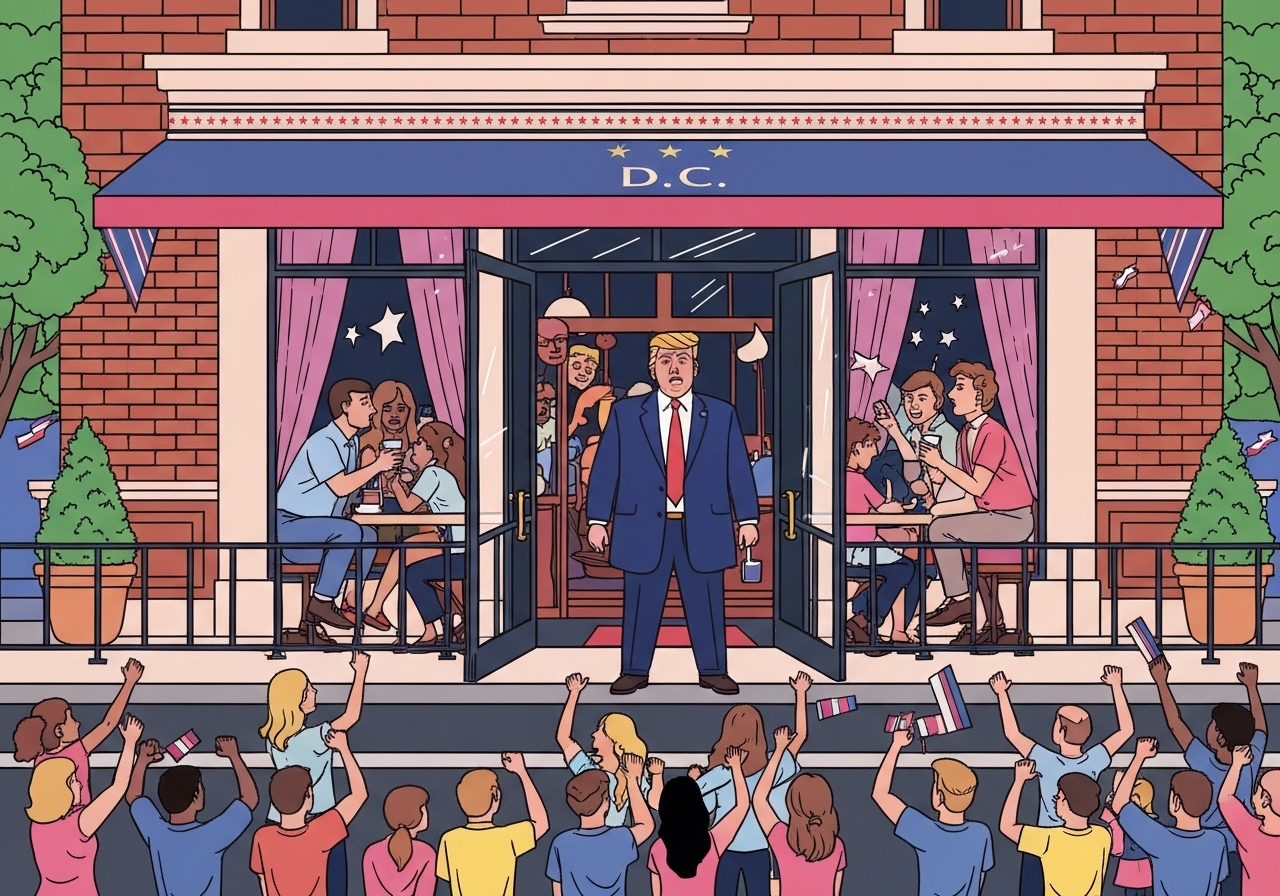
On the evening of Sept. 9, 2025, President Donald Trump dined at Joe’s Seafood, Prime Steak & Stone Crab near the White House while a small group of protesters inside displayed Gaza flags and chanted, and supporters outside cheered. Secret Service agents removed the inside demonstrators after short exchanges; outside the restaurant, moments of applause mixed with boos. The visit came amid Mr. Trump’s public push to federalize police and deploy the National Guard in U.S. cities, and the White House reported nearly 2,200 arrests connected to the Washington crackdown since Aug. 7.
Key Takeaways
- When and where: The dinner took place Sept. 9, 2025, at Joe’s Seafood on 15th Street NW in Washington, D.C.
- Arrests: The White House said there have been nearly 2,200 arrests tied to the Washington crackdown announced Aug. 7, 2025.
- Participants: Attendees included Vice President J.D. Vance, Secretary of State Marco Rubio, Defense Secretary Pete Hegseth and White House Chief of Staff Susie Wiles.
- Protest action: A small group held miniature Gaza flags and chanted inside; Secret Service removed those demonstrators, saying repeatedly, “Time to go. Time to go.”
- Public reaction: Supporters inside and outside the restaurant chanted “U-S-A,” while others booed and some held Palestinian banners as they exited.
- Policy backdrop: The event occurred amid Mr. Trump’s broader moves to federalize local policing and to deploy the National Guard to cities including a June deployment to Los Angeles and threats toward Chicago, Baltimore and New Orleans.
- Messaging: Mr. Trump claimed crime in D.C. has fallen and asserted restaurants were “booming,” statements that local data and observers say require closer verification.
Background
Since announcing an intensified federal crackdown on Aug. 7, 2025, the Trump administration has emphasized rapid deployments of federal law enforcement and National Guard units as a central public-safety strategy. The President has framed these moves as restoring public order in cities he depicts as beset by crime, while critics argue they amount to political theater and risk escalating tensions with local authorities. Deployments have included the National Guard in Los Angeles in June and threatened operations in largely Democratic cities such as Chicago, Baltimore and New Orleans, prompting pushback from some state and city leaders.
Public demonstrations and counter-demonstrations have been frequent in the weeks since the crackdown was announced, and restaurants and small businesses report mixed effects: some owners say reservations have held steady, while others report declines. Advocacy groups opposed to the administration’s policies have staged protests that sometimes move from sidewalks into commercial spaces, drawing law enforcement responses that civil liberties advocates say should be narrowly targeted and legally justified. The White House has sought to use such appearances as political symbolism, emphasizing the President’s public visibility and ties to supporters.
Main Event
Mr. Trump’s motorcade traveled a short distance from the White House to Joe’s Seafood on Sept. 9. Video shared on social platforms showed him greeting some diners and then pausing after spotting a small cluster of protesters inside who displayed tiny Gaza flags and chanted slogans critical of U.S. policy on Israel and Gaza. According to footage and nearby reporters, the President moved closer to the protesters and gestured briefly; he did not appear to engage in an extended verbal exchange.
Secret Service officers then directed the small group to leave, repeating, “Time to go. Time to go,” as the demonstrators were escorted out. Some leaving the restaurant carried Palestinian banners; others in the dining room responded with booing or chants of support for the President. Outside, mixed reactions continued: cheers from supporters mingled with scattered boos and anti-administration chants from bystanders.
After the meal, the President returned to the White House after 10 p.m. Press Secretary Karoline Leavitt, who joined the party, later listed his dinner items as crab, shrimp, salad, steak and dessert. The visit was notable because the President rarely dines offsite while in Washington, and such public outings have grown less frequent since his former hotel nearby was sold.
Analysis & Implications
Politically, the outing served multiple purposes: it offered a staged demonstration of normalcy and public support while reinforcing the administration’s law-and-order narrative ahead of continued campaigning. Public appearances like this can reassure supporters and generate social-media attention, but they also invite confrontations that amplify opposition messages, particularly when protests touch on sensitive international issues like the Israel-Hamas war.
From a policy perspective, claims that federal measures have dramatically reduced crime in Washington require disaggregation. The President’s assertion that the city has “virtually no crime” is at odds with the complexities of policing and reporting; crime statistics fluctuate by category and neighborhood, and high-security presidential movements make direct observational claims unreliable. Independent crime data and long-term trends are needed to assess real change.
The federalization of local policing raises legal and political questions. Deploying National Guard forces and federal agents into cities poses coordination challenges with state and local authorities and can spark constitutional and civil liberties concerns if actions blur lines between immigration enforcement, local criminal law, and political demonstrations. Governors and mayors have varied in their responses: some welcome assistance, others warn against heavy-handed tactics that could inflame communities.
Internationally, the episode underscores how U.S. domestic actions intersect with foreign policy debates. Protesters invoking Gaza reflected wider public unease about U.S. support for Israel, meaning domestic security moves can become focal points for global issues and transnational activism. That intersection complicates messaging and risks magnifying diplomatic sensitivities.
Comparison & Data
| Item | Detail |
|---|---|
| Arrests since Aug. 7 | Nearly 2,200 (White House figure) |
| Recent deployments | National Guard: Los Angeles (June); Washington: federalized forces since Aug. 7 |
| Potential targets | Chicago, Baltimore, New Orleans (threatened by administration) |
The White House’s nearly 2,200-arrest figure is the clearest numerical claim tied to the crackdown; however, that number alone does not describe charges, demographics, or outcomes of arrests. Comparisons across cities are complicated because jurisdictions record and report enforcement actions differently and because temporary federal deployments alter local policing patterns. Analysts advise examining underlying data (types of offenses, geographic concentration, demographic breakdowns and subsequent legal processing) before concluding the effectiveness or social impact of the operations.
Reactions & Quotes
Officials and organizations responded quickly after the dinner, with statements that framed the event within larger debates over public safety and civil rights.
“We’re going to be announcing another city that we’re going to very shortly,”
President Donald Trump (remarks, Sept. 9, 2025)
This remark, made before the dinner, fed speculation about imminent additional federal operations; it was cited by both supporters who welcomed more deployments and critics who warned of overreach. The administration suggested some governors and mayors would welcome assistance, a claim met with skepticism in jurisdictions opposing such interventions.
“Time to go. Time to go.”
Secret Service (on-site direction to protesters)
Secret Service officers used that phrase while escorting the inside demonstrators from the restaurant. The agency’s actions raised routine questions about the balance between protecting a visiting President and safeguarding demonstrators’ rights in private establishments.
“He had crab, shrimp, salad, steak and dessert,”
Press Secretary Karoline Leavitt (post-dinner comment)
That lighter, logistical detail underscored the staged and domestic nature of the event even as it unfolded against a backdrop of national policy clashes and international protest themes.
Unconfirmed
- The President’s claim that D.C. now has “virtually no crime” is not corroborated here with independent, city-level crime statistics and should be treated as an unverified assertion.
- Local restaurant trends described by Mr. Trump as “booming” are mixed according to proprietors and lack comprehensive, citywide sales data to confirm.
- The timing and location of any forthcoming city announcement referenced by the President remained unspecified and unconfirmed at the time of reporting.
Bottom Line
The Sept. 9 dinner was a tightly choreographed public moment that combined political messaging with a volatile protest environment: supportive crowds and a small inside demonstration highlighted the polarized reactions to the administration’s public-safety agenda. While the White House points to arrests and visible enforcement as metrics of success, those figures do not by themselves measure long-term public-safety improvements or community trust.
Officials, advocates and analysts will watch subsequent deployments and any released data closely: the accountability, legal justification and local collaboration behind federal actions will shape whether these interventions are seen as effective policy tools or controversial overreaches. For readers, the crucial takeaway is to distinguish immediate spectacle from sustained outcomes—the claims of reduced crime and economic uplift require independent verification and time to assess.
Sources
- CBS News (news report)
- The Associated Press (news agency; photo and reporting credit)
- The White House Briefing Room (official statements and press releases)
- Codepink (activist group statement page)