
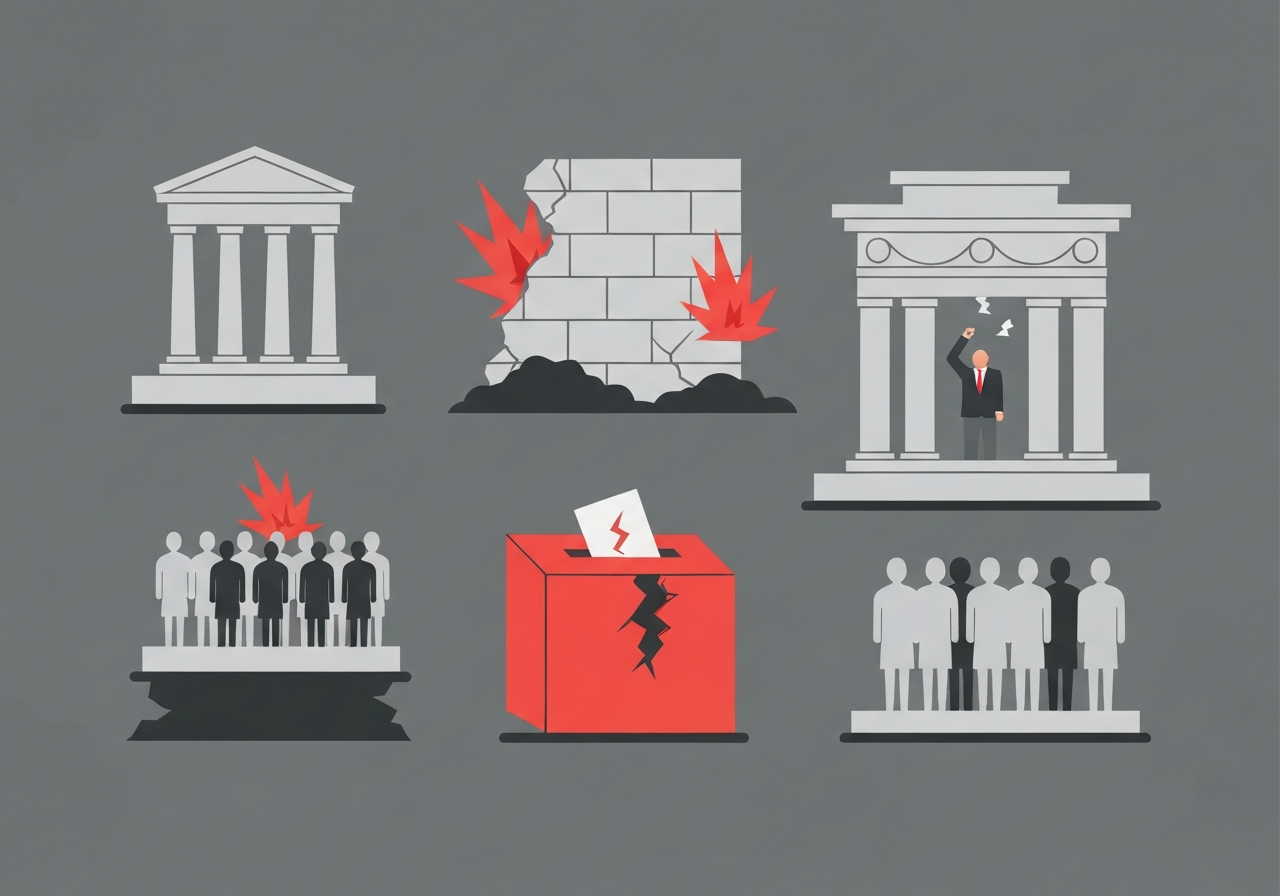
Human Rights Watch (HRW) says the world is experiencing a “democratic recession,” with roughly 72% of the global population now living under autocratic rule — a concentration of non-democratic governance not seen since the mid-1980s. HRW executive director Philippe Bolopion identified 2025 as a watershed year for rights in the United States, arguing that actions by the Trump administration have intensified pressures on democratic institutions and the international rules-based order. The report links those US developments with longstanding efforts by Russia and China to erode global norms, warning that the combined effect places the architecture protecting human rights at serious risk. HRW calls for coordinated action among rights-respecting democracies to defend legal checks and liberties at home and abroad.
Key takeaways
- HRW reports that 72% of the world’s people now live under autocratic governments, returning global democracy to levels last seen in 1985.
- The watchdog identifies 2025 as a tipping point in the United States, citing actions that weakened electoral trust, judicial independence and government accountability within 12 months of a second Trump term.
- Specific US concerns flagged include efforts to “nationalise” voting administration, reported financial ties (a disclosed $500m investment tied to an Emirati royal family member) to a Trump-family crypto venture, and use of state power to intimidate opponents, press and civil society.
- HRW documents recent rights abuses ranging from restrictions on free expression to deportations to countries where returnees face torture, raising rule-of-law alarms.
- The report links US trends with persistent strategies by Russia and China to undermine multilateral norms, together forming a global threat to rights defenders and normative institutions.
- In the UK HRW finds the 2025 Labour government pursued punitive immigration measures and protest restrictions that, the group says, have fuelled anti-migrant rhetoric and empowered far-right actors.
- HRW urges an alliance of democracies — including the UK, EU members and Canada — to coordinate policy, economic incentives and UN voting blocs to defend the rules-based order.
Background
HRW’s annual country-by-country assessment, released in early February 2026, situates current trends in a decades-long erosion of democratic norms. The organisation traces a gradual global shift away from liberal democratic practices that predates recent political cycles, noting that the share of the world population living under autocratic rule has climbed steadily. Parallel to that domestic backsliding in some democracies, authoritarian powers such as Russia and China have increasingly pushed to reshape international institutions and weaken mechanisms that once upheld human-rights standards.
The report highlights how domestic policy choices and geopolitical strategy interact: when a major democracy retreats from defending multilateral rules, it can create spaces for autocratic actors to expand influence. Human-rights advocates and civil society organisations have relied on international legal frameworks and diplomatic pressure as safeguards; HRW warns those safeguards are fraying. The watchdog frames the current moment as a “perfect storm” in which domestic democratic backsliding and international erosion of norms amplify each other, producing broader consequences for activists, minorities and independent institutions.
Main event
HRW says a cluster of policy choices and public statements during 2025 signaled a systematic assault on checks and balances in the United States. The report catalogues steps that have undermined public confidence in elections, actions that limit judicial oversight or defy court orders, and uses of executive tools to pressure media, universities, legal firms and civil-society organisations. Bolopion characterised these moves as coordinated and relentless, arguing they target the institutional limits designed to restrain executives and protect rights.
The organisation cites recent developments: public calls by President Trump urging Republicans to “nationalise” aspects of the US voting system; investigative disclosures about a $500m investment tied to a member of an Emirati royal family in a Trump-family cryptocurrency company; and federal immigration enforcement linked to controversial deportations. HRW documents that such measures have direct consequences for vulnerable populations and for the credibility of democratic institutions.
In the UK, HRW focuses on the Labour government’s immigration stance and tightened protest rules during 2025, describing them as punitive and influential in normalising anti-migrant rhetoric. The report connects those domestic policies to a rise in far-right visibility in public spaces and political discourse across parts of Europe. HRW also notes widespread public protests in multiple countries during the period — from anti-ICE demonstrations in Minneapolis after the fatal shootings of Alex Pretti and Renee Good by federal immigration officers to unrest in Iran and youth-led protests in Morocco — as indicators of popular resistance to state actions.
Analysis & implications
HRW frames the US developments as doubly consequential: domestically they weaken democratic safeguards and internationally they hollow out a leading defender of the rules-based order. If a prominent democracy shifts toward executive aggrandisement, other states and non-state actors may take that as precedent or opportunity to intensify their own suppressive practices. Bolopion warns that the US retreat from multilateral norms reduces leverage for human-rights accountability and emboldens authoritarian alternatives to the current international system.
Russia and China’s long-term strategies to erode institutions are also central to HRW’s analysis. Moscow and Beijing have invested in diplomatic, economic and legal tactics that limit scrutiny and promote authoritarian-friendly governance models. Combined with setbacks in Western democracies, these moves create fewer effective international venues for defending rights, increasing risks to minorities, journalists and human-rights defenders worldwide.
Economically and geopolitically, HRW suggests an alliance of democracies could provide counterweights: pooled economic incentives, coordinated trade policy and cohesive UN voting could blunt some consequences of normative erosion. However, forming such coalitions faces hurdles — divergent national interests, electoral politics and domestic policy differences complicate sustained coordination. Still, HRW asserts that collective policy could restore some of the institutional scaffolding protecting rights.
Comparison & data
| Indicator | Circa 1985 | Circa 2026 |
|---|---|---|
| Share of world population under autocracy | ~72% (1985 benchmark) | 72% (reported by HRW) |
| Noted tipping point in US | — | 2025 (HRW assessment) |
The table contrasts two snapshots: HRW places current global autocracy levels on par with the mid-1980s, using population-weighted measures to reach the 72% figure. That comparison underscores the report’s central contention that the present distribution of political regimes represents a reversal of the democratic expansion of the late 20th century. The organisation uses country-by-country assessments to compile these figures, acknowledging that regional shifts and demographic changes shape the overall percentage.
Reactions & quotes
HRW leadership framed the report as an urgent call to action, warning that democratic erosion in major powers increases risk everywhere. Below are selected, concise remarks included in HRW coverage and subsequent commentary.
“The rules-based international order is under intense strain and that strain is putting rights defenders at risk.”
Philippe Bolopion, HRW (executive director)
This statement was offered as a summary of HRW’s core assessment: that coordinated pressure from powerful states and weakened democratic checks are compounding threats to rights worldwide. Bolopion urged democracies to consider strategic alliances to protect norms and institutions.
“When a leading democracy retreats from international constraints, it reshapes global expectations about accountability.”
Independent rights analyst (expert comment)
An external expert framed HRW’s findings as a reminder that actions in major states have outsized normative effects; the comment was provided to contextualise how domestic policy reverberates internationally.
Unconfirmed
- The report cites investigative revelations that a member of an Emirati royal family invested $500m in a Trump-family cryptocurrency company; HRW references those disclosures but the full legal and financial details have not been independently verified in this summary.
- Some reports and political claims about plans to “nationalise” voting administration are based on public statements and partisan commentary; precise policy mechanisms and legal outcomes remain contested and subject to litigation or legislative debate.
Bottom line
HRW’s assessment paints a picture of international institutions and domestic protections for rights under acute pressure from a combination of authoritarian state strategy and democratic backsliding in powerful countries. The organisation warns that without coordinated responses, both the international rules-based order and the day-to-day protections people rely on could erode further. For policymakers, civil society and citizens, HRW’s central recommendation is to pursue collective, rules-based strategies — legal, diplomatic and economic — to shore up institutions that protect basic liberties.
At the same time, the report stresses the continuing importance of grassroots mobilisation and independent journalism in exposing abuses and holding power to account. HRW frames the moment not as one for despair but for renewed, strategic action by rights-respecting states and civil society actors to defend democratic norms.
Sources
- The Guardian (international news report)
- Human Rights Watch (official NGO; HRW World Report and public statements)