
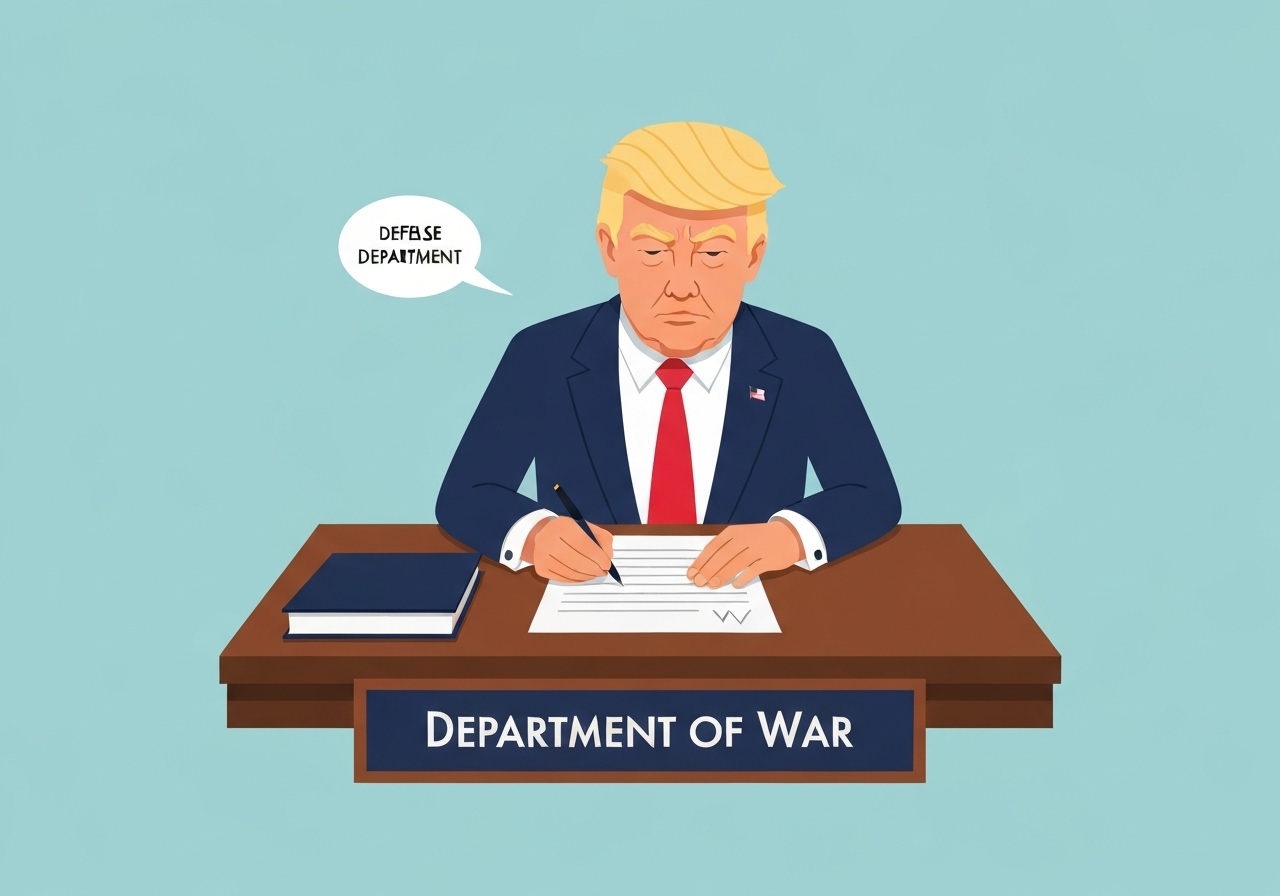
— President Trump signed an executive order this week directing the executive branch to recognize the Defense Department as the “Department of War” in ceremonial and nonstatutory contexts, a move that is symbolic until Congress acts and has generated debate over its message, cost and implications for U.S. military posture.
Key Takeaways
- The White House ordered the Defense Department to be recognized as the “Department of War” on Sept. 6, 2025; the change is ceremonial without congressional approval.
- Mr. Trump is simultaneously promoting his campaign for a Nobel Peace Prize and claiming peace through strength.
- The order allows use of “secretary of war” as a secondary title for the secretary of defense in executive-branch communications.
- Supporters in some Republican circles praised the change as a return to military tradition; critics called it symbolic belligerence.
- Experts warned of costs — estimated in the millions for signage, stationery and branding — and of potential diplomatic and legal signals.
- Officials have already begun swapping signs; the order applies to official correspondence, public communications and ceremonial contexts.
Verified Facts
On Sept. 5–6, 2025, the President signed an executive order instructing federal agencies within the executive branch to use “Department of War” as a secondary name and to allow “secretary of war” as a secondary title. By law, only Congress can change the official name of an executive department, so the order does not alter statutory titles or duties.
The White House framed the move as reflecting the United States’ fighting capability and a message of “victory” to allies and adversaries. Mr. Trump said in public remarks that strength has produced peace, adding that the rebranding would not be “the most expensive” change and could largely be handled through stationery and signage updates.
Some Republican lawmakers backed the change publicly. Senator Markwayne Mullin (R-Okla.) praised the decision on social media as part of a tougher national-security posture. At the same time, critics including analysts at the Quincy Institute and the Center for International Policy described the renaming as chiefly symbolic and warned it risks projecting an unnecessarily aggressive posture.
Observers also tied the move to recent operations and policy shifts. Col. Larry Wilkerson noted that the change coincides with a more offensive use of U.S. force, pointing to a recent strike on a vessel U.S. officials said was carrying Venezuelan drug smugglers — an action some experts say lacks clear legal precedent. Defense Secretary Pete Hegseth has begun implementing visual changes inside the department.
Context & Impact
Domestically, the renaming arrives amid President Trump’s public push to be seen as a peacemaker and his campaign for a Nobel Peace Prize. That juxtaposition has created confusion among allies, adversaries and the American public about the administration’s strategic direction.
Budgetary and practical effects are expected to be limited but not trivial. Analysts estimate costs in the low millions for rebranding items such as signs, stationery and digital assets. Critics argue the expense runs counter to stated goals of eliminating wasteful spending.
Internationally, the change may alter perceptions of U.S. intent at a moment when global diplomatic settings have shifted: leaders from China, Russia, India and North Korea recently met at a summit in China without U.S. participation, underscoring debates about American influence and posture.
- Perception: Risks signaling a more confrontational U.S. stance to allies and competitors.
- Operational: Could reflect or accelerate a preference for offensive military options.
- Legal: Some recent uses of force are being scrutinized for their statutory and international-law bases.
“I think I’ve gotten peace because of the fact that we’re strong.”
President Donald J. Trump / White House remarks
Unconfirmed
- Whether the administration will seek legislation to permanently rename the department through Congress.
- Long-term operational doctrine shifts tied directly to the renaming, as opposed to separate policy choices already underway.
- Any exact total cost to implement the rebranding across all agencies and facilities nationwide.
Bottom Line
The executive order to use “Department of War” is a symbolic rebrand that exposes tensions between the administration’s peace-oriented messaging and a more force-forward presentation of U.S. power. Absent congressional action, the change is largely ceremonial, but it carries diplomatic, budgetary and rhetorical consequences that merit continued public and congressional scrutiny.