
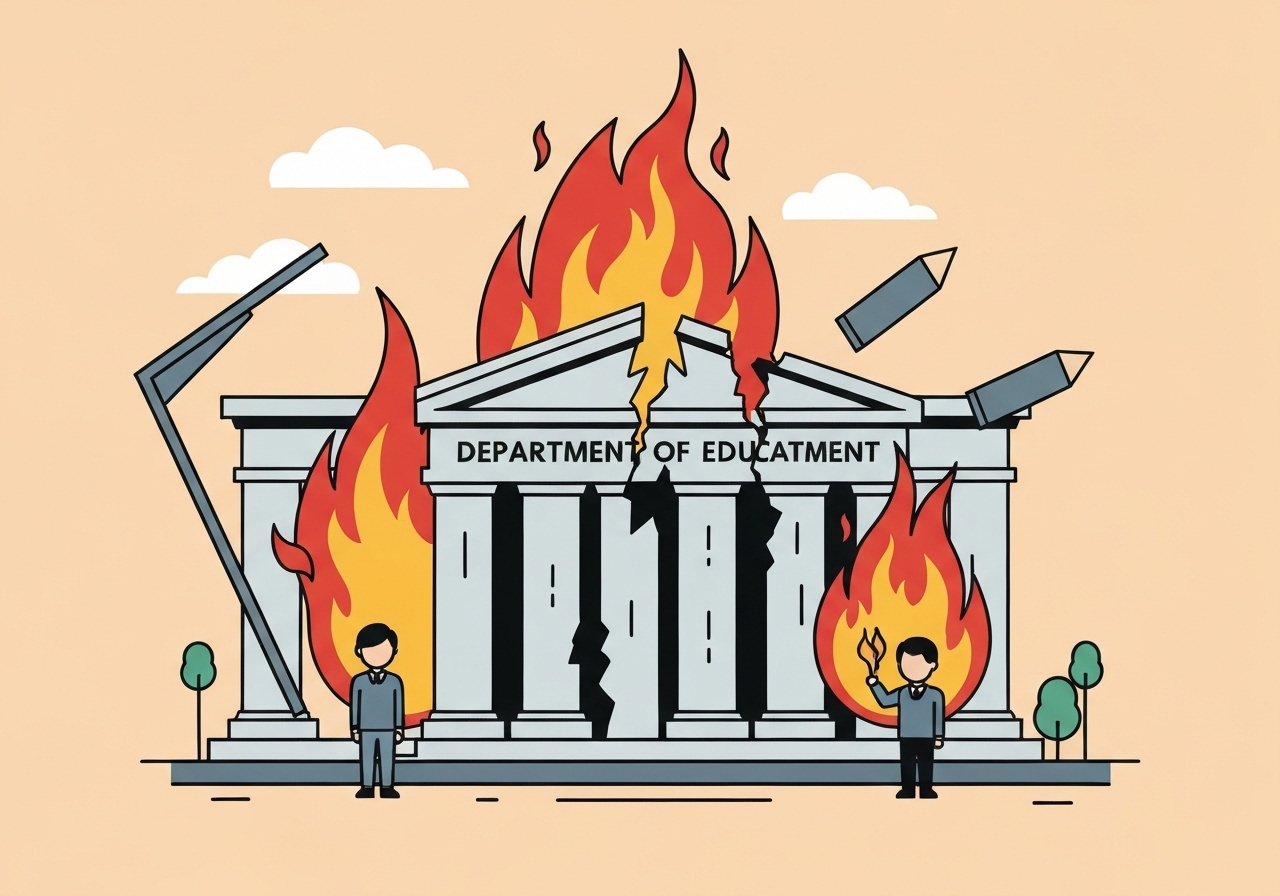
On Nov. 18, 2025, the Trump administration unveiled an administrative plan that reallocates major Education Department responsibilities to other federal agencies, a step it said furthers a longer-term goal of dismantling the department. The announcement shifts functions from the Office of Elementary and Secondary Education and the Office of Postsecondary Education largely to the Labor Department, while child-care grants for college students and foreign medical school accreditation move to HHS. Fulbright programs and international education grants are slated for the State Department and the Indian Education Office will transfer to the Interior Department. Administration officials framed the moves as reducing bureaucracy and sending more resources to schools; critics including teachers’ unions and student-rights groups warned of disruption and politicization.
Key Takeaways
- Announcement date: Nov. 18, 2025 (updated 5:08 p.m. ET) — the administration presented a package of program shifts and agency reassignments.
- Primary transfers: responsibilities from the Office of Elementary and Secondary Education and the Office of Postsecondary Education will be moved largely to the U.S. Department of Labor.
- Program-specific moves: a college student child-care grant program and foreign medical-school accreditation will go to Health and Human Services; Fulbright and international education grants will move to the State Department.
- Indian Education Office: management will be transferred to the Interior Department, changing how federal support for Native education is administered.
- Stated rationale: the administration says the reorganization will cut red tape and direct more money to classrooms, per Education Secretary Linda McMahon.
- Political hurdle: eliminating the Department of Education entirely would require an act of Congress; the announced transfers are administrative steps short of statutory closure.
- Pushback: teachers’ unions and student-advocacy groups oppose the plan, citing potential disruption to services and loss of centralized oversight.
Background
The U.S. Department of Education was created by Congress in 1979 and began operations in 1980 to centralize federal involvement in education policy, civil-rights enforcement, student aid and program oversight. Over four decades the department has housed offices devoted to K–12 policy, higher-education oversight, grant programs and compliance work, even as debates continued over the proper balance of federal and state authority. President Trump has repeatedly stated a preference for shrinking or eliminating the department, framing that goal as a way to return control to states and local districts; closing the agency, however, requires congressional approval and statutory repeal.
Administrations since the department’s founding have varied in how aggressively they consolidate or redistribute education functions within the federal government, often moving programs across agencies to reflect policy priorities. Stakeholders range from state education chiefs and local districts to higher-education institutions and federally recognized tribes; changes to program stewardship typically trigger complex operational, legal and funding questions. Teachers’ unions and student-rights groups have historically resisted moves they say weaken federal civil-rights enforcement and reduce resources for disadvantaged students.
Main Event
Officials announced on Nov. 18 that the Department of Labor will take over a large swath of programs previously administered by the Department of Education’s two primary offices for K–12 and higher education. Administration briefings described the shift as an administrative reorganization intended to streamline workforce and education links, positioning Labor to coordinate job-training and postsecondary pathways more directly. The moves include specific transfers: the child-care grant program targeted at college students and foreign medical-school accreditation will be reassigned to Health and Human Services, while Fulbright and other international-education grants will be managed by the State Department.
Interior will assume responsibility for the Indian Education Office, a change the administration characterized as placing Native education programs within a department already responsible for many tribal affairs. Officials emphasized the reassignments could be implemented through executive reorganization authorities and interagency memoranda; they stopped short of laying out a full timeline for every program’s operational handover. Education Secretary Linda McMahon said the plan was part of a broader push to reduce federal layers and refocus resources “on students, families and schools.”
Critics questioned how the transfers align with the administration’s stated goal to give states more power over education policy, noting that moving programs to other federal departments keeps responsibilities at the federal level rather than devolving them to state governments. Teachers’ unions and student-advocacy organizations signaled immediate opposition, warning of potential service interruptions and a loss of centralized enforcement of federal civil-rights protections in schools and colleges. Congressional lawmakers from both parties indicated the plan will prompt oversight hearings and could face legal and budgetary challenges.
Analysis & Implications
Operationally, reallocating programs among federal departments can create both efficiencies and frictions. On the one hand, placing workforce-linked postsecondary programs under Labor could improve alignment between training and employment policy; on the other hand, moving K–12 authority out of a single education-focused agency may fragment accountability for civil-rights enforcement and program continuity. Administrative transfers require detailed transition plans for staff, IT systems, grant rules and intergovernmental coordination—areas where poorly managed handoffs can disrupt services to students.
Politically, the announcement advances a narrative consistent with the administration’s long-term aim to reduce the department’s footprint, but it does not circumvent Congress. Any statutory elimination of the Department of Education would require passage of legislation that transfers or repeals existing law. The reassignments may therefore be both a tactical measure to reallocate functions and a signaling device intended to rally supporters while shifting some program oversight to agencies perceived as more ideologically aligned.
There are likely financial and diplomatic ripple effects. Moving Fulbright and international-education grants to the State Department could integrate those programs more closely with foreign policy objectives, potentially changing selection criteria or strategic priorities. Reassigning foreign medical-school accreditation to HHS may tie evaluation criteria more tightly to public-health standards rather than education policy norms. For Native education, moving the Indian Education Office into Interior changes the departmental context for program delivery and could affect tribal consultation practices.
Comparison & Data
| Program / Office (Before) | Receiving Agency (After) |
|---|---|
| Office of Elementary and Secondary Education | Department of Labor |
| Office of Postsecondary Education | Department of Labor |
| College student child-care grant program | Health and Human Services |
| Foreign medical-school accreditation | Health and Human Services |
| Fulbright & international education grants | State Department |
| Indian Education Office | Interior Department |
The table above consolidates the principal transfers announced by the administration. While the list outlines which agencies will receive program management, it does not capture the full operational mechanics—such as appropriation flows, rulemaking authority, or the administrative timeline for each handover. Those details will determine whether the reassignments produce measurable efficiency gains or create transitional gaps for students and institutions that rely on federal supports.
Reactions & Quotes
Administration officials highlighted the move as a streamlining effort intended to reduce duplication and focus funds on direct services:
“Cutting through layers of red tape in Washington is one essential piece of our final mission.”
Linda McMahon, U.S. Education Secretary (official statement)
In the same statement, the secretary framed the reorganization as student-centered rather than purely structural:
“This is an attempt to refocus education on students, families and schools.”
Linda McMahon, U.S. Education Secretary (official statement)
Outside the administration, advocacy groups and union leaders raised concerns about continuity and oversight. Teachers’ unions warned the changes could weaken federal civil-rights enforcement and upset long-standing compliance channels; student-rights organizations expressed worry about transitions for financial aid, campus services and accreditation oversight. Congressional leaders signaled they will examine the authority used for the transfers and seek documentation on projected savings and implementation plans.
Unconfirmed
- The precise timeline for each program’s transfer and when services will be administered by the receiving agencies has not been published and remains unclear.
- The projected budgetary savings claimed by administration officials have not been itemized publicly and require independent verification.
- It is not yet confirmed whether every transfer will require new rulemaking, interagency memoranda, or congressional appropriations approvals in specific cases.
- The extent to which states will gain new authority over program rules as a result of these transfers is unconfirmed and may vary by program.
Bottom Line
The Nov. 18, 2025 announcement represents a substantive administrative reshaping of where key federal education functions will sit inside the executive branch, moving program management to Labor, HHS, State and Interior. Officials present the changes as a bureaucratic slimming intended to concentrate resources in classrooms and better align education with workforce and health priorities.
But the package falls short of statutory elimination of the Department of Education, which would require congressional action. The practical effects will depend on implementation details—timelines, funding flows, rule changes and oversight mechanisms—and those factors will determine whether students, schools and higher-education institutions experience disruption or benefit from improved coordination.
Sources
- The New York Times (news report) — original reporting on the administration announcement, Nov. 18, 2025.