
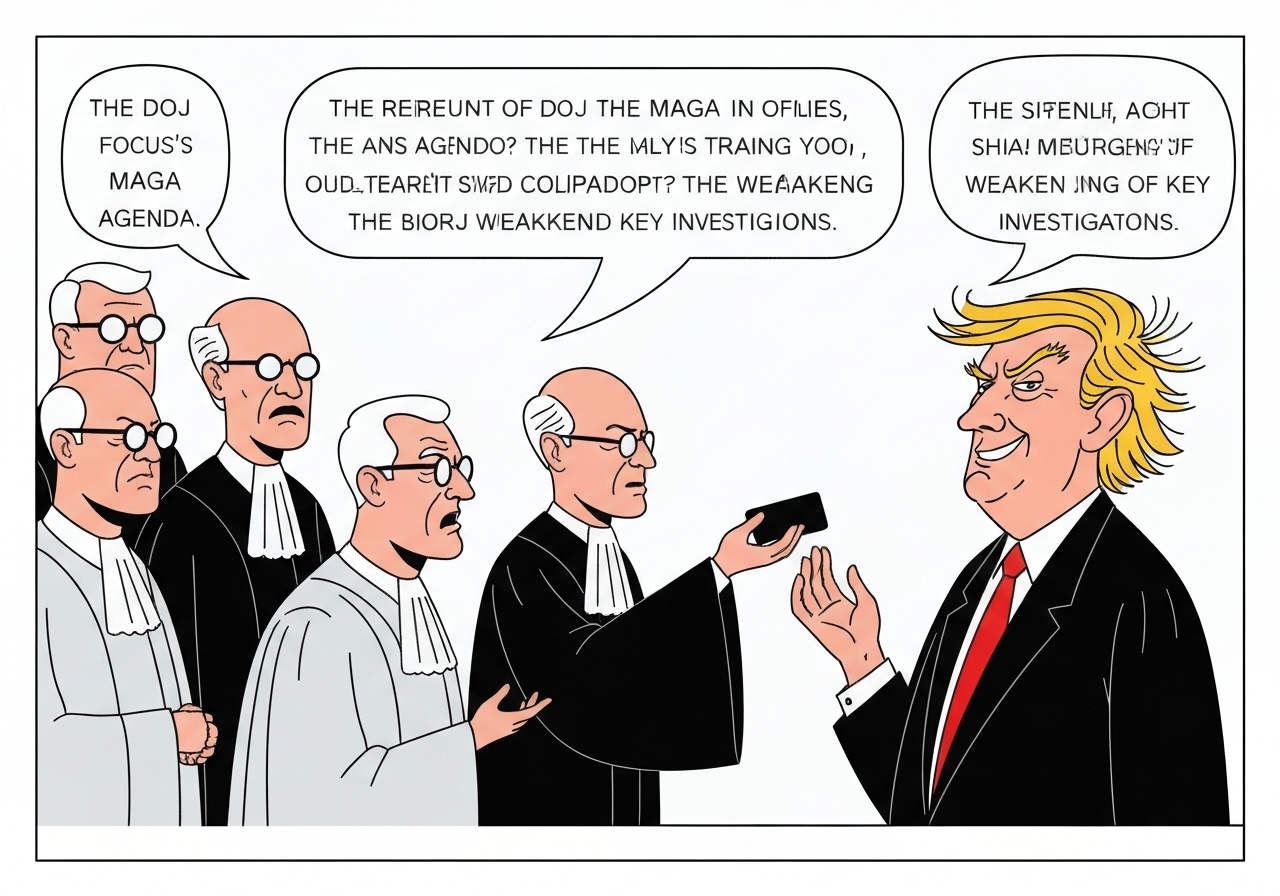
Lead: Former prosecutors and legal experts say changes at the U.S. Department of Justice since President Trump’s return in 2025 have redirected resources toward MAGA priorities, prompting thousands of departures and undermining investigations in civil rights, national security, voting and public corruption. Data compiled by the nonpartisan Justice Connection and DOJ records show roughly 5,500 staff — attorneys and non-attorneys — have left since the administration began reshaping the department, and critics argue the effects are immediate and lasting.
Key Takeaways
- About 5,500 DOJ employees have departed since Trump took office, a mix of firings, resignations and deferred-exit programs, shrinking institutional capacity across the department.
- DOJ employed roughly 10,000 attorneys last year, a baseline that advocates say is now strained by recent exits and hiring shortfalls.
- The Civil Rights Division reportedly lost about 70% of its roughly 600 lawyers and staff, leaving core voting-rights and police-misconduct work under-resourced.
- The Voting Section’s attorney numbers fell from about 30 to less than half, even as DOJ has taken positions on high-stakes redistricting disputes in Texas and California.
- The Public Integrity Section declined from roughly 30 lawyers at the start of 2025 to about two, according to former staff, after high-profile case dismissals and clemency actions.
- High-profile management changes — including ousters in the eastern district of Virginia and new, less-experienced appointees — preceded resignations of veteran national security and white-collar prosecutors.
- Experts warn the exodus erodes institutional memory and investigative capacity, potentially increasing risks to public safety and hampering long-term enforcement.
Background
After the 2024 election and President Trump’s inauguration in 2025, the administration moved quickly to reconfigure the Justice Department’s leadership and priorities. Attorney General Pam Bondi and senior appointees have initiated staffing changes framed by the administration as a realignment to prioritize immigration enforcement and other MAGA-aligned objectives. Critics say the campaign of removals and reassignments has disproportionately targeted prosecutors and investigators seen as insufficiently supportive of the new agenda.
Justice Connection, a nonpartisan group representing current and former DOJ staff, compiled departure data showing a near 5,500-person reduction in DOJ personnel since the transition. Historically, continuity at the department has been viewed as essential for long-running civil rights, national security and public-corruption probes; dismantling that continuity, former officials say, reduces the department’s ability to pursue complex criminal schemes and to sustain multi-year civil investigations.
Main Event
Top-level personnel moves included the removal or pressured resignations of numerous experienced prosecutors. In the eastern district of Virginia, U.S. Attorney Erik Siebert resigned after refusing pressure to bring politically sensitive charges; he was replaced by White House counsel Lindsey Halligan, a lawyer with little prosecutorial experience. Halligan’s subsequent indictment of former FBI director James Comey drew swift judicial criticism, with a federal judge flagging misstatements to a grand jury and procedural errors.
That reshuffling prompted multiple departures in the Virginia office, including long-serving national security and white-collar prosecutors such as Michael Ben’Ary and others. Former colleagues say these losses have hollowed out an office that traditionally led on complex fraud and national-security investigations. At Main Justice, leadership changes and hiring delays reportedly left the Civil Rights Division and its Voting Section severely understaffed, even as DOJ took controversial positions in state redistricting fights.
In some cases, the department’s prosecutorial stance shifted dramatically: high-profile public-corruption charges were dropped early in the administration, and President Trump granted clemency to certain figures, including former congressman George Santos, a move critics say weakened ongoing corruption enforcement. Separately, on his first day back in office this year, President Trump reportedly granted pardons to more than 1,500 MAGA-aligned individuals connected to the January 6 Capitol attack, an action sources say has further demoralized prosecutors who had worked on those cases.
Analysis & Implications
The departures represent more than personnel changes; they undercut the institutional knowledge that allows prosecutors and investigators to connect disparate cases and to anticipate criminal networks’ behavior. Experts note that countering domestic violent extremism, dismantling sophisticated fraud rings and pursuing long-running civil-rights remedies depend on teams with deep subject-matter experience — expertise that cannot be rebuilt quickly.
Politicized hiring and prosecutorial decisions also risk eroding public trust in DOJ’s impartiality. When enforcement choices align with a partisan agenda — for example, selectively defending one set of redistricting plans while challenging another — the department’s credibility with state officials, local law enforcement and communities of color can deteriorate, making future cooperation harder to secure.
There are immediate operational consequences: fewer attorneys mean fewer grand-jury prosecutions, delayed investigations, and less capacity to supervise consent decrees or long-term civil-rights agreements. Over time, the diminished ability to pursue corruption and complex financial crime could create enforcement gaps that embolden bad actors domestically and reduce U.S. leverage in cross-border investigations.
Comparison & Data
| Unit / Metric | Before 2025 | After Changes (reported) |
|---|---|---|
| Total DOJ departures | N/A | ~5,500 staff left |
| DOJ attorneys (baseline) | ~10,000 (2024) | Hiring uneven; capacity strained |
| Civil Rights Division staff | ~600 | -70% (approx. 180 remain) |
| Voting Section attorneys | ~30 | <15 (reported) |
| Public Integrity Section | ~30 | ~2 (reported) |
These figures reflect reported staff reductions and do not capture all changes in contractor support, investigators, or the shifting of personnel between offices. Still, the pattern of concentrated losses in civil rights, voting and corruption units stands out in interviews with former prosecutors and in advocacy group tallies.
Reactions & Quotes
Former DOJ staff and independent experts have been vocal about the impact.
“The purge we’ve witnessed at the justice department has been catastrophic, and it isn’t slowing down,”
Stacey Young, founder and executive director, Justice Connection
Young framed the departures as a sustained campaign that has driven away long-term public servants and weakened the department’s capacity to protect national security, the environment, economic interests and civil rights.
“Effective federal law enforcement requires training and expertise… the loss of experience comes at a cost to public safety,”
Barbara McQuade, former U.S. Attorney and law professor
McQuade warned that dismantling units that counter violent extremism and organized crime could increase risks that otherwise experienced teams would have prevented.
“The DoJ is supposed to represent all Americans, without regard for party,”
David Becker, Center for Election Innovation and Research (former DOJ attorney)
Becker criticized recent interventions in redistricting litigation and the reduction in voting-rights attorneys as evidence the department has shifted toward partisan objectives.
Unconfirmed
- Whether every case dismissal or clemency was driven solely by political motives rather than legal assessments remains contested and not independently verified.
- Some specific staffing counts by office are based on former staff reports and internal tallies rather than uniformly published DOJ rosters; exact totals may vary pending official accounting.
- The long-term effect on specific crime rates and national-security incidents is uncertain and depends on future hiring, policy choices and interagency cooperation.
Bottom Line
The reported exodus of thousands of DOJ personnel and the reorientation of the department toward MAGA-aligned priorities represent a meaningful shift in federal enforcement capacity. Experts argue this is more than partisan personnel management: it is a redefinition of institutional mission that has tangible operational consequences for civil rights enforcement, voting protections, corruption probes and national-security investigations.
Rebuilding the lost capacity — if policymakers choose to do so — will take years of targeted recruitment, training and restoration of institutional trust. In the near term, observers say congressional oversight, transparent DOJ reporting on staffing and caseloads, and public scrutiny of prosecutorial decisions will be critical to assessing whether the department can regain balanced, nonpartisan enforcement.