
Lead
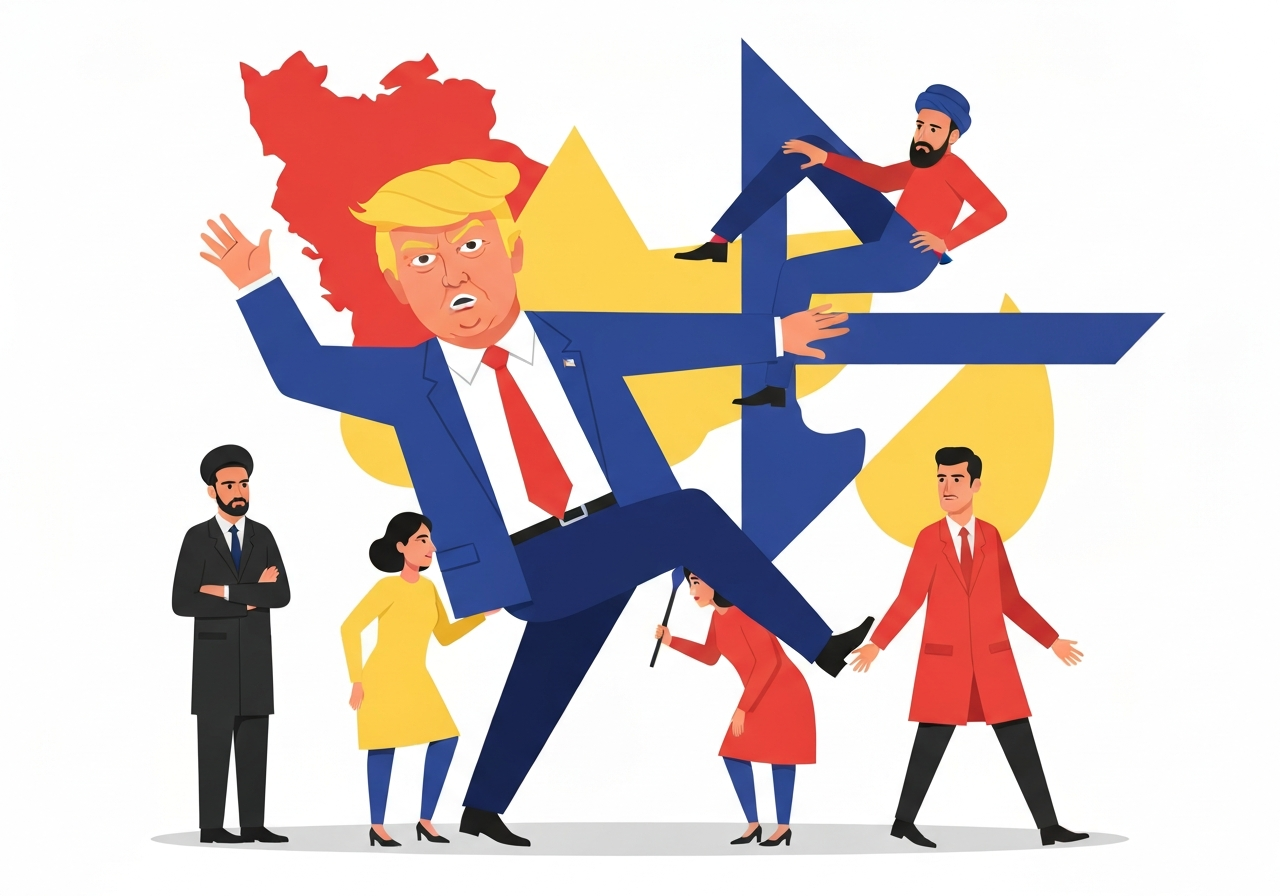
As the US-Israeli war on Iran enters its third week (March 15–16, 2026), President Donald Trump is under intensifying pressure to produce a clear endgame. His public explanations have shifted between predictions of a swift conclusion and appeals for European and Gulf partners to take on a greater role. That inconsistency has left allies and adversaries alike uncertain about when—or whether—U.S. involvement will wind down. Meanwhile, Tehran has shown little sign of acquiescing, and rival powers appear to be exploiting the ambiguity.
Key Takeaways
- The conflict entered its third week on March 15–16, 2026, increasing diplomatic and domestic pressure on President Trump to define an exit strategy.
- Mr. Trump has alternated between saying the war will end soon and asking European and Gulf allies for greater support, creating uncertainty about U.S. intentions.
- European and Gulf partners have been publicly cautious; none have committed to large-scale military deployments as of March 16, 2026.
- Iran has resisted calls to stand down, reducing the immediate prospect of a negotiated settlement.
- Observers report that Russia is gaining diplomatic leverage from Western divisions, using the situation to expand influence in the region.
- Prolongation of the campaign risks economic disruptions and political fallout for U.S. partners reluctant to deepen involvement.
Background
The present confrontation between U.S.-Israeli forces and Iran is now measured in weeks rather than days, placing allied capitals under pressure to reassess their commitments. Historically, Washington has relied on coalition contributions to share operational, logistical and political burdens; partners’ reluctance can slow or reshape a campaign. For European and Gulf states the calculus is complex: public opinion, economic ties with Iran, and concerns about escalation all limit appetite for direct military involvement.
Domestically in the United States, presidential authority gives Mr. Trump significant latitude over military options, but that power is tempered by political, legal and logistical constraints. Allies expect at minimum a clear political objective and an exit framework when partnering with the U.S. in kinetic operations. At the same time, rival states see strategic opportunity: gaps in Western unity can be turned into diplomatic or economic advantage.
Main Event
Over the past week President Trump has presented differing rationales for continuing military pressure on Iran, at times projecting confidence that operations would conclude quickly and at other moments urging allies to share the burden. Those changing signals complicate allied planning and make it harder to predict the U.S. timeline for de-escalation. From partner capitals to regional militaries, officials report scrambling to interpret Washington’s intent.
European and Gulf governments have publicly expressed caution; diplomats and defense officials have signaled reluctance to commit troops or large-scale assets without clearer objectives and exit terms. That restraint has practicality as well as political roots: long deployments carry costs, and governments remain wary of being drawn into an open-ended confrontation. The absence of robust allied commitments limits options available to U.S. commanders and narrows diplomatic leverage.
On the Iranian side, Tehran has shown limited willingness to accede to terms that would end hostilities on the present trajectory. That stance reduces the effectiveness of pressure campaigns that rely on demonstrating overwhelming allied unity. In parallel, Moscow and other competitors are capitalizing on Western uncertainty to increase diplomatic engagement with regional actors and to present themselves as alternative security partners.
Analysis & Implications
The immediate political implication for the U.S. is a sharper focus on presidential credibility: persistent mixed messaging erodes partners’ confidence and complicates coalition building. If allies doubt the U.S. commitment or clarity of purpose, they are less likely to accept risky commitments. That, in turn, can force Washington to either escalate unilaterally or to accept a prolonged stalemate—both outcomes carry domestic and international costs.
Regionally, a drawn-out campaign could deepen instability across the Middle East, disrupting energy markets and threatening supply lines that affect global trade. Even short-term disruptions can raise prices and feed into political pressures on European and Asian governments. For Gulf states, the choice to assist Washington involves weighing security guarantees against possible retaliatory exposure and public opposition.
Strategically, rival powers gain from ambiguity. Russia’s ability to play the role of mediator or security partner grows when Western cohesion wanes, allowing Moscow to strengthen ties with Iran and other regional actors. That realignment would have longer-term consequences for influence over trade routes, energy diplomacy, and military basing options.
Comparison & Data
| Metric | Value/Status |
|---|---|
| Elapsed time | Third week (as of March 15–16, 2026) |
| Allied troop commitments | Limited / largely noncombat (publicly) |
| Iranian posture | Resistant to immediate settlement |
| Rival influence (noted) | Russia increasing diplomatic leverage |
The table above summarizes the state of play in concrete terms: the campaign has moved beyond initial strikes into a phase where the duration, partner contributions and adversary response are the decisive variables. Those indicators suggest a narrowing of politically acceptable options for Western capitals unless messaging and coordination improve.
Reactions & Quotes
‘The president has at times signaled an imminent end while also calling for partners to carry more of the burden,’ a White House official summarized when asked about recent remarks.
White House (official summary)
‘Without clearer objectives and burden-sharing, allies are reluctant to deepen engagement, which risks creating openings for other powers,’ a regional security analyst observed.
Regional security analyst (independent)
‘Iran’s current posture does not indicate near-term willingness to negotiate under existing pressure,’ said an academic expert on Iranian politics.
Academic expert (area studies)
Unconfirmed
- Whether the U.S. has a formal, time-bound plan to end operations is not publicly confirmed.
- Reports of undisclosed bilateral talks between Washington and Tehran have not been verified by official sources.
- The scale of behind-the-scenes offers from European or Gulf states to support the campaign remains unclear.
Bottom Line
After three weeks of hostilities, the course of the campaign depends less on battlefield dynamics than on political clarity from Washington and willingness among partners to share risk. President Trump occupies the position most able to define an exit, but inconsistent public signals have diminished allied ability to plan and constrained diplomatic leverage. Without clearer objectives and a credible burden-sharing arrangement, the conflict risks becoming protracted, increasing costs for the United States and its partners.
Close observers should watch for two signals as indicators of a turning point: explicit, detailed U.S. criteria for ending operations; and concrete commitments from European or Gulf states to support either military or diplomatic steps. Absent those, rival powers like Russia are likely to convert Western disunity into longer-term influence gains in the region.
Sources
- Bloomberg — News outlet reporting on shifting U.S. messaging (March 15–16, 2026).
- White House Briefing Room — Official statements and summaries (official source for presidential remarks).
- U.S. Department of State — Official foreign policy statements and diplomatic engagement (official source).