
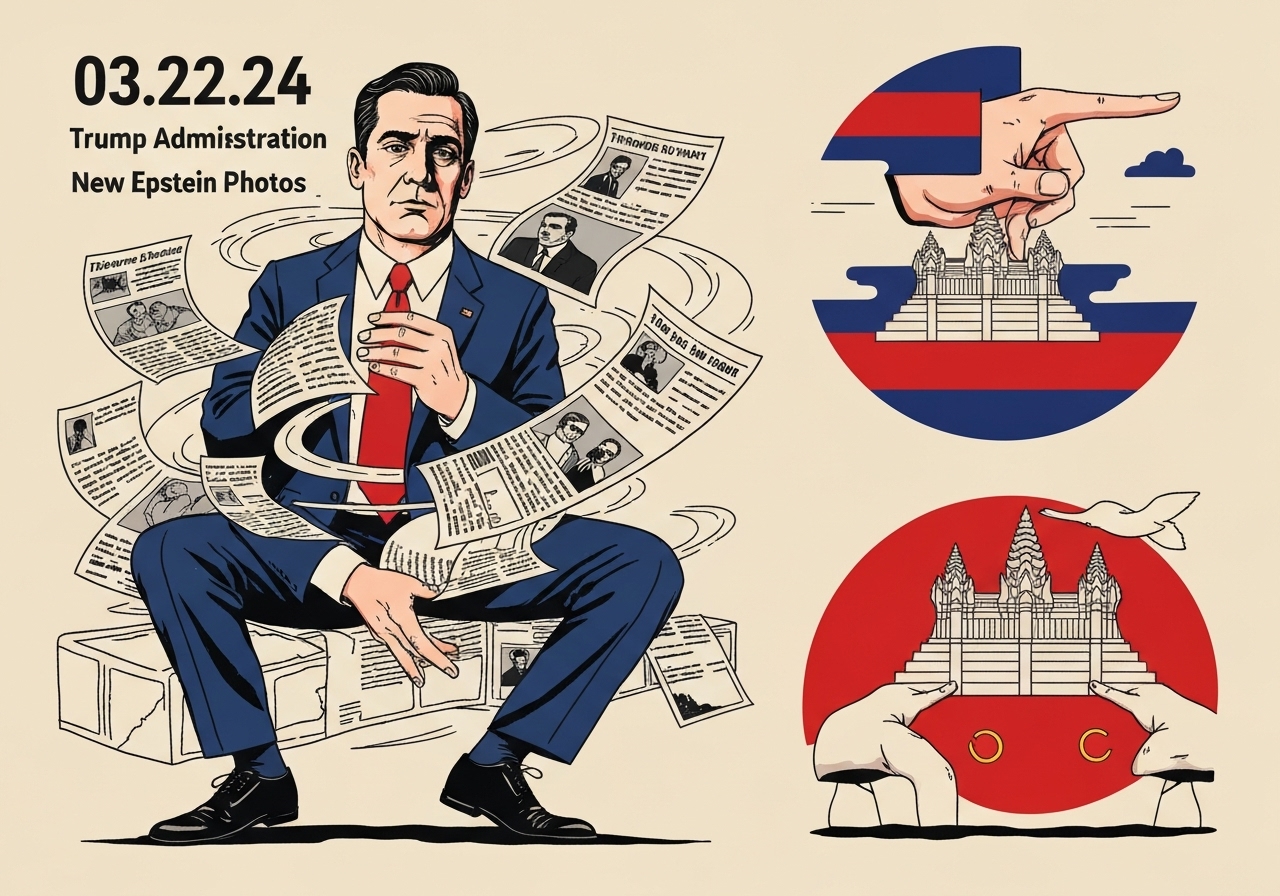
Lead: President Trump on Friday said he had helped broker a return to an October peace framework between Thailand and Cambodia after a fresh spike in border fighting killed at least 20 people and displaced more than 500,000. House Democrats released 19 photographs drawn from a larger trove tied to Jeffrey Epstein, prompting renewed calls for the Justice Department to make files public by a Dec. 19 deadline. Separately, the Navy delivered a review of Senator Mark Kelly’s involvement in a veterans’ video to the Pentagon for legal assessment, and Mr. Trump announced a symbolic pardon for former Mesa County clerk Tina Peters, who is serving a nine-year state sentence for tampering with voting equipment.
Key Takeaways
- President Trump posted that Thailand and Cambodia agreed to a cease-fire and would return to the terms of a peace pact signed in October in Kuala Lumpur, where Mr. Trump attended the ceremony.
- At least 20 people were reported killed and over 500,000 displaced in the recent Thailand–Cambodia escalation, which included airstrikes and rocket fire.
- House Oversight Democrats released 19 photos from Jeffrey Epstein’s image trove (drawn from roughly 95,000 files); the selection included images of former Presidents Trump and Clinton but provided limited context.
- The Justice Department faces a statutory deadline of Dec. 19 to make parts of its Epstein investigative files public, though exemptions could limit disclosure.
- The Navy submitted a report assessing retired Captain and Senator Mark Kelly’s role in a Nov. 18 video urging service members to refuse unlawful orders; the Pentagon’s Office of General Counsel is now reviewing the report.
- Mr. Trump announced he would pardon Tina Peters, convicted of state election-related offenses and sentenced to nine years; presidential clemency does not extend to state convictions.
- Thailand’s caretaker prime minister, Anutin Charnvirakul, dissolved parliament in late-night action, setting an accelerated election timetable and reflecting domestic political turbulence tied to the border crisis.
Background
The border between Thailand and Cambodia has been a recurring flashpoint for decades, with disputes concentrated along a nearly 500-mile boundary that remains partly undefined. In October, leaders of both countries signed a fragile peace agreement in Kuala Lumpur in a ceremony attended by President Trump; the pact sought to reduce tensions but left many local issues unresolved. Historically, clashes have flared near contested sites and cultural landmarks; prior rounds of violence, including bouts around 2011, prompted international mediation and a 2013 United Nations court order that shaped troop deployments.
Jeffrey Epstein’s network and posthumous litigation have been the subject of long-running congressional and Justice Department scrutiny since his death in federal custody in 2019. Congress recently passed a law requiring the Justice Department to release certain investigative materials by Dec. 19, though the statute includes carve-outs for privacy and ongoing investigations. The Oversight Committee has obtained a large volume of files from Epstein’s estate and related devices; Democrats say selective releases are necessary to spur full disclosure, while Republicans call the timing and selection politically motivated.
The domestic political scene in the United States provides the context for other developments in this package: Pentagon and Justice Department actions involving elected officials and allies of Mr. Trump—alongside high-profile clemency moves—reflect a broader pattern of the administration using executive and institutional levers to pursue policy and political aims. Those moves intersect with standard legal and institutional limits, such as the president’s inability to pardon state convictions and the procedural norms that govern military discipline for retired officers.
Main Event
House Oversight Democrats released 19 images on Friday from a substantially larger set of roughly 95,000 files tied to Jeffrey Epstein’s email account and one of his laptops. Committee Democrats said the photos illustrate Epstein’s connections to wealthy and influential figures in politics, finance, academia and entertainment. The images were published without accompanying email metadata or explanatory materials, and some women’s faces were redacted — a step Democrats said was intended to protect potential victims.
President Trump posted on Truth Social that he had spoken with Thailand’s caretaker prime minister Anutin Charnvirakul and Cambodia’s leader, Hun Manet, and that both agreed to a cease-fire effective Friday night and to revert to the October peace terms. Cambodian officials had not immediately confirmed the phone call, and Thai officials gave mixed signals; Mr. Anutin earlier urged the president to pressure Cambodia to withdraw troops and remove land mines. In the week leading up to the announcement, Thailand carried out air raids while Cambodia returned fire with rockets, producing the reported casualties and mass displacement.
The Navy has forwarded to the Pentagon secretary’s office a report from the Secretary of the Navy assessing Senator Mark Kelly’s participation in a short Nov. 18 video in which six former military or intelligence officials warned service members about unlawful orders. The action follows an order from Defense Secretary Pete Hegseth to investigate the senators who made the video; the legal question centers on whether a retired officer who appears in such material engaged in conduct meriting reactivation for disciplinary proceedings. The Pentagon’s Office of General Counsel is conducting legal review of the Navy secretary’s submission.
On Thursday, Mr. Trump announced he would pardon Tina Peters, a former Mesa County clerk convicted in state court of tampering with voting equipment and sentenced to nine years. Legal experts and Colorado officials noted the pardon is symbolic because presidential clemency applies to federal offenses and does not override state convictions. The move follows earlier interventions by allies and a letter urging clemency on Peters’ behalf, and comes amid broader presidential clemency actions this term in which Mr. Trump has granted relief to several high-profile allies.
Analysis & Implications
The release of a small subset of Epstein-era images is likely to intensify political pressure on the Justice Department to comply with the Dec. 19 disclosure statute while also amplifying partisan disagreement over context and intent. Democrats argue photographic evidence should be paired with investigative files and metadata to allow meaningful public assessment; Republicans counter that images alone can be misleading without provenance or corroboration. Legal and privacy exemptions in the statute mean congressional and public demands may collide with countervailing claims about victim protection and ongoing investigations.
If the Thailand–Cambodia cease-fire holds, it would represent a rapid de-escalation of a conflict that threatened broader regional instability and humanitarian catastrophe. However, cease-fires in the region have proved fragile in the past, and the October Kuala Lumpur accord was always described as a limited framework. The mass displacement—more than half a million people—creates an urgent humanitarian need and will test whether international relief, land-mine removal and local deconfliction mechanisms can operate amid renewed political turbulence in Bangkok.
The Navy’s delivery of a report on Senator Kelly underscores the unusual posture of the current administration toward former military officers who now serve in elected office. Recalling retired officers to active duty for punishment is legally permissible in narrow circumstances, but it is rarely used and would carry significant political and institutional consequences. The Pentagon’s legal review will weigh precedent, statutory criteria and separation-of-powers concerns; any move to pursue disciplinary or criminal steps would generate intense judicial and congressional scrutiny.
Mr. Trump’s announcement of a symbolic pardon for a state-convicted official signals continued reliance on high-profile gestures to reward allies and shape political narratives. While legally ineffective for state sentences, symbolic pardons can shift public perception, create legal and diplomatic friction with state authorities, and heighten partisan tensions over federalism and executive authority. Observers will watch whether this pattern alters prosecutorial behavior, state–federal relations, or voter mobilization in upcoming elections.
Comparison & Data
| Event | Scope | Notable outcomes |
|---|---|---|
| 2011 border clashes (Thailand–Cambodia) | Sporadic fighting near disputed temples | Deadly incidents; 2013 U.N. court order to adjust troop deployments |
| 2025 escalation (Dec.) | Cross-border air and rocket exchanges | At least 20 killed; over 500,000 displaced; October Kuala Lumpur pact under strain |
The table highlights the recurrence of violence along a partly undefined frontier and the step-change in humanitarian displacement in the latest escalation. The October peace framework did not resolve local command-and-control issues, and renewed hostilities expose gaps in enforcement and deconfliction that international actors had hoped the 2025 pact would close.
Reactions & Quotes
House Oversight Democrats framed the photo release as a demand for fuller transparency; Representative Robert Garcia emphasized the need for more documents before the Justice Department deadline.
“These disturbing photos raise even more questions about Epstein and his relationships with some of the most powerful men in the world. We will not rest until the American people get the truth.”
Rep. Robert Garcia (D-CA), Oversight Committee
The White House responded by calling the release selective and politically motivated, with a spokeswoman accusing Democrats of redactions intended to advance a partisan narrative.
“Random redactions and a Democrat hoax do not change the facts about our record supporting victims and calling for transparency.”
Abigail Jackson, White House spokeswoman
Colorado officials stressed the constitutional limits of a presidential pardon over state convictions after Mr. Trump announced clemency for Tina Peters.
“Tina Peters was convicted by a jury of her peers for state crimes in a state court. Trump has no constitutional authority to pardon her.”
Jena Griswold, Colorado Secretary of State
Unconfirmed
- The president’s claim that he spoke directly with Cambodia’s leader Hun Manet was not confirmed by Cambodian officials at the time of the announcement.
- Mr. Trump’s statement that the roadside bomb that triggered the latest clashes was “an accident” has not been verified by independent military or forensic sources.
- It remains unclear whether the 19 photos released by Democrats include original metadata or accompanying communications that would establish provenance and context.
Bottom Line
The Friday package of developments — from congressional photo releases to claims of an immediate cease-fire, a Navy review of a senator, and a symbolic pardon — underscores how diplomatic, legal and political threads are colliding at once. Each item raises distinct questions of evidence, institutional authority and precedent: whether the Justice Department will meet statutory transparency obligations, whether a fragile cease-fire will hold, how far the Pentagon will go in assessing retired officers who are now lawmakers, and what symbolic clemency does politically if not legally.
In the days ahead, analysts should watch for three concrete signals: whether Cambodian authorities confirm a sustained truce and troop movements; whether the Justice Department releases additional Epstein materials with metadata; and whether the Pentagon takes any personnel or legal action stemming from the Navy’s report on Senator Kelly. Those developments will determine whether these episodes become transient headlines or catalysts for longer-term institutional change.