
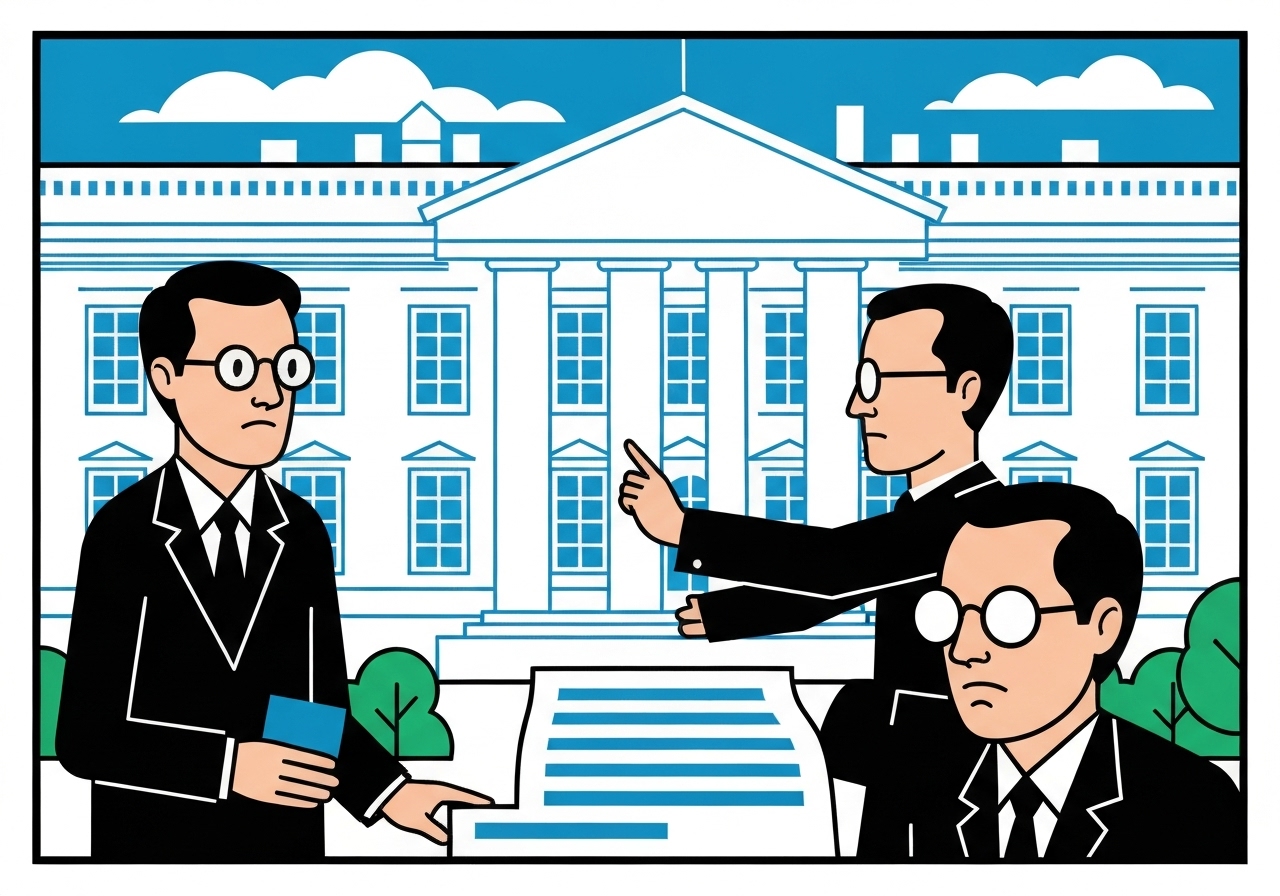
The White House has circulated a draft executive order that would empower the attorney general to contest state-level artificial intelligence rules, escalating a national fight over who should govern AI. The proposal, reported this week by The Information and confirmed to reporters by sources familiar with the draft, would direct Attorney General Pam Bondi to assemble a task force aimed at targeting state AI statutes on federal preemption grounds. Supporters of a federal-first approach say the measure is meant to prevent a burdensome patchwork of 50 different regulatory regimes; critics say an executive order cannot lawfully displace state legislation and that Congress remains the proper forum. It remains unclear whether President Donald Trump will sign this draft or how close it is to final White House approval.
Key Takeaways
- The draft order would instruct Attorney General Pam Bondi to form a task force charged with challenging state AI laws, asserting federal authority over interstate commerce.
- The approach seeks to argue that state AI measures are preempted by federal commerce power and other legal doctrines; the exact legal theories are not public.
- In July, the Senate voted 99-1 against a proposed multi-year moratorium on state AI laws, reflecting congressional reluctance to bar state action outright.
- Prominent backers of a federal-first strategy include Sen. Ted Cruz and some Silicon Valley investors who warn a patchwork could disadvantage U.S. AI companies and startups.
- Advocacy groups such as the Center for Democracy and Technology have pushed back, arguing preemption by executive order is legally suspect and that Congress, not the president, should decide.
- Republican House leaders, including Rep. Steve Scalise, have pursued legislative language to limit state AI rules, attempting to add such provisions to the NDAA.
- President Trump publicly urged a single federal standard on social media and at the U.S.-Saudi Investment Forum, framing 50 different state rules as impractical for nationwide companies.
Background
The debate over AI governance has split stakeholders across federal and state lines. Federal advocates argue that a single national framework would provide regulatory certainty for industry and protect interstate commerce, a conventional rationale for centralized policymaking. State lawmakers, by contrast, have accelerated their own efforts—especially on safety, bias, and transparency—citing the slow pace of federal action and the urgency of emerging harms from AI systems. Many state proponents say they prefer comprehensive federal rules but will move ahead if Congress fails to act, producing a de facto laboratory of differing approaches.
Legal preemption—the idea that federal law can displace conflicting state law—has been a focal point in this fight. Normally, preemption is resolved by Congress or through litigation in federal courts; presidents have limited authority to override state statutes by executive fiat. The July Senate vote rejecting a moratorium on state AI laws by 99-1 underscored congressional reluctance to entirely freeze state initiatives, even as some lawmakers seek federal guardrails. Technology companies and investors are closely watching the balance: startups warn that divergent state standards can increase compliance costs, while civil-society groups emphasize local protections and experimentation.
Main Event
According to people familiar with the draft, the proposed executive order would direct Attorney General Pam Bondi to convene a task force to evaluate and, where appropriate, challenge state AI statutes in court. The task force would reportedly be charged with identifying legal bases to seek injunctions or preemption rulings, with the commerce clause cited as a primary theory for federal authority over interstate AI operations. Details about the scope, timeline, or resource allocation for that task force were not included in the documents seen by reporters.
News of the draft first surfaced in reporting by The Information and was picked up by national outlets; the White House declined to comment when asked by NBC News. On social media and at public events this week, President Trump and allies pushed for a single federal standard. Representative Steve Scalise announced efforts to insert anti-state-regulation language into the National Defense Authorization Act, while Senator Ted Cruz and several tech investors have publicly endorsed federal preemption to avoid regulatory fragmentation.
Opponents reacted quickly. The Center for Democracy and Technology issued a statement contending an executive order cannot unilaterally preempt state laws and that Congress should be the arbiter of federal-state boundaries. Legal scholars warn that an administration-led push raises separation-of-powers questions and would almost certainly prompt court challenges, creating months or years of litigation rather than an immediate, nationwide regulatory regime.
Analysis & Implications
Legally, the draft faces significant hurdles. While the federal government can preempt state laws where Congress has legislated, an executive order attempting to declare or enforce preemption is untested and may exceed presidential authority. Courts typically determine preemption by interpreting statutes and the Constitution; an administration-initiated enforcement strategy could be countered by state attorneys general and private parties in federal court. If the administration pursues litigation, outcomes will likely turn on narrow statutory readings and the factual record about how state rules affect interstate commerce.
Politically, the move signals the administration’s preference for centralized AI governance and its willingness to use executive tools to shape regulatory boundaries. That posture may appeal to industry groups seeking uniformity and to lawmakers concerned about interstate economic friction. Yet it risks alienating states that have invested political capital in regulating AI-related harms and civil-rights advocates who worry federal standards might be weaker than state protections.
Economically, the short-term effect could be uncertainty for startups and established firms alike. Companies operating across state lines may delay product launches or adjust compliance plans until the legal picture clarifies. In the longer term, a successful federal preemption would simplify compliance for national operators but could also entrench a lower regulatory floor if Congress or the courts endorse a narrow federal standard.
Comparison & Data
| Approach | Speed | Scope | Likely Legal Basis |
|---|---|---|---|
| Federal legislation | Slow (months–years) | Nationwide if passed | Congressional statute |
| Executive order / task force | Fast (weeks–months) | Enforcement-driven, contested | Enforcement authority, preemption claims |
| State laws | Variable (some fast) | Patchwork across 50 states | State police powers |
The table highlights trade-offs: federal statutes offer clear nationwide authority but take time, executive action moves quickly but faces legal limits, and state laws vary in pace and content. That mix helps explain why both industry and civil-society actors are pressing competing strategies while courts and Congress remain central to any permanent resolution.
Reactions & Quotes
Advocacy groups that focus on digital rights warned immediately that an executive order could not lawfully preempt state action and that such a step would bypass Congress. The Center for Democracy and Technology stressed the limits of executive power and urged congressional debate rather than unilateral action by the White House.
“The president cannot preempt state laws through an executive order; that is a matter for Congress and the courts,”
Travis Hall, Center for Democracy and Technology (paraphrased)
Supporters in Congress and industry framed a different calculus: a single federal standard would prevent compliance costs from multiplying and help U.S. companies compete globally. Some Republican lawmakers and investors warned that divergent state standards could fragment the market and create barriers for national services.
“We need one federal standard to avoid 50 separate regulatory regimes that would hinder American AI firms,”
Sen. Ted Cruz and allied investors (paraphrased)
President Trump reiterated those themes in public remarks and on social media this week, arguing that a patchwork of state rules would be unworkable for companies operating nationally. His comments tied the regulatory question to broader political messaging about state-level policy differences.
“You can’t go through 50 states; we need a single approval to avoid a chaotic system,”
President Donald Trump (paraphrased from remarks and social media)
Unconfirmed
- It is not confirmed whether President Trump will sign the draft executive order or when any final version might be released.
- The precise legal theories and internal guidance the task force would use to challenge state laws have not been made public.
- There is no public timetable for litigation or enforcement actions that might follow from this draft.
Bottom Line
This draft executive order represents a decisive attempt by the administration to centralize AI regulation and blunt state-level initiatives that some see as threatening to a single national market. If implemented, the plan would almost certainly trigger immediate legal fights over the boundaries of executive authority and federal preemption, producing months or years of contested litigation rather than instant uniformity.
For companies and investors, the episode underscores persistent regulatory uncertainty: a federal victory would simplify compliance for nationwide operations, but litigation could prolong instability. For states and civil-society groups, the move crystallizes a larger battle over who sets standards for technologies that affect public safety, civil rights, and economic competition.