
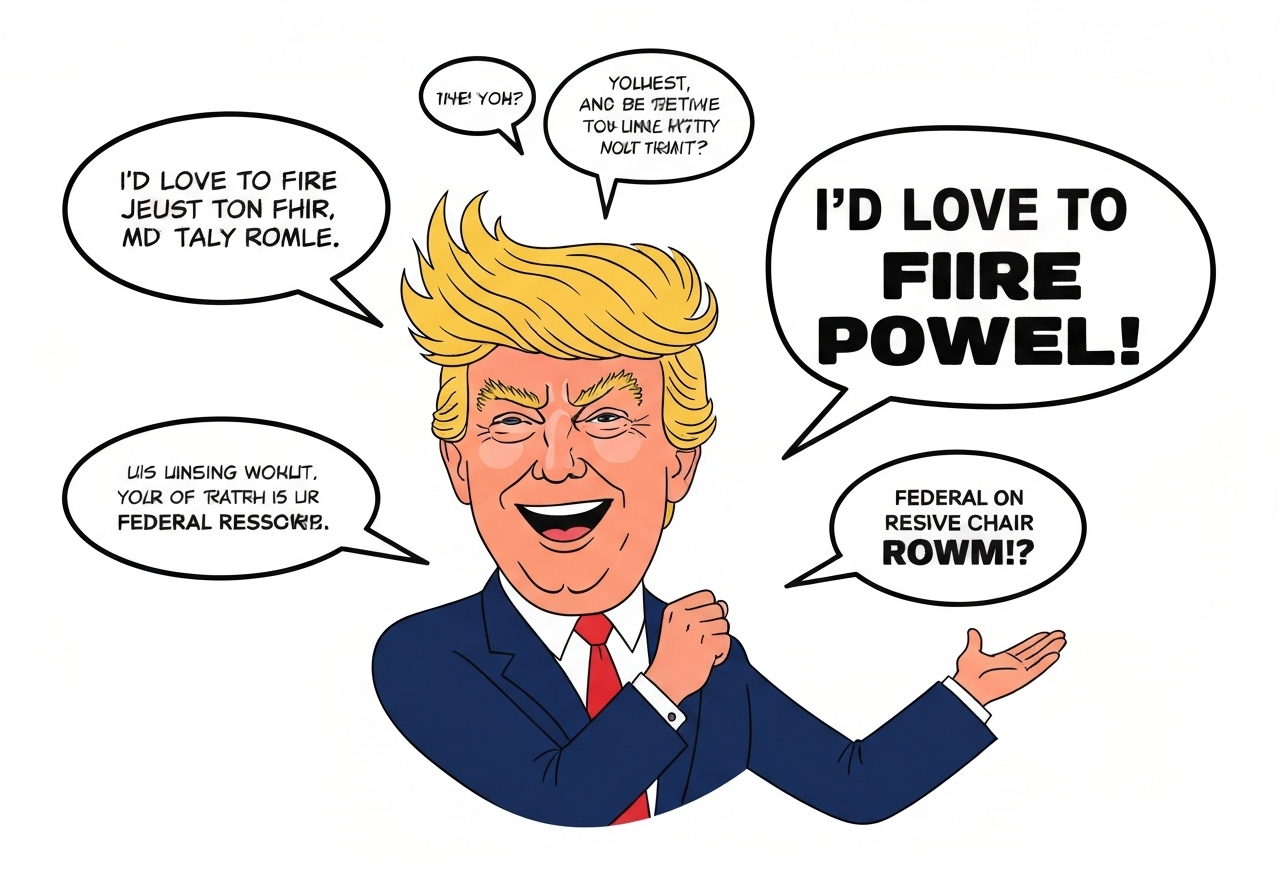
Lead: On 29 December 2025 at a joint press event with Israel’s prime minister Benjamin Netanyahu, former US president Donald Trump renewed public attacks on Federal Reserve chair Jerome Powell, calling him a “fool” and saying he would “love to fire” him. Trump repeated disputed claims about the cost of a Federal Reserve building renovation and threatened a possible “gross incompetence” lawsuit against Powell. He also contrasted the renovation estimate with the reported $400m cost for a new White House ballroom, and said he will name a successor to Powell in January.
Key Takeaways
- On 29 Dec 2025, at a White House press event, Donald Trump publicly criticized Fed chair Jerome Powell and said he might fire him.
- Trump repeated an asserted Fed renovation cost of $4.1bn, a figure higher than the $2.5bn estimate Powell cited on camera this year.
- Trump threatened a “gross incompetence” lawsuit against Powell but has not filed any legal action as of the press event.
- He claimed the White House ballroom project will cost $400m and said that figure is lower than the Fed renovation — he previously estimated $200m for the ballroom.
- Powell was first appointed in 2018 and reappointed in 2022; Trump said he will name a Fed chair successor in January 2026.
- Trump framed his remarks amid a broader political argument over Fed policy and construction spending, rather than a technical critique of monetary policy.
Background
Jerome Powell has served as Federal Reserve chair since his 2018 appointment and began a second term after reappointment in 2022. The chair’s role is independent in practice: the Fed sets monetary policy to meet mandates on inflation and employment, while presidents nominate and the Senate confirms chairs. Presidential criticism of Fed chairs is not unprecedented, but direct threats of dismissal or litigation against a sitting chair are rare and raise questions about institutional norms.
Debate over the renovation of the Federal Reserve building has featured in public commentary for months. Officials have provided cost estimates that differ from political claims, and on-camera exchanges earlier this year highlighted those discrepancies. Meanwhile, the White House has advanced a separate construction project — a ceremonial ballroom to replace a demolished wing — that has drawn attention for its changing cost estimates.
Main Event
At the press conference, Trump launched a forceful personal attack on Powell, calling him a “fool” and reiterating that he would like to remove him from office. He told reporters he was considering legal action for what he termed “gross incompetence,” and said a lawsuit was being discussed internally though no filing was announced. Trump did not acknowledge that he originally appointed Powell in 2018; instead he criticized President Biden’s decision to reappoint him in 2022.
Trump repeated the claim that the Fed renovation has reached $4.1bn, and contrasted that figure with what he described as the much lower cost of the White House ballroom. Powell, in on-camera exchanges earlier this year, cited a $2.5bn estimate for the Fed project; the differing figures were part of the public dispute. Trump asserted that the Fed renovation was “the highest price in the history of construction,” a comparative claim that was not substantiated at the event.
Turning to the White House project, Trump said the ballroom is “under budget and ahead of schedule,” while acknowledging the current cost estimate of $400m is higher than the $200m he cited months earlier. He explained the increase by saying the site will host an inauguration and therefore required additional security measures, including bullet-proof glass and a drone-resistant roof.
When pressed about who he might nominate to replace Powell, Trump declined to name a person and said he would announce his pick sometime in January 2026. The remark signals an upcoming political decision with implications for US monetary policy and markets, but offered no immediate detail on the administration’s preferred policy direction.
Analysis & Implications
Public attacks on central bank officials can affect perceptions of Fed independence. Powell’s role requires technical judgments on interest rates and balance-sheet policy; repeated political pressure could raise concerns among investors and international partners about whether monetary policy will be insulated from partisan debate. Markets often react more to concrete policy signals than rhetoric, but sustained political conflict increases uncertainty.
Trump’s focus on construction costs reframes the dispute as one of fiscal stewardship rather than monetary technique. By juxtaposing the Fed renovation estimate with the White House ballroom cost, he sought to highlight perceived waste. However, construction budgets are shaped by scope, security, and regulatory requirements; headline-to-headline comparisons risk oversimplifying complex procurement and security-driven expenses.
The threat of a “gross incompetence” lawsuit is legally and politically notable. Removing a Fed chair requires a high legal bar — the Federal Reserve Act allows for removal only for “cause” — and courts have historically been deferential to the Fed’s institutional role. A suit, if filed, would likely face immediate legal challenges and raise constitutional questions about the separation between executive oversight and central bank independence.
Looking ahead, the January 2026 announcement of a successor could matter for the Fed’s policy trajectory. Markets will watch nominees’ views on inflation, rate-setting, and the Fed’s balance-sheet. A nominee aligned closely with a political agenda could prompt debate in the Senate confirmation process and among economic stakeholders about the Fed’s operational independence.
Comparison & Data
| Item | Official/Reported Estimate | Trump-stated Figure |
|---|---|---|
| Federal Reserve renovation | $2.5bn (cite: Powell on-camera statement) | $4.1bn (Trump claim) |
| White House ballroom | $400m (latest estimate cited by Trump) | $200m (earlier Trump estimate) |
The table shows the divergence between official or publicly cited estimates and the figures Trump repeated at the event. Differences stem from scope definitions, additional security requirements and, in public debate, rounding or rhetorical inflation. Direct cost comparisons should account for differing building types, security specifications and procurement timelines, which can materially change price outcomes.
Reactions & Quotes
Trump’s remarks prompted immediate attention from political and financial commentators. The tone of his comments — combining personal criticism and cost-focused allegations — framed the dispute as both political and managerial.
“I’d love to fire him. Maybe I still might.”
Donald Trump, former US president (press conference, 29 Dec 2025)
The comment underscores Trump’s personal antagonism toward Powell and signals potential executive pressure. Previously, Powell himself responded in public exchanges by citing the Fed renovation estimate of $2.5bn.
“The estimate is $2.5bn,”
Jerome Powell (on-camera exchange cited earlier in 2025)
Powell’s on-the-record figure has been used by officials to contest higher political estimates. Legal and policy experts warned that any attempt to remove a Fed chair without clear statutory cause would trigger institutional and likely judicial pushback.
Unconfirmed
- Whether the Trump team will formally file a “gross incompetence” lawsuit against Jerome Powell has not been confirmed; no filing was announced on 29 Dec 2025.
- Trump’s claim that the Fed renovation is the “highest price in the history of construction” was not substantiated with comparative, independently verified data at the event.
- The final, fully reconciled cost of the White House ballroom and the Fed renovation may change as contracts and security requirements are finalized; current cited figures are estimates.
Bottom Line
Donald Trump’s Dec 29, 2025 remarks combined personal criticism of Jerome Powell with disputed spending claims and a threat of legal action. The episode highlights tensions between political actors and an institution designed to operate with technical independence. While rhetoric alone does not change monetary policy, persistent political pressure and the forthcoming presidential choice of a successor could influence perceptions of Fed independence and create market uncertainty.
Key near-term items to watch are (1) whether any legal action is filed, (2) the identity and policy stance of the nominee Trump announces in January 2026, and (3) how markets and the Senate respond to that nomination. Each will bear on the Fed’s ability to pursue its dual mandate free from undue political interference.
Sources
- The Guardian (news report)
- Federal Reserve Board (official)
- The White House (official)