
Lead
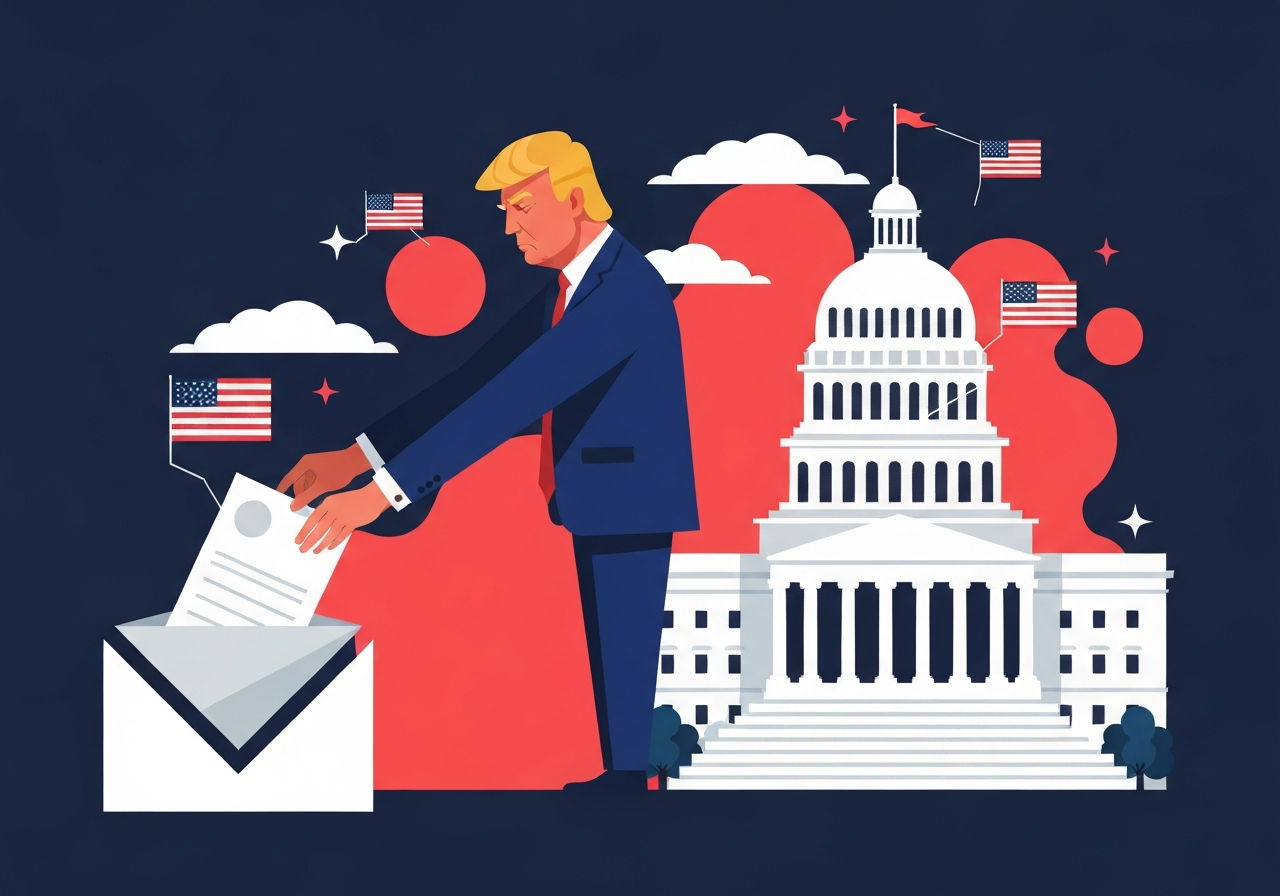
President Donald Trump cast a mail ballot in Palm Beach County on Tuesday, March 24, in a special election for Florida state legislative seats; county records show his ballot was counted. At the same time he has intensified public attacks on mail voting — calling it “corrupt as hell” — and is pressing Congress to pass the SAVE Act, a proposal that would sharply restrict universal mail ballots. Early in-person voting in the contest ran through the preceding Sunday while Trump remained at his south Florida estate. The White House did not immediately respond to requests for comment.
Key Takeaways
- Palm Beach County records indicate the president’s March 24 special-election mail ballot was submitted and counted for Florida State House District 87 and Senate District 14.
- Early in-person voting for the special election ended the Sunday before the Tuesday contest; Trump was at his south Florida residence during that early-voting period.
- Trump publicly urged passage of the SAVE Act, legislation that would bar universal mail ballots and narrow mail voting to select categories such as disabled voters, military personnel and those traveling on Election Day.
- The SAVE Act faces steep odds to clear the narrowly divided U.S. Senate even with presidential advocacy.
- Trump has repeatedly labeled mail voting as fraudulent since contesting the 2020 election result; multiple courts and the U.S. attorney general have found no evidence that mail ballots changed the 2020 outcome.
- One day before the Florida vote, the U.S. Supreme Court heard arguments in a Mississippi case about counting ballots postmarked by Election Day but received later — a practice allowed in 14 states and the District of Columbia.
- Trump posted a late-Monday endorsement for the House contest on his Truth Social account but did not disclose that he had voted by mail.
Background
Since the 2020 presidential election, Mr. Trump has focused on mail ballots as the locus of alleged fraud, a claim repeatedly rejected by federal and state courts as well as by the Justice Department under his administration. The COVID-19 pandemic in 2020 increased the share of voters who used mail ballots, prompting heated debates over access, security and election administration that have continued at the federal and state levels. Aides to the president say his grievances target state-run universal mail programs rather than individual voters who use absentee ballots for legitimate reasons, including health or travel.
The SAVE Act, which the president is promoting, would fundamentally change how many states administer absentee and mail voting by restricting universal mailed ballots and reserving the method for narrowly defined groups. The bill has drawn attention amid broader national priorities, including ongoing foreign policy concerns and temporary gaps in Department of Homeland Security funding, complicating Congress’s bandwidth to pursue sweeping election-law changes. Internationally, dozens of democracies use some form of mail or absentee voting, a point critics of the president’s stance often cite to argue that postal voting can be secure when well administered.
Main Event
Palm Beach County voter files show that Trump requested and returned a mail ballot for the March 24 special election and that the ballot was counted. County records indicate he does not hold a standing vote-by-mail request in Florida, meaning he must request a mail ballot for each individual contest. The special-election ballot included Florida State House District 87 and Senate District 14.
Trump used his Truth Social account late Monday to endorse Republican Jon Maples in the House contest, urging supporters in District 87 to vote on Tuesday, March 24, while not noting his own method of voting. The endorsement emphasized turnout — “Polls are open from 7:00 A.M. to 7:00 P.M.” — but left undisclosed that his own vote had been cast by mail and already tallied according to county records.
The timing of the Florida vote coincided with a broader legal debate: the U.S. Supreme Court on Monday heard arguments in a Mississippi case about whether states may count absentee ballots that are postmarked by Election Day but arrive later. That practice exists in 14 states and the District of Columbia and has been a focus of Trump’s criticism; he has singled out postmark rules as a vulnerability that should be curtailed.
Analysis & Implications
Politically, the president’s push to limit mail voting through the SAVE Act aligns with a strategy to narrow voting methods that he and allies argue are susceptible to fraud, though courts have not substantiated such claims at a scale that would alter major election outcomes. If enacted, the SAVE Act would likely reduce the availability of mail ballots in states that currently deploy universal mail programs, potentially suppressing convenience-driven turnout and shifting turnout patterns in close races. That effect would depend heavily on how states restructure absentee rules and the degree to which voters adapt to alternative methods like early in-person voting.
Legally and procedurally, the SAVE Act faces substantial hurdles. It would require passage in a closely divided Senate where cloture and filibuster dynamics matter; implementation would also invite immediate litigation, centered on federalism, equal protection and administrative feasibility. State election officials warn that restricting universal mail programs could increase election-day demand at polling places and strain local resources, while advocates for access caution that narrowing mail-vote eligibility risks disenfranchising voters with mobility, health or scheduling constraints.
On the international comparison point, many established democracies combine postal and in-person voting without the degree of partisan controversy seen in the U.S., but institutional safeguards, verification methods and public trust vary. Reform proponents in the U.S. cite those differences to argue for stricter federal standards, while critics say the federal government should not preempt diverse state practices that reflect local conditions and voter expectations.
Comparison & Data
| Feature | Typical U.S. Practice | Examples Abroad |
|---|---|---|
| Universal mailed ballots | Varies by state; some states send ballots to all registered voters while others do not | Several European democracies and other established democracies allow widespread absentee/mail voting |
| Postmark counting rules | Allowed in 14 states and the District of Columbia to count ballots postmarked by Election Day | Countries set distinct deadlines and verification standards depending on legal frameworks |
The table shows broad contrasts rather than exhaustive counts. Domestic policy is state-driven and uneven; international systems provide models but reflect different administrative frameworks and trust environments.
Reactions & Quotes
“We’re the only country in the world that does it that way. Corrupt as hell.”
Donald Trump, President
This remark, made during a White House meeting with Irish Prime Minister Micheál Martin, encapsulates the president’s rhetorical focus on mail voting. The comment has been cited by allies pressing for statutory limits and criticized by voting-rights advocates who say it mischaracterizes established election safeguards.
“We’re going to start with an executive order that’s being written right now by the best lawyers in the country to end mail-in ballots because they’re corrupt.”
Donald Trump, August public remarks
The president has previously suggested executive action to restrict mail voting; aides say his present complaints are directed at universal systems rather than individual voters. Legal experts note that an executive order would face immediate judicial review and practical limits due to state control over elections.
Unconfirmed
- Any claim that mail ballots changed the overall outcome of the 2020 presidential election remains unsupported by courts and the Justice Department and is therefore not substantiated.
- Whether the White House will pursue a new executive action to ban or tightly restrict mail voting beyond past statements is not confirmed and would face legal and political obstacles.
Bottom Line
President Trump’s decision to cast a mail ballot in Palm Beach while publicly campaigning to restrict mail voting underlines a central tension in the national debate: the difference between individual use of absentee voting and opposition to state-run universal mail programs. The SAVE Act—if advanced—would represent a substantial federal intrusion into how states administer voting and would almost certainly trigger legal challenges and operational strain in local election offices.
For voters and policymakers, the immediate consequence is likely heightened scrutiny of mail-ballot rules and court determinations, particularly after the Supreme Court heard arguments in a related Mississippi case about postmarked ballots. In the near term, passage of sweeping federal restrictions appears unlikely in a closely divided Senate; the dispute is more likely to play out in state legislatures, administrative rulemaking and future litigation.