
Lead
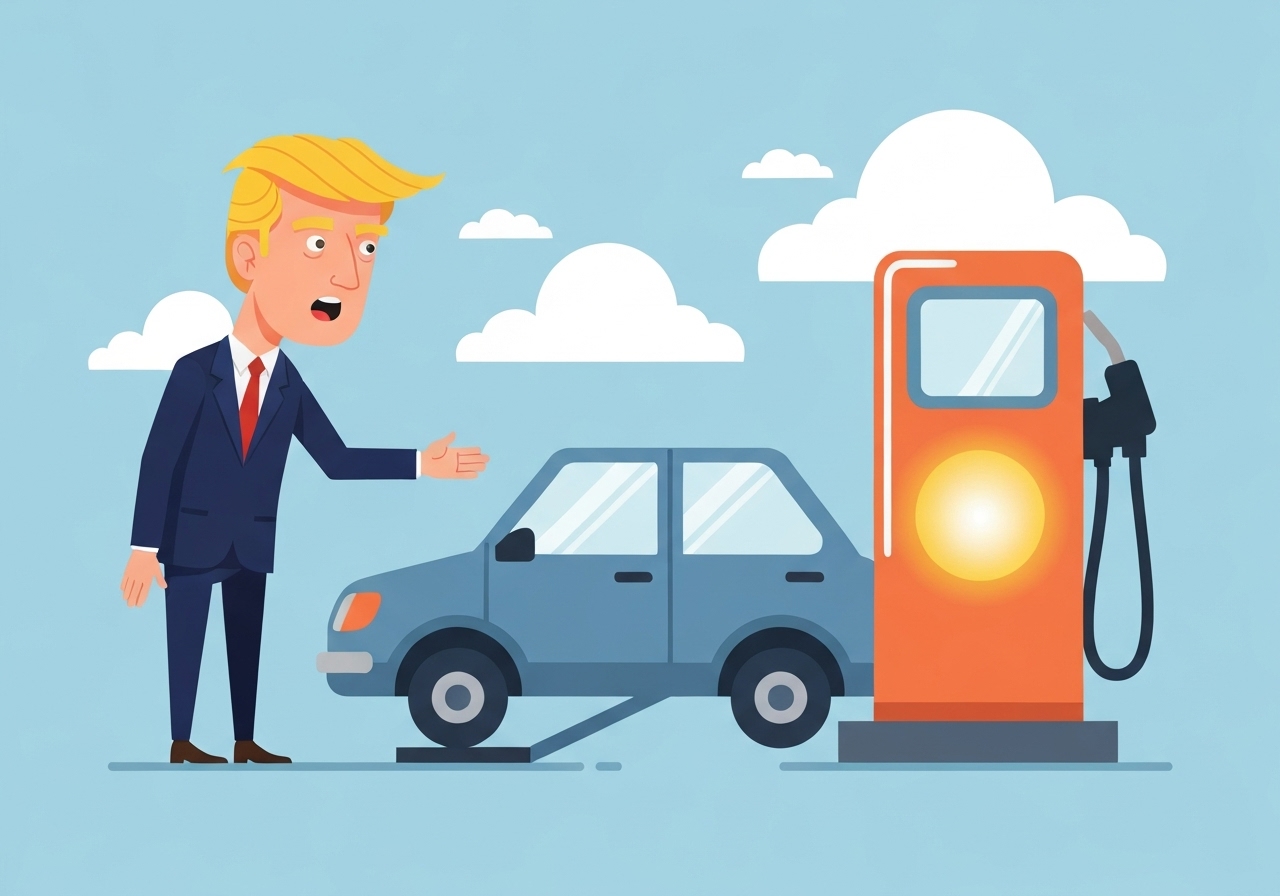
On Dec. 3, 2025, in the Oval Office, President Donald Trump announced new, looser federal fuel-economy (CAFE) targets that would apply through the 2031 model year for more than 15 million new cars and trucks sold annually in the United States. The White House said the proposal would reduce required fleetwide average fuel economy to roughly 34.5 miles per gallon from about 50 mpg under the previous rules and would expand the availability of lower-priced gas-powered vehicles. Administration officials and executives from Ford, Stellantis and General Motors framed the change as a move to improve affordability and protect U.S. auto jobs; environmental groups and others criticized the rollback for raising long-term fuel costs and emissions. The rulemaking must still undergo the standard regulatory process, including a public comment period, before any change takes effect.
Key takeaways
- The proposed CAFE target would lower the fleetwide light-duty average to about 34.5 mpg through model year 2031, compared with roughly 50 mpg under the prior standard.
- The rule affects more than 15 million new cars and trucks sold in the U.S. each year and would be implemented through normal notice-and-comment rulemaking.
- The White House projected aggregate consumer savings of $109 billion and suggested buyers could see at least $1,000 lower sticker prices on some new vehicles.
- Detroit automakers attended the announcement; Ford cited a $5 billion U.S. investment and Stellantis cited $13 billion in U.S. commitments.
- U.S. tariffs and trade actions have added more than $30 billion in duties for auto imports so far in 2025, a separate cost pressure on the industry.
- The administration removed fines for CAFE penalties in a recent legislative package, meaning automakers would not face standard federal fines if they miss the new targets while the policy regime remains in place.
Background
Federal fuel-economy rules (CAFE) set fleet-average miles-per-gallon targets automakers must meet across their U.S. sales. The Biden administration finalized stricter standards that aimed to accelerate the shift to electric vehicles and raise fleet averages toward roughly 50 mpg by the early 2030s, part of a broader climate and air-quality agenda. Automakers and some trade groups argued those rules assumed a faster EV transition and overlooked consumer demand patterns and higher electrified-vehicle costs.
Since President Trump took office earlier in 2025 he has moved to unwind several regulatory measures tied to vehicle emissions and state-level clean-car rules, framing the changes as protections for affordability and manufacturing. Automakers have lobbied Washington on both deregulation and tariff relief; at the same time, White House trade actions have imposed new or higher duties on many auto imports, creating competing cost signals for manufacturers and consumers.
Main event
The Dec. 3 Oval Office event featured President Trump alongside industry figures including Ford CEO Jim Farley, Stellantis CEO Antonio Filosa and John Urbanic, a plant manager for GM’s Orion Assembly site. Trump described the prior standards as overly burdensome for consumers and predicted the rollback would lower upfront vehicle prices. He said buyers could eventually see savings of “at least” $1,000 on new cars as a direct result of the relaxed rules.
Executives at the event emphasized the business case for slower EV adoption and the costs of electrification. Farley called the announcement a win for affordability and common sense, and Filosa said the new targets were aligned with “real customer demand.” Urbanic noted that the Orion plant is shifting some planned EV work back to gas-powered SUVs and trucks under the administration’s policy direction.
GM CEO Mary Barra, not present in the Oval Office, told reporters that if EV sales had not materialized as expected and if the rules remained strict, GM might have needed to curb gas-vehicle sales or reduce production at certain plants. The White House framed the proposal as preventing an unwanted, government-driven shift to EVs that would raise costs for consumers, pointing to Cox Automotive data showing average new-vehicle prices passed $50,000 in September 2025.
Officials cautioned the proposal is not final. It must move through the National Highway Traffic Safety Administration (NHTSA) rulemaking process and a public comment period before becoming binding; simultaneously, legislative and administrative steps taken earlier this year removed financial penalties for CAFE shortfalls, changing the enforcement landscape for automakers.
Analysis & implications
The immediate political effect is clear: the administration is using deregulation to address consumer concerns about high vehicle prices and to strengthen ties with the domestic auto industry. Relaxing CAFE targets reduces near-term compliance costs for manufacturers that rely heavily on high-profit, low-mpg light trucks and SUVs. That can stabilize production plans and lower some sticker prices, at least on paper.
From a climate and consumer running-cost perspective, the change has trade-offs. Lowering fleet mpg requirements can increase fuel consumption and greenhouse-gas emissions over the lifetime of affected vehicles, and independent analysts warn that any short-term purchase price gains could be offset by higher fuel expenditures across years of vehicle ownership. Environmental groups contend higher fuel use will raise annual household gasoline bills.
On industry strategy, the proposal reduces regulatory pressure to accelerate electrification, potentially slowing investments in battery plants and EV supply chains. However, recent tariff policies aim to incentivize reshoring and domestic production, creating a complex mix of incentives and penalties that could both raise near-term costs and encourage longer-term onshore investment in parts and assembly.
Comparison & data
| Metric | Prior standard | Proposed standard |
|---|---|---|
| Fleetwide mpg (light-duty) | ~50 mpg | ~34.5 mpg |
| Affected annual sales | More than 15 million new cars and trucks | |
| Average new-vehicle price (Sept. 2025) | Above $50,000 (Cox Automotive) | |
| Estimated 2025 U.S. auto tariffs collected | More than $30 billion (federal data) | |
These figures show the scale of the regulatory reset and the economic context. Cutting the mpg target by roughly 15 mpg represents a substantial loosening compared with the prior rule. Price and tariff data underline why industry leaders and the administration emphasize affordability and competitiveness as central justifications.
Reactions & quotes
Industry and labor voices largely welcomed the move as a practical reset aligned with current market conditions and a chance to avoid near-term production disruptions.
“We’re reviewing NHTSA’s announcement, but we’re glad the agency has proposed new fuel-economy standards,”
John Bozzella, Alliance for Automotive Innovation (industry group)
The industry group framed the change as a path to regulatory stability and achievable targets; Bozzella noted automakers face significant headwinds in scaling EV sales fast enough to meet earlier mandates. Ford and Stellantis highlighted billion-dollar U.S. investments and said predictable, achievable rules are necessary to preserve jobs and competitiveness.
“Drivers will be paying hundreds of dollars more at the pump every year if these rules are put in place,”
Kathy Harris, Natural Resources Defense Council (environmental group)
Environmental advocates countered that looser CAFE targets lock in higher fuel use and greater emissions, increasing gasoline expenditures over time and undermining climate and public-health goals. The NRDC emphasized long-term fuel costs and public-health impacts as chief concerns.
“Today’s action is a win for American drivers,”
Mike Sommers, American Petroleum Institute (energy industry)
Energy and oil-industry representatives praised the rollback as restoring choice and affordability for consumers and said they will work with the administration on energy and manufacturing policy. Overall, public reaction split along predictable industry, environmental and political lines.
Unconfirmed
- The administration’s estimate that individual buyers will save “at least” $1,000 has not been independently verified and may vary widely by model and market segment.
- Precise long-term impacts on average annual fuel spending for U.S. households are model-dependent and have not been confirmed in publicly released, peer-reviewed analyses tied to this specific proposal.
- Claims that the rule change will directly cause immediate plant retooling or permanent shifts in production at named facilities are reported by companies but not independently verified at the facility level.
Bottom line
The Trump administration’s proposal to relax federal fuel-economy targets through model year 2031 is a significant regulatory shift with immediate political and industrial implications. It likely eases compliance costs for automakers, supports continued sales of large gas-powered trucks and SUVs, and reduces near-term pressure to accelerate EV production.
But the proposal also raises important questions about long-term fuel costs, greenhouse-gas emissions and the pace of technological transition in a sector that is capital-intensive and globally competitive. The rule will proceed through formal rulemaking; stakeholders, from environmental groups to auto unions and global trading partners, will seek to influence the final shape of the policy during the public comment period and possible legal or legislative challenges.
Sources
- The Detroit News — (media)
- White House press release — (official/government)
- Cox Automotive — (industry analytics)
- Natural Resources Defense Council — (environmental organization)
- Alliance for Automotive Innovation — (industry trade group)