
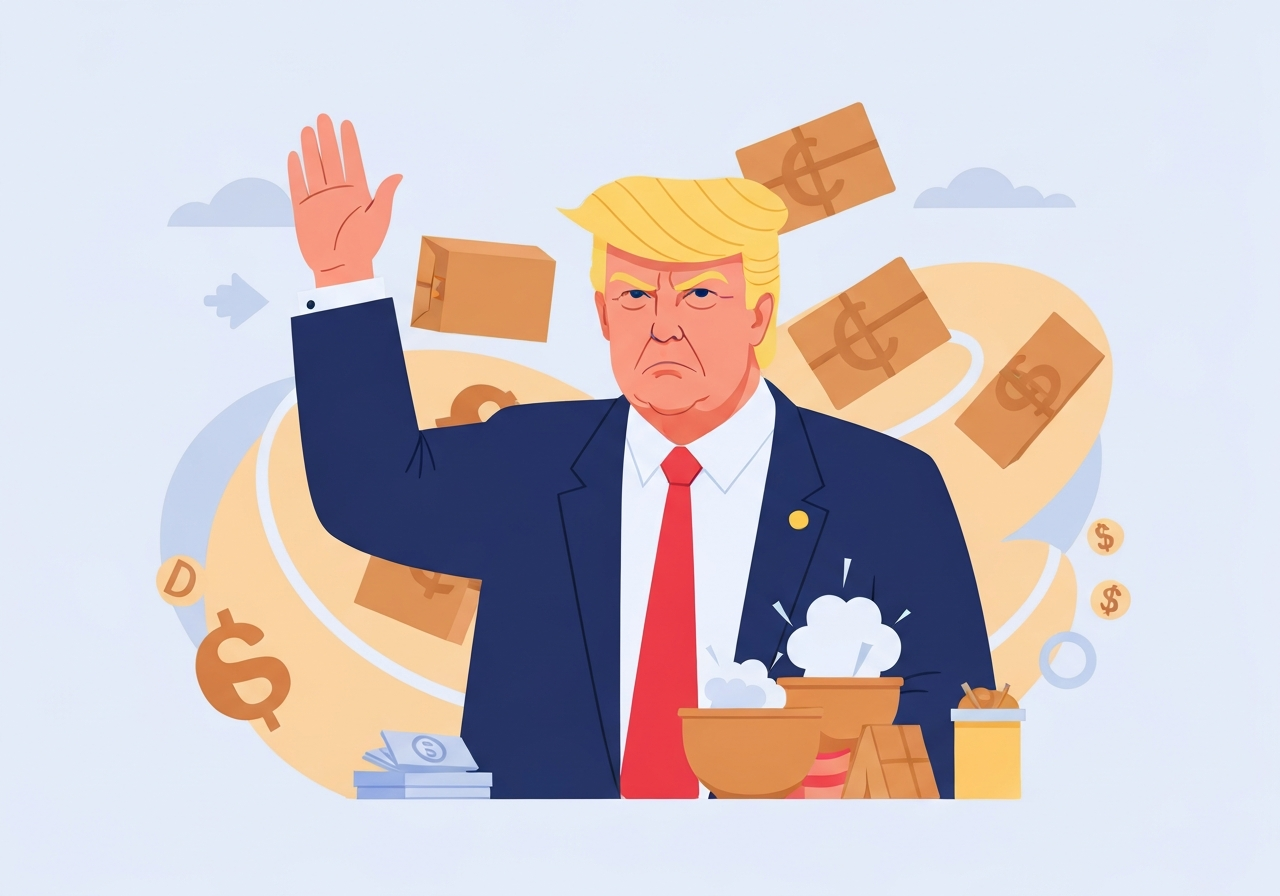
— President Donald J. Trump announced on social media that he will raise a new, global tariff to 15 percent effective immediately, signaling he will proceed with steep import taxes despite a Supreme Court decision that struck down his earlier set of duties. The announcement came a day after the court found the president lacked authority for the previous tariffs, and followed an earlier directive from Mr. Trump that would have applied a 10 percent across-the-board rate beginning Feb. 24. The new action invokes a rarely used statutory mechanism that allows a temporary broad tariff capped at 15 percent for 150 days unless Congress acts to extend it.
Key Takeaways
- President Trump announced a global tariff of 15 percent on Feb. 21, 2026, saying it takes effect immediately.
- The announcement followed a Supreme Court decision on Feb. 20, 2026, that invalidated his prior set of targeted duties as beyond presidential authority.
- Mr. Trump had earlier set a 10 percent replacement tariff that was to begin after midnight on Feb. 24, 2026, using a seldom-used 150-day authority.
- The statute invoked limits the rate at 15 percent, constraining the specific power used to impose the tariff but not precluding other trade actions by the administration.
- For some U.S. partners, including Britain and Australia, a 15 percent tariff will be higher than previous U.S. rates; for others such as China, Vietnam, India and Brazil, it will be lower than rates that were applied under the invalidated duties.
- The move could raise import costs, spur diplomatic pushback and invite legal or congressional responses in the weeks ahead.
Background
Over the past four years the administration has pursued an aggressive trade policy aimed at reshaping U.S. import exposure and supporting domestic industry. That strategy included a series of narrowly targeted tariffs on dozens of trading partners and product lines. Last week, however, the Supreme Court concluded that at least some of those targeted duties exceeded presidential authority, invalidating the prior set of measures on Feb. 20, 2026. The court’s ruling removed a legal foundation for those duties and compelled the administration to look for alternative statutory tools to maintain broad import levies.
In response, the White House initially announced a stopgap plan to impose a 10 percent global tariff using a provision that permits a temporary, across-the-board duty for up to 150 days unless Congress extends it. That mechanism — rarely used and never before deployed in this way by a president — caps the rate at 15 percent and limits the administration’s scope under that particular authority. The administration’s shift to an immediate 15 percent rate represents a rapid recalibration intended to preserve the broader policy goal while operating inside the statutory ceiling.
Main Event
On Saturday, Mr. Trump posted that the new global tariff would be 15 percent and would take effect immediately. According to the administration’s directive reported by news outlets, the measure is intended to replicate, in broad terms, some of the economic pressure that targeted duties had sought to create. The immediate timing surprised trading partners and market participants who had been preparing for a planned Feb. 24 start of a 10 percent rate. The administration framed the step as a lawful use of the statutory authority that permits a time-limited, economy-wide tariff.
Officials acknowledged the law caps the rate at 15 percent, which is why the president’s earlier 10 percent plan was within the same legal framework but set at a lower level and a later start date. The Supreme Court’s invalidation of the previous duties left the administration with fewer clear options, and the 150-day mechanism became the vehicle for a swift, across-the-board action. White House advisers have also said privately that other trade tools could be deployed in the coming months to target specific goods or countries, although those steps would raise separate legal and diplomatic questions.
The new rate will have different practical effects across countries. For Britain and Australia the 15 percent level will exceed the tariffs those exporters previously faced; for China, Vietnam, India and Brazil the new uniform rate is lower than some of the punitive duties that had been in place. Businesses that import intermediate goods warn that higher broad-based tariffs can raise costs for manufacturers and consumers, while some domestic producers say the duties may strengthen U.S. competition in certain industries.
Analysis & Implications
Economically, a sudden, broad 15 percent tariff will likely raise import prices across a wide range of goods, with magnitude depending on how much of the cost is absorbed by foreign exporters versus passed through to U.S. buyers. Supply chains that rely on foreign components could see immediate input-cost pressure, while end consumers may face higher prices for some finished goods. The uniform nature of the tariff reduces the precision of targeting but increases its breadth, making it a blunt instrument compared with earlier, product-specific levies.
Politically, the step tests relations with close U.S. partners that face a higher duty and could prompt formal complaints or retaliatory measures. Allies such as Britain and Australia may register diplomatic protests and seek exemptions or negotiations. Major exporters like China and Brazil, who face a lower rate compared with the invalidated duties, may calculate a different mix of responses, balancing the political signal against the more limited immediate economic harm.
Legally, invoking a seldom-used 150-day authority narrows the administration’s flexibility under that statute because of the 15 percent cap and the time limit. However, the administration’s explicit signaling that it may pursue additional authorities suggests further actions could follow, potentially inviting fresh legal challenges or congressional intervention. Congress could move to extend, modify or block the tariff window, creating a new political battleground in which industry groups, trading partners and lawmakers will vie for influence.
Comparison & Data
| Element | Previous Duties (invalidated) | Planned 10% (Feb. 24) | New Global 15% |
|---|---|---|---|
| Start date/Duration | Varied by measure; struck down on Feb. 20, 2026 | Planned after midnight Feb. 24, 2026; 150 days authority | Announced Feb. 21, 2026; effective immediately; capped at 150 days under statute |
| Rate | Varied by country/product; included punitive, higher duties | 10 percent flat | 15 percent flat (statutory cap) |
| Scope | Targeted tariffs on specific countries/products | Across-the-board imports to U.S. | Across-the-board imports to U.S.; uniform rate |
The table summarizes how the new directive differs from the invalidated targeted duties and the earlier 10 percent plan. Precise effects will depend on product mixes and how firms reprice or absorb costs; sector-level analysis will be necessary to estimate inflationary pass-through and distributional impacts.
Reactions & Quotes
Officials and observers reacted quickly after the announcement, offering competing views about legality, economic impact and diplomatic consequences. Below are representative short quotations reported in coverage and the contexts that follow.
“The new, global tariff of 15 percent will take effect immediately.”
President Donald J. Trump (social media; reported by The New York Times)
That line formed the core of the administration’s public statement on Feb. 21. It communicates both immediacy and permanence under the chosen statutory route, while leaving open the prospect of additional, separate measures.
“The president did not have the authority to issue them.”
Majority opinion, Supreme Court ruling (reported by The New York Times)
The court’s finding on Feb. 20 removed the legal basis for the prior targeted duties and forced the administration to pivot to a different statutory tool. Legal analysts note the court’s language will shape subsequent litigation about any new or follow-on tariffs.
Unconfirmed
- The extent and timing of any additional targeted tariffs the administration may impose using other legal authorities remain unconfirmed.
- Whether Congress will act to extend, modify or block the 150-day tariff window is uncertain and depends on forthcoming legislative dynamics.
- Potential retaliatory measures from specific trading partners have not been announced and remain speculative.
Bottom Line
The administration’s move to a 15 percent global tariff on Feb. 21, 2026, is a rapid policy response to a Supreme Court decision that invalidated prior targeted duties. By using a seldom-invoked 150-day authority and setting the rate at the statutory maximum, the White House has preserved a broad import tax while acknowledging legal constraints tied to that tool.
Watch for several near-term developments: congressional debate over the temporary tariff window, any formal complaints or countermeasures from trading partners, and administrative steps to pursue additional targeted duties under different authorities. Those actions will determine whether the 15 percent measure is a temporary holdover, the start of a broader trade strategy, or the subject of further legal and political contestation.
Sources
- The New York Times (U.S. newspaper, reporting on announcement and Supreme Court ruling)