
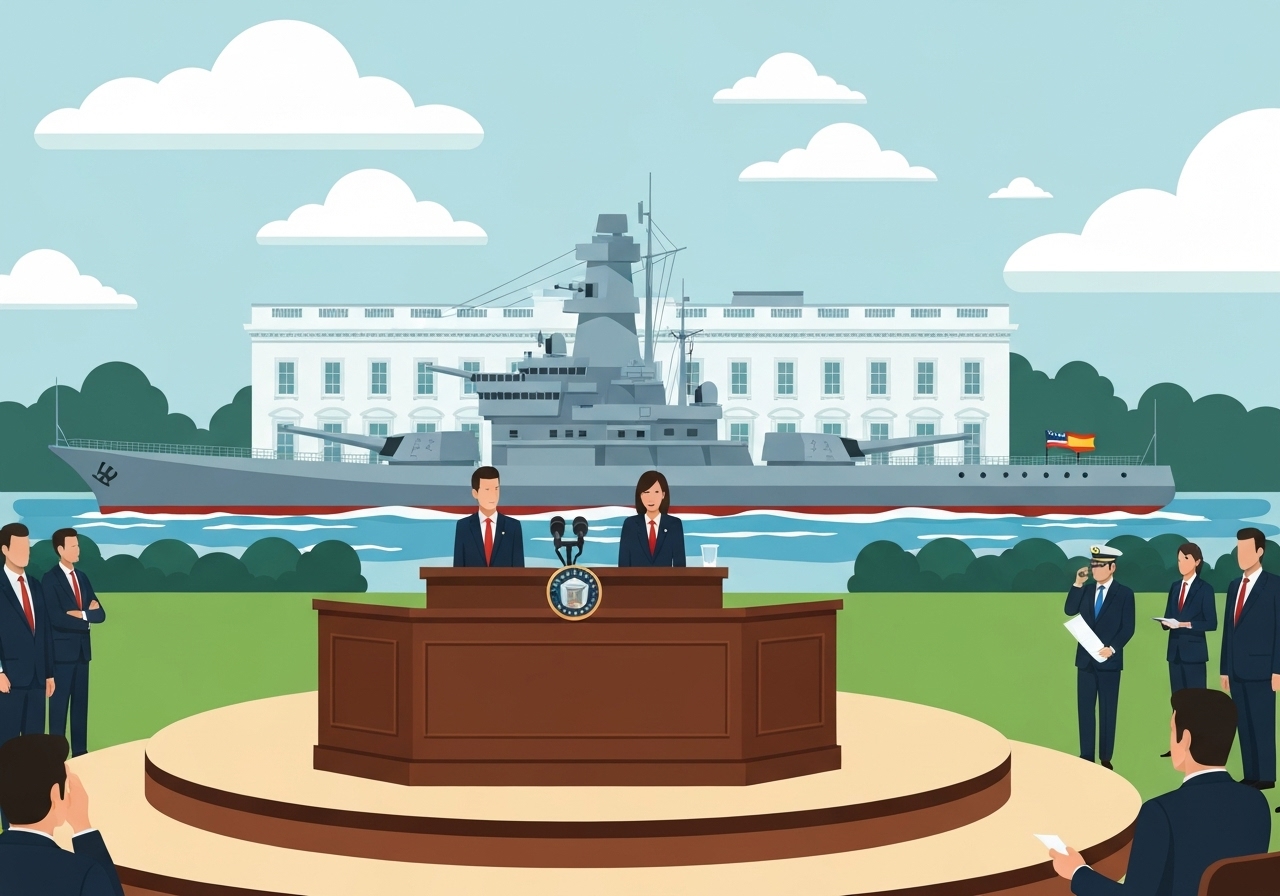
Lead: President Donald Trump on Monday, speaking at his Mar-a-Lago club in Palm Beach, Florida, unveiled a plan for a large new naval warship he called a “battleship” and said it would be the first element of a so-called “Golden Fleet.” He said the first hull will be named USS Defiant and described the vessel as larger than World War II Iowa-class ships and equipped with advanced weapons. A U.S. official told reporters that design work is underway and construction is slated to begin in the early 2030s. The announcement follows recent Navy program cancellations and ongoing technology and budget challenges within the sea service.
Key Takeaways
- The new ship, dubbed the USS Defiant, was announced by President Trump at Mar-a-Lago; he framed it as the lead ship of a proposed “Golden Fleet.”
- The Golden Fleet website describes the guided-missile battleship as roughly 35,000 tons with a crew of about 650–850 sailors, compared with roughly 60,000 tons for historical Iowa-class battleships.
- Planned weapons listed by the president include hypersonic missiles, nuclear cruise missiles, railguns and high-powered lasers—technologies that are at varying stages of development or, in some cases, abandoned.
- An anonymous U.S. official told The Associated Press that design efforts are underway and construction is planned for the early 2030s, a timeline that would add years to procurement cycles.
- The announcement follows the Navy’s recent cancellation of a new small warship program and chronic delays and cost overruns on Ford-class carriers and Columbia-class submarines.
- Some technologies cited—railguns and ship-deployed nuclear cruise missiles—face technical, budgetary or treaty barriers; Navy railgun work was halted in 2021 and nuclear cruise missiles raise non-proliferation concerns.
- Navy Secretary John P. Phelan endorsed the effort publicly and described the planned ship as one that will “inspire awe and reverence” when visiting foreign ports.
Background
Battleships historically were large, heavily armored vessels armed with heavy-caliber guns and were central to early- and mid-20th-century naval strategy. The U.S. Iowa-class battleships, the largest built for the U.S. Navy, displaced about 60,000 tons at their peak and were modernized in the 1980s with added missile systems and upgraded electronics before being retired in the 1990s.
Since World War II, doctrinal and technological shifts—most notably the rise of aircraft carriers, long-range missiles and precision munitions—relegated traditional battleships to symbolic and limited roles. Over recent decades the Navy has focused on carriers, submarines and multi-mission surface combatants, while ambitious new programs have struggled with cost and schedule.
President Trump has previously intervened in ship design and technology choices, pushing for aesthetic changes and older technologies during his first term. That pattern informs how the White House described the new project, combining nostalgia for large surface combatants with an emphasis on cutting-edge weaponry.
Main Event
At Mar-a-Lago, Trump presented the initiative as a sweeping modernization and branding effort for the surface fleet, calling for a new class of large guided-missile warships. He characterized them as “the fastest, the biggest, and by far 100 times more powerful” than historic battleships—a rhetorical claim that the Navy and independent analysts would need to assess technically.
The administration released a Golden Fleet website outlining a guided-missile battleship roughly the same length as an Iowa-class but lighter in displacement—about 35,000 tons—and with a substantially reduced crew of 650–850 sailors. The site emphasizes missile armament rather than the heavy guns that defined 20th-century battleships.
An unnamed U.S. official told reporters that initial design effort is moving forward and that construction is expected to begin in the early 2030s. The timeline would place first steel cutting more than half a decade away and squarely in a future budget cycle, increasing uncertainty about funding and program continuity.
Navy Secretary John P. Phelan spoke alongside the president and framed the ship as a morale and image builder for the Navy. He said the vessel would project American presence and, in his words, “inspire awe and reverence for the American flag whenever it pulls into a foreign port.”
Analysis & Implications
Feasibility: Several of the systems Trump named face maturity or policy barriers. The Navy abandoned its railgun effort in 2021 after more than a decade and hundreds of millions spent without delivering a deployable weapon. Directed-energy lasers have reached limited operational use—small-scale systems aimed at drones are now aboard a handful of destroyers—but they remain constrained by power generation and tactical range.
Treaty and policy concerns: The suggestion of shipborne nuclear cruise missiles raises non-proliferation questions. Deploying nuclear cruise missiles at sea could conflict with arms-control commitments and would likely trigger diplomatic pushback from allies and competitors, particularly Russia, with which the U.S. has existing arms accords.
Budget and procurement risk: The Navy’s recent track record—program delays on Ford-class carriers and Columbia-class submarines and the cancellation of a small warship program—suggests cost and schedule are major risks. A new large-ship program sized like an Iowa but incorporating novel weapon systems would demand shipyard capacity, sustained funding, and stable technical baselines over years.
Strategic value versus symbolism: If realized, a missile-centric large surface combatant could offer additional firepower and presence options, but analysts will ask whether it improves survivability and mission effectiveness in contested littoral and open-ocean environments compared with existing platforms like carriers, submarines and multi-mission destroyers.
Comparison & Data
| Attribute | Iowa-class (1980s upgrade) | Planned USS Defiant (Golden Fleet) |
|---|---|---|
| Displacement | ~60,000 tons | ~35,000 tons (website claim) |
| Primary armament | 16-inch guns, cruise missiles (1980s retrofit) | Missiles, hypersonics, lasers (proposed) |
| Crew | ~2,700 (wartime complements varied) | ~650–850 (website claim) |
| Projected construction | Built 1940s; modernized 1980s | Design underway; construction planned early 2030s (official) |
The table contrasts the large displacement and crew of historic Iowa-class battleships with Golden Fleet claims of a smaller, more automated vessel focused on missile systems rather than big guns. Such reductions in crew and displacement reflect modern automation trends but also imply different survivability and mission trade-offs.
Reactions & Quotes
Officials and the president framed the announcement very differently. Below are direct remarks reported publicly, with surrounding context.
“They’ll be the fastest, the biggest, and by far 100 times more powerful than any battleship ever built,”
President Donald J. Trump
Trump used hyperbolic language to emphasize the ship’s promised superiority and to link the design to a revival of naval prestige. Independent technical assessment will be required to evaluate such comparative claims.
“The USS Defiant will inspire awe and reverence for the American flag whenever it pulls into a foreign port,”
Secretary of the Navy John P. Phelan
Phelan endorsed the program as a tool for diplomatic presence and morale, signaling at least public service-level support for proceeding with design. How Navy leadership balances presidential preference with operational requirements will shape the program’s technical path.
Unconfirmed
- Whether the U.S. will legally and politically permit shipborne nuclear cruise missiles remains unresolved and would depend on treaty interpretation and future policy decisions.
- The early-2030s construction start date comes from an anonymous official and is subject to change depending on funding, design maturity and political will.
- The precise mix and operational readiness of advanced weapons (functional hypersonics, railguns, and large-scale shipboard lasers) on a single hull is not confirmed and would require sustained development and testing.
Bottom Line
The Golden Fleet announcement blends symbolic appeal with ambitious technical claims. While the USS Defiant concept draws on nostalgia for large surface combatants, the proposed vessel—as described—relies heavily on technologies that are still evolving or constrained by policy, treaty and budget realities.
Key near-term indicators to watch include: the Navy’s formal design requirements, Congressional funding decisions in coming budget cycles, independent technical assessments of the listed weapons, and international diplomatic responses to any suggestion of sea-based nuclear cruise missiles. Absent sustained funding and practical technical breakthroughs, the project may remain more aspirational than operational for years.
Sources
- NPR (U.S. news outlet reporting)
- Associated Press (news agency referenced in reporting)