
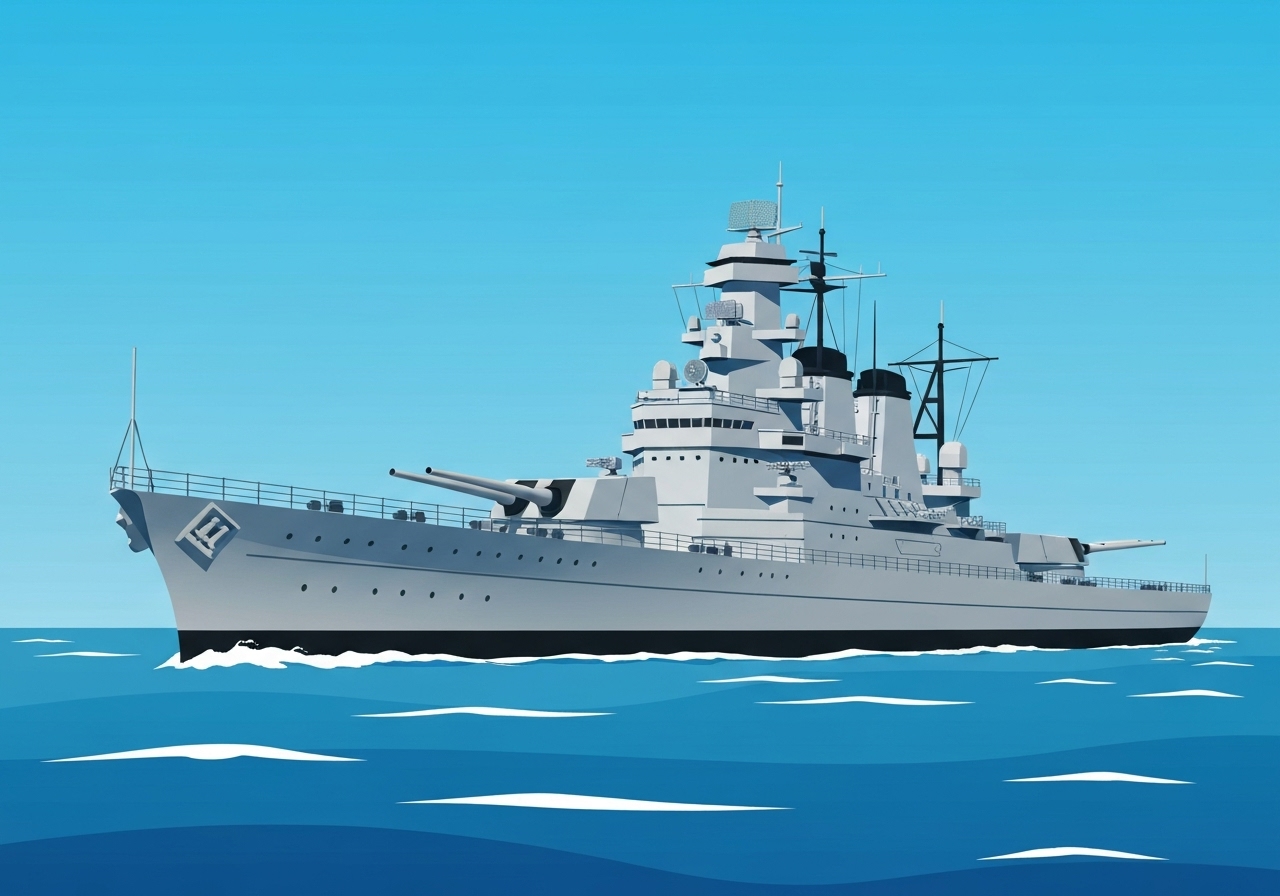
Lead: President Donald Trump announced on Monday at his Mar-a-Lago resort a plan for the Navy to build a large warship he called a “battleship,” the first of a proposed “Golden Fleet” to be named USS Defiant. He said the vessel will be larger than World War II Iowa-class ships and carry advanced weapons including hypersonic and nuclear-capable cruise missiles, rail guns and high-energy lasers. A U.S. official told The Associated Press that design work is underway and that construction could begin in the early 2030s. The announcement follows recent Navy decisions to cancel or modify other shipbuilding programs amid delays and cost overruns.
Key Takeaways
- President Trump announced a new warship program called the “Golden Fleet,” naming the lead ship USS Defiant and describing it as a modern “battleship.”
- The proposed Defiant is described as roughly the length of an Iowa-class ship but about 35,000 tons — roughly half the Iowa-class’s ~60,000-ton displacement — with a crew of 650–850 sailors.
- Trump claimed the ships would mount hypersonic missiles, nuclear cruise missiles, rail guns and high-energy lasers; many of those systems remain in testing or were previously curtailed (railgun program ended in 2021).
- A U.S. official told AP that ship design is underway and that construction is planned to start in the early 2030s, though no formal contract or schedule was disclosed.
- The announcement comes after the Navy canceled plans for a new small combatant and switched to a modified Coast Guard cutter amid cost and schedule issues.
- Navy Secretary John Phelan endorsed the idea as a symbolic return to a storied ship type and said the USS Defiant “will inspire awe and reverence” when visiting foreign ports.
- Experts note modern naval doctrine favors carriers and long-range missiles over heavily armored gunships; primary armament described for Defiant would be missile-based rather than big guns.
Background
The term “battleship” historically described heavily armored 20th-century warships armed with very large-caliber guns and designed for ship-to-ship combat and shore bombardment. At their peak in World War II, U.S. Iowa-class battleships displaced about 60,000 tons and carried large crews and heavy armor. After WWII the role of the battleship declined rapidly as aircraft carriers and precision long-range missiles became central to naval power projection.
In the 1980s the U.S. Navy modernized its Iowa-class ships by adding cruise and anti-ship missiles and upgrading sensors, but by the 1990s all four were decommissioned. Since then, the Navy has focused on aircraft carriers, submarines and multi-mission surface combatants; recent new-ship programs such as Ford-class carriers and Columbia-class submarines have experienced cost and schedule challenges.
Main Event
At Mar-a-Lago, Trump announced his intention to work with the Navy on a new class of large guided-missile warship, which he repeatedly described with the historical label “battleship.” He said the ships would be “the fastest, the biggest, and by far 100 times more powerful than any battleship ever built,” a characterization that was not independently verified in his remarks. Trump named the first vessel USS Defiant and said he would be involved in aesthetic and design choices.
An unnamed U.S. official speaking to The Associated Press confirmed that design efforts have begun and that construction is tentatively planned to start in the early 2030s, but provided no procurement schedule or budget figures. The administration’s description lists advanced payloads — hypersonic missiles, nuclear-capable cruise missiles, rail guns and lasers — many of which are in development or have faced setbacks in naval integration efforts.
The announcement arrived after the Navy canceled plans for a new small warship, opting instead for a modified Coast Guard cutter to fill that role amid rising costs and delays. Navy leadership has publicly acknowledged a string of programmatic challenges on multiple platforms, including production and timeline slips for carriers and submarines.
Analysis & Implications
The proposal to build a new large guided-missile ship branded as a “battleship” blends symbolic appeal with contested technical feasibility. Modern naval power emphasizes mobility, stealth, sensors and networked strike options; heavy armor and large-caliber guns no longer define sea control. If built according to the public description, the Defiant would rely primarily on missile systems rather than gigantic naval guns, aligning in part with contemporary naval practice but using a nostalgic label.
Many of the weapons Trump cited face technical, legal and budgetary constraints. The Navy ended its railgun development effort in 2021 after spending hundreds of millions and more than a decade; high-energy lasers have seen limited deployment on a small number of destroyers but remain niche. Developing and deploying nuclear-capable cruise missiles on surface ships would raise treaty and non-proliferation concerns and require legal and policy review.
From a procurement perspective, starting a major new capital-ship program in the 2030s would compete for resources with Ford-class carriers, Columbia-class submarines and other prioritized programs. The Navy’s shipbuilding industrial base is already strained, and new designs can take years of testing, prototyping and stable funding before production begins. Without a clear acquisition plan, schedule and cost estimate, the announcement is better viewed as a strategic direction than an executable program.
Comparison & Data
| Characteristic | Iowa-class (WWII-era) | Proposed “Defiant” (announced) |
|---|---|---|
| Displacement | ~60,000 tons | ~35,000 tons (announced) |
| Crew | ~2,700 (WWII complement varied) | 650–850 (announced) |
| Primary armament | 16-inch guns, secondary guns, missiles (modernized) | Missiles (hypersonic, cruise), rail guns, lasers (announced) |
The table highlights the announced reduction in displacement and crew compared with WWII-era battleships while signaling a shift in primary weapons from large guns to missile and directed-energy concepts. Those announced weapon sets vary in maturity; for example, railgun development was halted in 2021, while some laser systems have seen limited deployment.
Reactions & Quotes
Senior defense officials and analysts responded cautiously, noting the difference between rhetorical goals and acquisition realities. Below are representative statements with context.
“The U.S. Navy will lead the design of these ships along with me, because I’m a very aesthetic person.”
President Donald Trump
Trump framed his involvement as both aesthetic and strategic, emphasizing personal input on design. His assertion that he will co-lead design work departs from normal defense acquisition practice, which typically rests with service engineers, acquisition professionals and civilian leadership in the Pentagon.
“The USS Defiant will inspire awe and reverence for the American flag whenever it pulls into a foreign port.”
Navy Secretary John Phelan
Phelan endorsed the program’s symbolic value at his confirmation stage and in public remarks, presenting the ship as a morale and presence-building asset. Officials have not provided acquisition timelines or budget baselines to support that vision.
“We spent hundreds of millions and more than 15 years developing a railgun before ending the effort in 2021.”
Defense program history (summarized)
Analysts highlight past program terminations and technology hurdles to caution that ambitious weapon lists do not guarantee fielding within a specific timeframe.
Unconfirmed
- Whether the announced list of weapons (hypersonics, nuclear cruise missiles, rail guns and large lasers) will all be integrated onto a single hull is not yet confirmed by Navy acquisition documentation.
- Specific timelines, budgets, procurement authority and shipyard assignments for the USS Defiant program have not been publicly released and remain unverified.
- The claim that the new ships will be “100 times more powerful” than any prior battleship is a rhetorical assertion and lacks quantifiable, independently verified metrics.
Bottom Line
President Trump’s announcement frames a large new surface combatant as a revival of the battleship concept combined with modern missile and directed-energy weapons. The proposal is heavy on grand vision and symbolism but light on procurement detail: there are no published budgets, schedules or verified acquisition plans beyond an AP-sourced note that design work has begun and construction could start in the early 2030s.
Technically and politically, integrating the full list of announced capabilities would face hurdles: several systems are still developmental, the shipbuilding industrial base is already tasked with major programs, and deploying certain payloads (notably nuclear-capable cruise missiles) would raise treaty and policy issues. For readers tracking U.S. naval power, the announcement signals a strategic preference and rhetorical shift rather than an immediately executable shipbuilding program; follow-up on official procurement documents will be crucial to assess feasibility.