
Lead
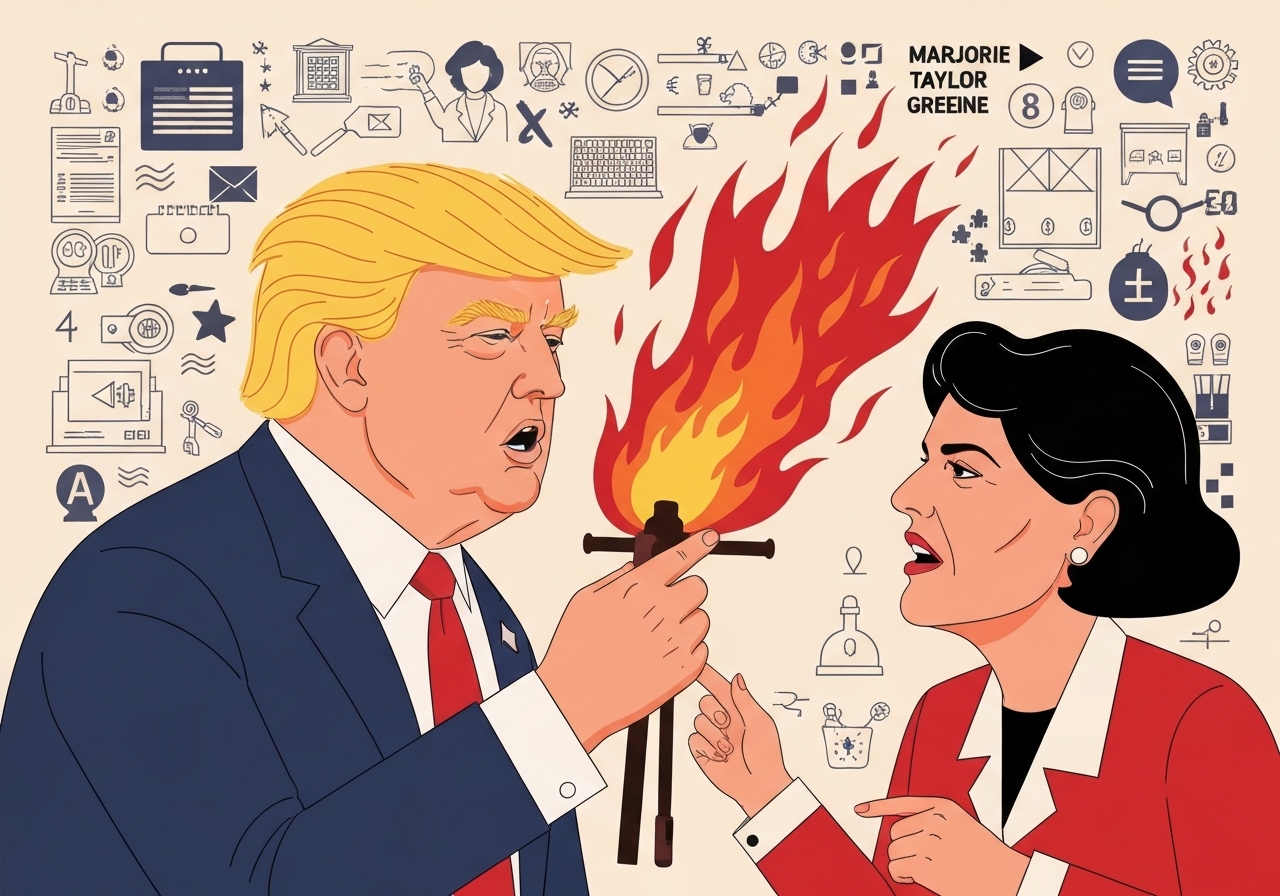
President Donald Trump and Rep. Marjorie Taylor Greene intensified a public dispute over the weekend after a sequence of comments and social-media posts escalated into the withdrawal of Mr. Trump’s endorsement and threats of backing a primary opponent. The exchanges centered in part on Greene’s criticism of the administration’s priorities and her assertion that she has pushed for release of records tied to the Jeffrey Epstein investigation. The dispute played out on national media, on Air Force One and across X, producing sharp personal language and claims of threats against the congresswoman. The immediate result is an open intra-party rift with potential consequences for Republican unity and a possible primary fight in Greene’s Georgia district.
Key Takeaways
- President Trump publicly revoked his endorsement of Rep. Marjorie Taylor Greene and said he would support a primary challenger if the right candidate runs, after a series of critical exchanges this week.
- Greene told followers she has received death threats following the dispute and attributed intensified online attacks to the backlash from the president’s comments.
- The conflict escalated after Greene questioned in an NBC News interview whether Mr. Trump was sufficiently focused on domestic affairs, prompting his response aboard Air Force One calling her “a very different figure.”
- Greene has publicly urged release of files related to the Jeffrey Epstein investigation and contends the president is fighting to keep those files from coming out.
- Mr. Trump used strong language on social media, calling Greene “Lightweight” and accusing her of becoming a RINO; he later wrote that he sees her as someone who only “COMPLAIN[s].”
- The confrontations occurred in the span of a few days, including a Friday remark on Air Force One and social-media posts on Saturday during the same weekend.
- Political figures and conservative activists are already discussing potential primary challengers in Greene’s district, a sign the dispute could produce an intra-party contest.
Background
Marjorie Taylor Greene, a Republican representative from Georgia, has been a prominent and polarizing figure within the GOP since her election. She has positioned herself as a staunch Trump ally on many issues and routinely praises and defends the former president’s agenda. Historically, Mr. Trump’s endorsements have carried significant weight in Republican primaries and often discourage intra-party challenges. That history makes his public withdrawal of support for Greene notable and potentially consequential.
The Jeffrey Epstein investigation and related records have been a flashpoint for lawmakers and the public, driving demands for transparency about potential wrongdoing and institutional failures. Calls to release files tied to Epstein have come from multiple quarters; Greene’s recent public push aligns her with victims’ advocates and others seeking disclosure. At the same time, the release of such materials can have legal and political implications, which has made the subject a sensitive one for officials and allied political actors.
Main Event
The dispute intensified after Greene told NBC News in an interview that concerns about foreign visits to the White House and the flow of attention to international leaders left domestic priorities neglected. Her remarks prompted a terse reaction from Mr. Trump on Friday aboard Air Force One, where he said she had changed in recent weeks and was no longer a figure he supported, adding that constituents might be displeased with her shift.
Over Saturday, the conflict moved onto social media. Mr. Trump posted a message labeling Greene “Lightweight Congresswoman Marjorie Taylor Brown (Green grass turns Brown when it begins to ROT!)” and later wrote that he saw nothing but her complaints. He also warned that reasonable conservatives considering a primary against her would have his “Complete and Unyielding Support” if the right challenger emerges.
Greene countered on X (formerly Twitter), saying she had received death threats and blaming Mr. Trump for stoking online hostility. She also stated she had privately texted the former president about her efforts to push for release of Epstein-related files and suggested his subsequent attacks were intended to dissuade other Republicans from pursuing disclosure ahead of an upcoming vote on releasing the records.
The exchange included direct accusations about motives and tactics: Greene framed her actions as defending Epstein victims and exposing a network of wealthy, powerful figures; Mr. Trump framed Greene as having drifted away from conservative priorities. The verbal sparring unfolded while the president was reported to be golfing in Florida, underscoring the public, round-the-clock nature of the confrontation.
Analysis & Implications
This dispute highlights a fissure within the Republican coalition between insurgent, media-savvy members and the party’s broader strategic apparatus. Mr. Trump’s withdrawal of endorsement signals that endorsements are conditional and that public dissent from favored figures can carry immediate political penalties. If Mr. Trump follows through with support for a primary challenger, Greene could face a well-funded contest that reshapes the dynamics in her district.
The Epstein records issue complicates the partisan calculus. Calls to release documents are likely to draw public attention and sympathy from constituencies demanding accountability, but they also raise legal and privacy concerns that may deter some leaders from full disclosure. Greene’s framing—linking her push to defending victims—could broaden her appeal among voters who prioritize transparency, while critics will see her stance as politically opportunistic or destabilizing.
For Republican leaders, the episode underscores the trade-off between enforcing party discipline and tolerating outspoken members who galvanize segments of the base. Short-term, the fight could distract from legislative priorities and messaging cohesion. Midterm and primary calendars may reflect the fallout: a contested primary or an internal backlash could energize opponents and drain resources that would otherwise support broader GOP efforts.
Comparison & Data
| Moment | Actor | Action |
|---|---|---|
| This week (reported) | Marjorie Taylor Greene | Questioned Trump’s focus on domestic affairs in NBC News interview |
| Friday | Donald Trump | Called Greene “a very different figure” on Air Force One |
| Saturday | Donald Trump | Withdrew endorsement and warned of backing a primary challenger |
| Saturday | Marjorie Taylor Greene | Posted she received death threats and accused Trump of blocking Epstein file release |
The table above summarizes the public moves in the dispute. Taken together, the sequence shows a rapid escalation over a matter of days, moving from media remarks to on-the-record comments aboard Air Force One and then to social-media exchanges that included threats, denunciations and a formal withdrawal of endorsement.
Reactions & Quotes
Responses have ranged from pointed presidential criticism to Greene’s public defense and claims of danger.
“Lightweight Congresswoman Marjorie Taylor Brown (Green grass turns Brown when it begins to ROT!)…all I see ‘Wacky’ Marjorie do is COMPLAIN, COMPLAIN, COMPLAIN.”
Donald J. Trump — social media post
Context: Mr. Trump used social media language to announce his withdrawal of support, framing his decision as a response to what he described as her changed posture.
“As a Republican, who overwhelmingly votes for President Trump‘s bills and agenda, his aggression against me … is completely shocking to everyone.”
Rep. Marjorie Taylor Greene — X post
Context: Greene framed her position as loyal to the former president’s legislative priorities while asserting that his public attacks have intensified online threats against her.
Unconfirmed
- Whether Mr. Trump has taken any formal legal or administrative steps to block release of Epstein-related files beyond the public denials and social-media posts; that claim remains Greene’s assertion and is not independently verified here.
- The direct source(s) and motivation for the alleged death threats received by Greene have not been confirmed publicly; investigations or law enforcement statements were not cited in the reporting.
- It is not yet confirmed which prospective challenger, if any, will receive Mr. Trump’s concrete backing in a primary against Greene if a contest materializes.
Bottom Line
The exchange between Mr. Trump and Rep. Greene marks a notable intra-party confrontation with implications for GOP cohesion and candidate discipline. A withdrawal of a former president’s endorsement is uncommon and could trigger a contested primary, shifting attention and resources in a district race. Greene’s push to release Epstein-related records anchors the dispute in a broader public demand for transparency, even as concrete evidence about obstruction or suppression of materials has not been publicly verified.
For Republican leaders, the episode poses a choice between calming party infighting to preserve legislative focus and allowing energetic, outspoken members to operate independently. Observers should watch for any formal primary entries, law-enforcement inquiries into threat claims, and developments around the status of the Epstein records to assess whether this disagreement is a short-lived spat or a turning point in intra-party dynamics.
Sources
- ABC News (news media) — original reporting summarizing the public exchanges, interviews and social-media posts involving Mr. Trump and Rep. Greene.