
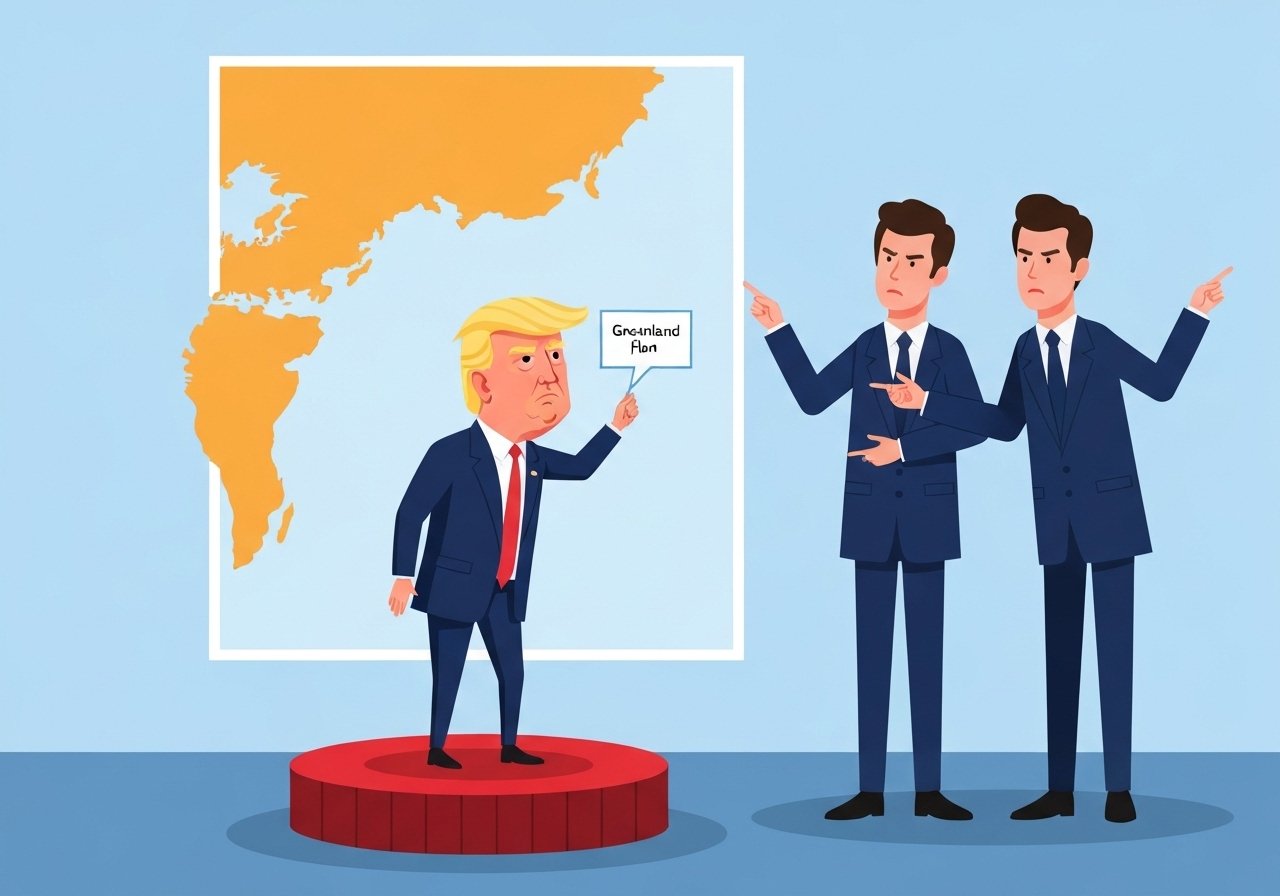
On Jan. 10, 2026, senior U.S. advisers reignited a public debate over Greenland, a semiautonomous territory of Denmark, after a top aide declined to rule out force and restated a claim that the island should belong to the United States. European capitals were taken aback by Stephen Miller’s comments on CNN, which questioned Denmark’s rights over Greenland and echoed President Trump’s earlier declaration that “we do need Greenland, absolutely.” The episode undercut a yearlong quiet effort by Danish Prime Minister Mette Frederiksen and others to dissuade the U.S. administration and prompted urgent private consultations among NATO and EU diplomats. Officials described a rapid shift from diplomatic irritation to contingency planning to avoid a damaging public confrontation.
Key Takeaways
- Stephen Miller, a senior White House aide, said on CNN that “by what right does Denmark assert control over Greenland?” and declined to categorically rule out military action.
- President Trump has earlier said publicly that “we do need Greenland, absolutely,” reviving a long-simmering U.S. interest in the island.
- Danish Prime Minister Mette Frederiksen and European counterparts had spent roughly a year attempting to dissuade the White House through quiet diplomacy.
- More than a dozen diplomatic and military officials across Europe described the comments as shocking and said they are drafting possible responses, including NATO reinforcement and negotiated concessions.
- European planners are exploring options that range from bolstering regional defense to offering controlled access to Greenland’s mineral resources to defuse the crisis.
- Officials privately worry the push may be driven as much by a U.S. presidential legacy aim as by concrete security or economic priorities.
Background
Greenland is a large, sparsely populated island that has long been part of the Kingdom of Denmark with extensive self-government in domestic affairs, while Denmark retains responsibility for defense and foreign relations. Its geopolitical profile has risen in recent years as Arctic shipping lanes, climate change and reports of mineral potential attracted broader international interest. Past U.S. administrations have shown intermittent strategic attention to the Arctic; discussions about Greenland resurfaced in public debate under President Trump after his earlier comments about American need for the island. European leaders have managed Greenland-related diplomacy quietly for years, balancing Danish sovereignty, Greenlandic self-rule and outside interest from multiple states.
The recent exchange followed weeks of private outreach by Danish and other European officials to the White House aimed at containing any public escalation. Those efforts reflected fears that a unilateral U.S. move would test NATO cohesion and unsettle transatlantic defense arrangements. Greenlandic authorities and local stakeholders were not central to the public discourse until the recent television remarks made the issue immediate and urgent. For Denmark, the situation reopens difficult political and constitutional questions about how to protect Greenland’s interests while preserving broader bilateral relationships.
Main Event
The flashpoint came when Stephen Miller was asked on CNN to rule out the use of military force to acquire Greenland; his refusal and follow-up comment that Greenland “should be part of the United States” intensified alarm in European capitals. Diplomats who spoke with reporters said Miller’s blunt framing effectively nullified months of behind-the-scenes persuasion led by Prime Minister Frederiksen and others. European officials described scenes of rapid private coordination among foreign ministries and NATO liaison offices to scope contingency plans and talking points. In several capitals, senior officials convened to weigh options designed to prevent a public standoff while preserving deterrence in the Arctic region.
London, Berlin and Brussels have discussed measures that could be presented to Washington as shared security initiatives, including modest NATO force posture adjustments aimed at signaling resolve without provoking escalation. Another track under consideration is a negotiated, economic-style response: offering more structured access to Greenland’s mineral and energy potential under strict legal and environmental controls if the U.S. opts for a transactional route. European diplomats said their preferred path is to de-escalate by negotiation rather than confrontational rhetoric or nation-to-nation ultimatums.
For Denmark and Greenland, immediate priorities include protecting Greenlandic decision-making and ensuring any discussion about resources or security involves Greenland’s government and people. Officials also expressed concern about domestic political fallout in Denmark if Copenhagen is seen as capitulating to outside pressure. Across the continent, leaders are weighing the domestic optics of any compromise and how to frame concessions to their publics without appearing weak on sovereignty issues.
Analysis & Implications
The episode highlights an unusual transatlantic strain: an allied power publicly contemplating territorial gain from another ally. Even an apparently rhetorical push raises practical questions about NATO’s political coherence if one member’s leadership entertains territorial claims against a fellow member’s domain. A negotiated outcome could preserve alliance unity if it addresses security concerns and provides benefits that Greenlandic institutions approve, but it also risks normalizing transactional diplomacy over established legal norms.
Economically, Greenland’s resource potential—reported in multiple assessments to include rare earths and other strategic minerals—makes it attractive to actors seeking supply chain security. European proposals to offer controlled mineral access aim to reduce the chance that the U.S. pursues unilateral action for resource reasons. Any arrangement that opens Greenlandic resources to foreign partners will face scrutiny over environmental safeguards, indigenous rights and revenue-sharing mechanisms.
Strategically, the comments may accelerate European efforts to strengthen NATO’s Arctic posture as a deterrent against both coercion and external influence by China or Russia. A coordinated transatlantic response could shift the conversation from bilateral bargaining to alliance-level burden-sharing and resilience. Domestically in the U.S., the drive to claim Greenland could play into political narratives about legacy and territorial expansion; European officials privately framed part of the risk as symbolic ambition rather than narrow strategic necessity.
Comparison & Data
| Attribute | Characteristic |
|---|---|
| Political status | Semiautonomous territory within the Kingdom of Denmark |
| Strategic value | High — Arctic location with reported mineral and maritime significance |
| Population | Small and dispersed, local governance central to decisions |
| Recent diplomatic focus | Increased since early 2020s amid Arctic geopolitics |
The table summarizes core, nonnumeric distinctions that inform policy choices: legal status, strategic importance, demographic reality and growing diplomatic attention. These qualitative features help explain why European governments prefer negotiation: Copenhagen must balance sovereignty and Greenlandic self-rule, while outside powers prize access but face legal and political constraints. Any bilateral deal that excludes Greenlandic institutions would be politically fraught and likely contested domestically and internationally.
Reactions & Quotes
European officials and NATO representatives responded swiftly with a mix of alarm and calls for measured, alliance-based handling of the issue.
“The real question is, by what right does Denmark assert control over Greenland? Obviously, Greenland should be part of the United States.”
Stephen Miller (on CNN)
This remark, reported live, is credited with prompting immediate private consultations among allied diplomats who described the comment as a departure from customary allied discourse.
“We do need Greenland, absolutely.”
President Donald J. Trump (earlier public remark)
That presidential phrase, made public prior to the CNN exchange, has been cited by European officials as evidence the administration’s interest predates the recent televised exchange and is not merely a rhetorical flourish.
“This feels less about security and more about a legacy play to ‘make America greater again.'”
European foreign minister (anonymous)
An unnamed European minister framed part of the concern as symbolic ambition; diplomats said that perception complicates straightforward resource- or security-focused bargains.
Unconfirmed
- Whether the White House has a formal plan to use military force to seize Greenland remains unconfirmed and is denied in official public channels.
- Rumors that the administration has offered to buy Greenland have not been substantiated with documentary evidence in this reporting.
- Reports that European capitals are preparing a single, unified package to present to Washington are preliminary and subject to change as deliberations continue.
Bottom Line
The immediate significance is political: a senior U.S. aide’s refusal to rule out force transformed a sensitive diplomatic conversation into an active alliance challenge that European capitals are taking seriously. Governments across Europe favor negotiation and alliance-based approaches that would preserve NATO cohesion while protecting Greenlandic agency. How events unfold will depend on Washington’s next steps, Greenlandic participation in any talks, and whether European states can craft credible deterrent and incentive measures that satisfy both security and sovereignty concerns.
For policymakers and observers, the central question is whether diplomacy can convert a provocative public moment into a managed dialogue that reinforces legal norms and local rights, rather than setting a precedent for transactional territorial claims among allies. The coming weeks are likely to reveal whether this is a transient rhetorical episode or the start of a longer, consequential debate about Arctic governance and alliance politics.
Sources
- The New York Times (news report)