
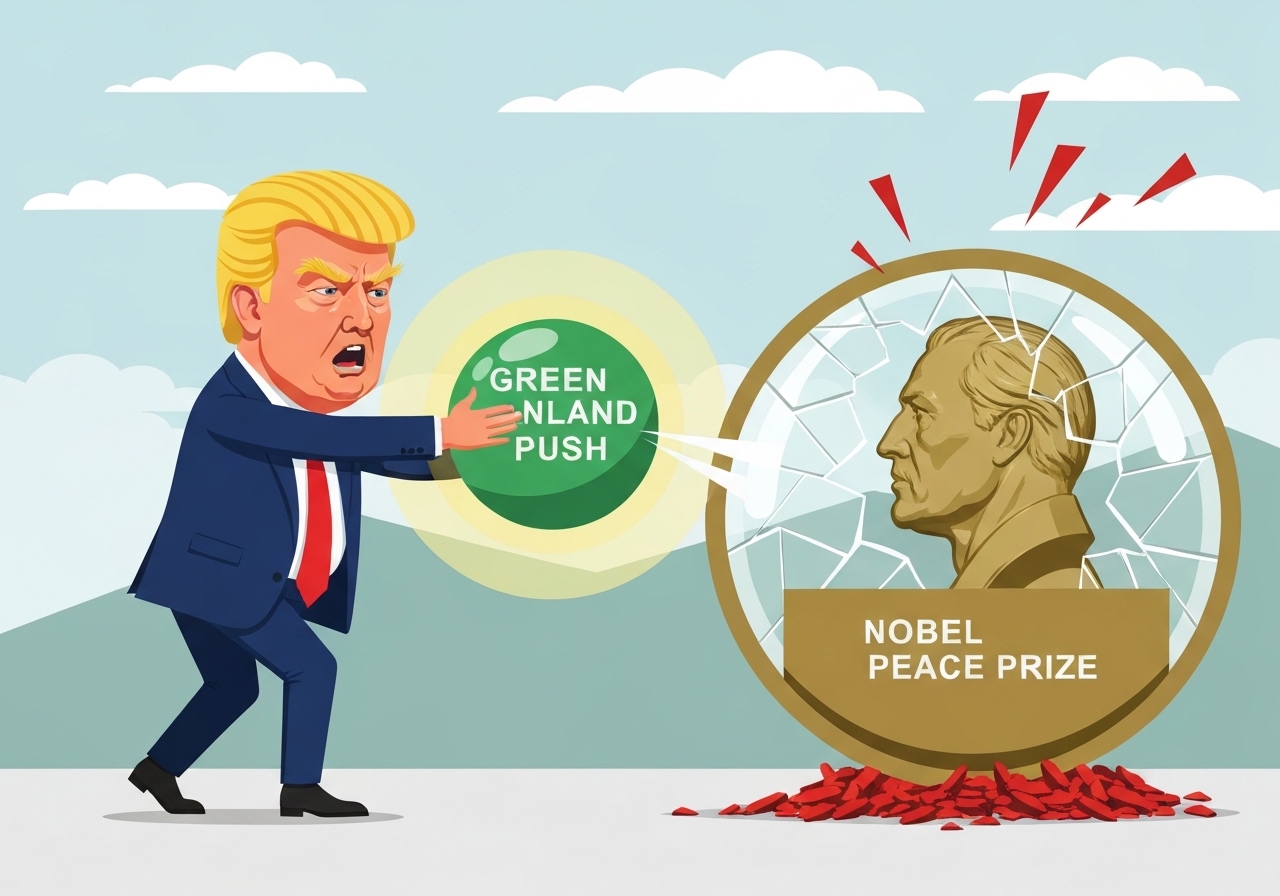
President Donald Trump told Norway’s prime minister in a text message that a failure to receive the Nobel Peace Prize has freed him to prioritize U.S. strategic interests — including a renewed bid to take control of Greenland. The exchange, sent to Prime Minister Jonas Gahr Store and confirmed by the prime minister’s office, arrived amid a surge in diplomatic friction over the Arctic island and was first reported on Jan. 19, 2026. Mr. Trump framed the move as linked to global security and referenced a claim — in his words — that he had ‘‘stopped 8 Wars PLUS,’’ saying the United States now must consider what is ‘‘good and proper’’ for the country. The message intensified a week of escalating tensions between Washington and Copenhagen over Greenland’s status and Arctic strategy.
Key Takeaways
- On Jan. 19, 2026, President Trump sent a text to Norway’s Prime Minister Jonas Gahr Store asserting that not receiving the Nobel Peace Prize changed his priorities for Greenland.
- Mr. Trump included the line that, because he was not awarded the Nobel Prize for ‘‘having stopped 8 Wars PLUS,’’ he no longer felt bound to ‘‘think purely of Peace.’li>
- The message also questioned Denmark’s legal claim to Greenland and stated that ‘‘the World is not secure unless we have Complete and Total Control of Greenland.’’
- Greenland has been part of the Kingdom of Denmark for more than 300 years; international leaders reacted with criticism and concern after the message was disclosed.
- The exchange was reported amid a week in which disputes over Arctic security and ownership of Greenland sharply escalated, raising diplomatic and military questions for NATO partners.
- Historical context: the United States explored purchasing Greenland in 1946 (reported offer of $100 million) and President Trump previously expressed interest in 2019, making the 2026 statements part of a recurring U.S. focus on the island.
Background
Greenland, a large Arctic island with strategic location and significant natural resources, has been tied to Denmark for more than three centuries. The island’s autonomy has expanded in recent decades, with the Naalakkersuisut (Greenlandic government) handling most internal affairs while Denmark retains responsibility for foreign policy and defense. The Arctic’s melting ice and new shipping routes have elevated Greenland’s geopolitical value for NATO countries, China, and Russia.
U.S. interest in Greenland is not unprecedented. In 1946 the United States reportedly made an offer of roughly $100 million for the island, and the topic resurfaced in 2019 when former President Trump publicly suggested buying Greenland. Those earlier episodes set a precedent for how American strategic calculations intersect with Danish sovereignty and Greenlandic self-determination. Stakeholders include the U.S. military, NATO allies, the Danish government, Greenland’s local authorities, and broader Arctic councils and investors tracking resource and transit opportunities.
Main Event
On Jan. 19, 2026, a text message from Mr. Trump to Prime Minister Jonas Gahr Store was disclosed by Norwegian officials and reported by multiple outlets. In the message Mr. Trump tied his push for Greenland to not receiving the Nobel Peace Prize, asserting that this outcome reshaped his public obligations and allowed him to emphasize what he described as U.S. security needs. The Norwegian prime minister’s office confirmed receipt of the text on the following day.
The message included two notable claims: first, that the lack of a Nobel citation relieved him of an obligation to ‘‘think purely of Peace,’’ and second, an assertion that ‘‘there are no written documents’’ proving Denmark’s claim to Greenland. He closed by saying global security required U.S. control of the island. Those lines prompted immediate rebukes from Danish officials and questions from other NATO partners about whether the White House was contemplating a formal acquisition strategy.
Diplomatic channels moved quickly. Copenhagen reiterated Denmark’s longstanding sovereignty and emphasized Greenlanders’ right to self-determination; Nuuk’s representatives also signaled concern over any external talk of transfer. Within Washington, officials offered mixed messaging: some emphasized defense and logistical interests in the Arctic, while others framed the text as a rhetorical escalation rather than the statement of an actionable policy.
Analysis & Implications
The president’s linking of a geopolitical initiative to a personal grievance — the Nobel outcome — reframes what would otherwise be an argument about strategy into a matter with political and symbolic dimensions. If a head of state publicly ties territorial ambitions to perceived personal slights, it complicates diplomacy by injecting questions about motive and predictability. Allies may read such rhetoric as signaling transactional approaches to alliance management, potentially eroding trust on matters that require long-term coordination, such as Arctic defense and search-and-rescue capabilities.
Strategically, Greenland offers military value: airfields, maritime access to the North Atlantic and Arctic Ocean, and proximity to polar surveillance corridors. A U.S. push to assert greater control could prompt increased NATO coordination or, alternatively, spur rival states to deepen Arctic engagement. Copenhagen must weigh Greenland’s autonomy and the preferences of Greenlandic institutions; forcing a transfer would likely face legal, political and possibly constitutional hurdles given Denmark’s and Greenland’s current arrangements.
Economically, Greenland’s mineral and rare-earth prospects add an investment dimension to geopolitical interest. Any move toward U.S. control could accelerate foreign investment scrutiny, alter mining negotiations, and shift energy development timelines. For domestic U.S. politics, the episode plays into debates about presidential conduct, executive decision-making on foreign affairs, and the balance between symbolic rhetoric and statecraft.
Comparison & Data
| Year | U.S. Engagement on Greenland |
|---|---|
| 1946 | Reported U.S. offer ~ $100 million to Denmark to purchase Greenland (postwar proposal). |
| 2019 | President Trump publicly expressed interest in buying Greenland; Denmark rejected the idea. |
| 2026 | President Trump linked a renewed push to the Nobel Peace Prize outcome in a Jan. 19 text to Norway’s PM; diplomatic tensions rose that week. |
The table shows recurring U.S. interest but differing contexts: 1946 was a postwar strategic calculation; 2019 and 2026 involve modern geopolitical and political dimensions shaped by climate change and contemporary alliance politics. The 2026 message introduced a rhetorical element tying personal grievances to policy, which is atypical in diplomatic communication.
Reactions & Quotes
Norway’s prime minister briefed officials after receiving the text and referred inquiries to the Norwegian prime minister’s office. The office confirmed receipt but described subsequent communications as routine diplomatic exchanges rather than a change in Norway’s Arctic policy.
We have received the message and continue to consult with our partners on Arctic security and international law.
Office of the Prime Minister of Norway (official statement)
Denmark quickly defended its sovereignty over Greenland. Copenhagen emphasized the island’s history within the Danish realm and underscored the centrality of Greenlanders’ own political rights in any discussion about territory.
Greenland is part of the Kingdom of Denmark and any discussion about sovereignty must respect legal arrangements and the will of Greenlandic people.
Danish Ministry of Foreign Affairs (official)
Experts in international law noted that a purchase or transfer of sovereignty would involve complex legal, political and local-consent requirements, and would likely prompt prolonged negotiation rather than a rapid transaction.
Acquiring territory in the 21st century involves treaty processes, local governance consent and multilateral consultations; a unilateral purchase is not a simple option.
International law scholar (expert commentary)
Unconfirmed
- Whether the White House has developed a formal plan to transfer or purchase Greenland beyond the rhetorical text is not confirmed.
- The extent to which the message reflects an official administration policy as opposed to a personal or campaign statement remains unclear.
- Any internal assessments about feasibility, cost estimates or timelines for acquisition have not been publicly disclosed.
Bottom Line
The Jan. 19, 2026 text linking a push for Greenland to the Nobel Peace Prize outcome transformed a long-running strategic discussion into a politically charged diplomatic episode. It heightened friction among NATO partners and raised immediate questions about motives, process and the role of personal rhetoric in foreign policy. For Greenlanders and Danish authorities, the message underscored the sensitivity of sovereignty and self-determination issues.
Looking ahead, expect Copenhagen and Nuuk to reaffirm legal and political safeguards, while NATO allies may seek clarifying consultations on Arctic defense arrangements. Any substantive shift toward U.S. control would require prolonged negotiation, legal adjustments and, crucially, the consent of Greenland’s political institutions — making a rapid transfer unlikely despite sharp rhetoric.
Sources
- The New York Times — news report on Jan. 19, 2026 (media)
- PBS NewsHour — public broadcaster report cited in initial disclosures (public broadcaster)
- Office of the Prime Minister of Norway — official government statements and confirmations (official)
- Danish Ministry of Foreign Affairs — statements on Greenland and sovereignty (official)